

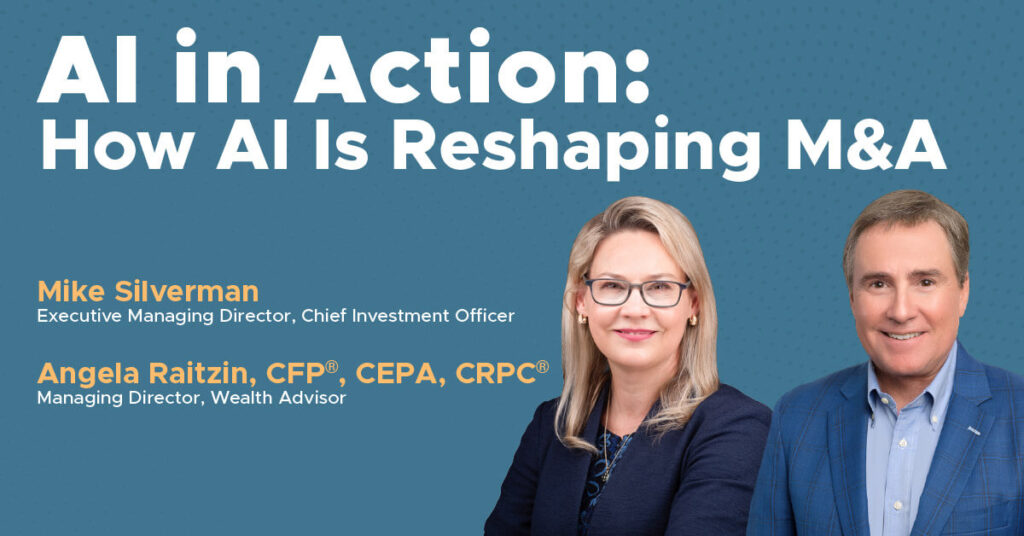
By Angela Raitzen, CFP®, CEPA, CRPC®, Managing Director, Wealth Advisor; and Mike Silverman, Executive Managing Director, Chief Investment Officer, Cresset
The following article is informed by insights shared during Cresset’s recent AI in Action event, featuring Tal Hacohen, Partner at Holland & Knight; Steve Rathbone, Vice Chairman and Managing Director at Stout; and Kathleen Garenani, Director of Responsible AI and AI Governance at BDO Digital.
Artificial intelligence (AI) is reshaping the landscape of mergers and acquisitions (M&A). AI has moved well beyond the experimental stage and is now a practical tool that helps bring greater speed, accuracy, and insight into the dealmaking process. It is being used to source opportunities, support due diligence, and even guide post-transaction integration, with its role continuing to expand. As its usage and influence becomes more pervasive, it raises important questions around ethics, governance, and the evolving place of human judgment.
Accelerating Efficiency Across the Deal Lifecycle
Across the M&A process, AI is redefining how teams manage time and information. AI is enabling organizations to streamline tasks that once consumed considerable time. Document review, market scans, and investment memos that once required hours can now be generated or summarized in minutes. Natural language models and data-driven algorithms support faster deal sourcing by analyzing large datasets and identifying opportunities that align with broader, strategic objectives. By easing the most labor-intensive steps, firms can devote more energy to deeper analysis and decision-making.
“AI is helping us reimagine due diligence, instead of combing through thousands of pages, we can pinpoint what matters in a fraction of the time. But technology doesn’t replace legal judgment. It just gives us more space to think critically and serve clients more efficiently,” notes Tal Hacohen, Partner at Holland & Knight
The due diligence phase, often the most resource-intensive stage of a transaction, is being transformed by AI. Advanced systems detect irregularities in financial statements, uncover compliance risks, and assess cybersecurity vulnerabilities with far greater speed and precision. Private equity firms and advisors (e.g., law firms, accounting firms, due diligence providers, etc.) are adopting these tools to validate investment theses, benchmark company performance, and evaluate operational resilience. These tools can provide early warning systems, surfacing potential risks sooner and providing sharper insights to buyers and sellers.
Kathleen Garenani, Director of Responsible AI and AI Governance at BDO Digital, views AI as a risk mitigator, “I see AI as a de-risking tool. It doesn’t eliminate human oversight; it enhances it. From due diligence to cybersecurity, AI helps us surface risks faster and focus our attention where it matters most.”
Advisory and legal practices are also evolving. AI can scan thousands of pages of contracts to extract key clauses, automate closing processes, and support regulatory compliance. For investment banks, AI shortens the time needed to prepare pitch books, marketing materials, and client communications. However, rather than replacing professional expertise, these tools enable the user to shift focus from repetitive work to higher-value counsel and strategy.
Meeting Evolving Client Expectations
Clients (e.g., private equity firms, strategic acquirors, etc.) are increasingly aware of AI’s capabilities and expect advisors to use it responsibly. Firms approach this in different ways, some are drafting use policies, while others are developing proprietary models to sharpen their competitive edge.
“Clients want advisors who understand AI but don’t defer to it. They’re looking for partners who can pair smart tools with sound judgment; that combination builds trust and saves time,” notes Tal.
No matter the path, thoughtful integration reflects efficiency, transparency, and responsiveness, qualities that are increasingly in demand in today’s market.
Steve Rathbone, Vice Chairman and Managing Director at Stout, is identifying ways to enhance efficiency using AI, “As we map every step of a transaction, we’re finding more points where AI can streamline the work, from sourcing to onboarding to execution. It’s not about replacing people; it’s about amplifying what they can do.”
Navigating Ethics and Regulation
The growing efficiencies of AI have brought new challenges around data governance, ethics, and accountability. As its role expands across the M&A landscape, firms must navigate complex questions of confidentiality, oversight, and responsible use. Protecting sensitive data remains paramount in M&A, where a breach can jeopardize an entire transaction. Firms must also stay current with evolving global regulations, such as the EU AI Act and the General Data Protection Regulation. Beyond compliance, trust depends on embedding fairness, transparency, and accountability into how AI systems are built and utilized.
“Responsible AI isn’t just a compliance exercise. It’s about stewardship, about knowing where your data lives, who touches it, and how decisions are made. Governance has to evolve as fast as the technology itself,” states Garenani.
Despite its transformative potential, AI cannot replace the nuance of human judgment. Strategic thinking, negotiation, and relationship management remain distinctly human skills. The roles of professionals are shifting; younger talent will need to become fluent in AI tools, while senior leaders will be called upon to interpret insights, guide strategy, and nurture client relationships.
“The key is developing a habit of asking: ‘What can AI do for me right now?’ Sometimes the answer is nothing, but often it challenges you to rethink old processes, and that’s where real innovation begins,” believes Rathbone. AI is not a substitute for expertise, but a multiplier of it. The adoption of AI across professional services is still in its early stages, but momentum is building. Firms that integrate the technology thoughtfully, while maintaining strong ethical standards, will be best positioned to succeed. Ultimately, the future of M&A will not be defined by technology alone, but by organizations that combine AI’s power with human insight to create smarter, faster, and more resilient dealmaking.