
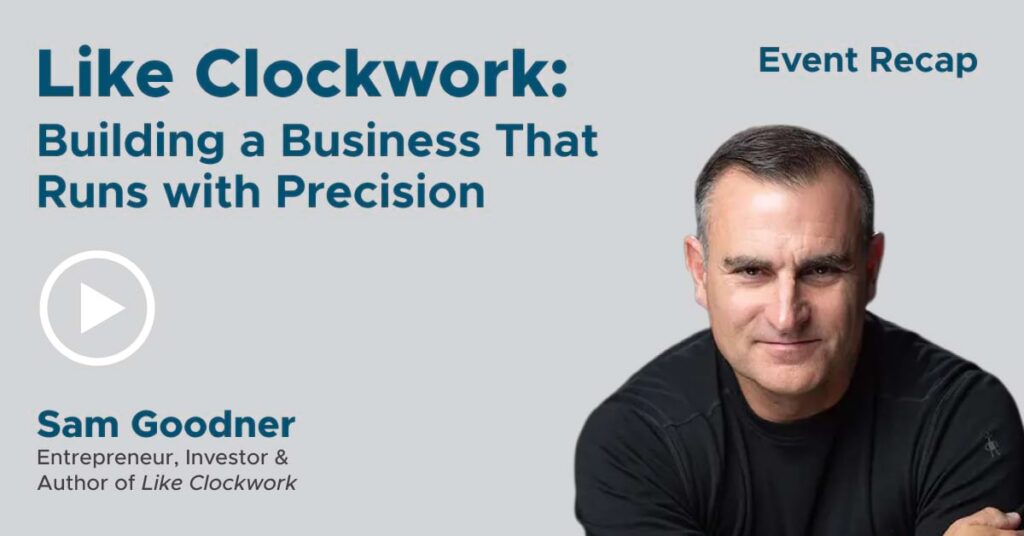
In a recent virtual conversation, Susie Cranston, President of Cresset, sat down with entrepreneur, investor, and author Sam Goodner to explore a question many founders quietly carry: How do you build an organization that scales with discipline while remaining deeply human?
Drawing on his experience as a Swiss Army mountain infantry officer and decades of company-building, Sam returned again and again to one central principle: clarity.
“If I had to boil it down to just one,” he shared, “the most important principle, in my opinion, that business leaders can learn from the military, it would be the importance of clarity.”
What followed was a practical roadmap for leaders seeking precision without rigidity, systems without bureaucracy, and growth without losing their culture.
Clarity Is the Foundation for Scale
In the military, Sam explained, clarity is non-negotiable. It is clear who is in command, what the mission is, what success looks like, and who owns which role. Communication must be precise.
That same discipline translates powerfully into business.
“In business, simply, everyone knows where we’re going, how we’re gonna get there, what our top priorities are, what everyone’s roles and responsibilities are, what’s expected of me, and how we measure success,” he said.
Clarity, in his view, is not abstract. It should permeate every layer of the organization, down to the level of a single meeting. “If you have a business meeting, and you leave that meeting, and you’re not completely clear on what was discussed, what we agreed to, and who’s accountable for what, then that’s a wasted meeting.”
For founders who feel indispensable, Sam offered a candid reframing. “When a leader starts feeling indispensable to their organization, that is always a red flag, in my opinion. And it usually means that the business has stopped scaling.”
Operational Scalability: Clarity, Repeatability, and Time
Sam distilled scalability into a simple formula: “Clarity plus repeatability plus time.”
Clarity comes first. Leaders must define core values, purpose, customers, structure, and the critical metrics that drive the business. Only then can they codify best practices across functions.
He recommends starting with sales, followed by recruiting and hiring, and then operationalizing each department in turn. Over time, the compounding effect of these systems allows the organization to grow beyond any one individual.
Alignment Is a Discipline
Leadership alignment, Sam emphasized, is easier to test than most assume.
“All you have to do is walk around your organization, walk up to some of your employees, and ask them a few simple questions,” he advised. These questions include: Why do we exist? Where are we going? What are our top priorities? There’s a strong chance that even executive teams will answer these questions differently.
“Unless you have the leadership team completely on the same page… then there’s no chance that everyone else in the organization is going to be aligned.”
And once that alignment is achieved, it must be reinforced relentlessly. Clarity is not a one-time announcement, it is a rhythm.
“Have clarity and alignment at the executive team level, and then you get to over-communicate that to the rest of the organization.”
Systems That Empower, Not Constrain
For many founders, systems can feel synonymous with bureaucracy. Sam sees the opposite.
“It’s precisely those systems that give you the freedom and time to think strategically and innovate,” he explained.
Well-designed systems should decentralize decision-making to the front lines, where teams are closest to customers. At one of his companies, Sam implemented what he called the “Five Rules of Empowerment.” Before making a decision, employees asked:
- Is it right for the customer?
- Is it right for our company?
- Is it in line with our core values?
- Is it ethical?
- Are you willing to be held personally accountable?
“If the answer to all five questions is yes, do not waste your manager’s time by asking them permission, just go do it.”
Crucially, empowerment requires a culture that does not punish thoughtful mistakes. “Did you follow the framework?… Then you forgive mistakes, and you learn from them, and you move on.”
Business Rhythm: The Power of Daily Cadence
Execution, Sam believes, depends on cadence and accountability.
He outlined a communication rhythm that includes daily huddles, weekly tactical meetings, and quarterly planning. The daily huddle, just 15 minutes, can be transformative.
“Your objective in this daily huddle is very short. It’s not to solve the problem,” he said.
Instead, it surfaces issues in real time and mobilizes the right people to address them offline.
For organizations feeling overwhelmed by operational complexity, this is often the first step. “If you implement this kind of communication and accountability cadence for your leadership team, your company will be unstoppable.”
Culture as a Living Operating System
Culture, in Sam’s view, is not aspirational language on a wall.
“When I say core values, I don’t mean slogans on a wall… I mean the true rules of engagement that your company lives by.”
Core values must shape hiring, promotions, rewards, and recognition. When systems and culture align, they amplify one another. When they conflict, friction follows.
Continuity Beyond the Founder
Succession planning is not just organizational hygiene, it is stewardship.
But few leaders, Sam observed, plan deliberately for continuity beyond their tenure. “Very few leaders are actually thinking about continuity beyond their own tenure. Which is a huge blind spot.”
His advice is direct: promotion should be contingent on preparing a successor. “The only way they get promoted is if they have already identified and mentored and trained their replacement.”
The Most Human Insight
Perhaps the most resonant moment of the conversation centered not on metrics or systems, but on people.
“Most organizations completely forget about their employees’ families,” Sam reflected.
By deliberately including spouses and children in events, communications, and traditions, leaders build loyalty and belonging that extend beyond the office walls.
A Simple Leadership Metric
As the conversation closed, Sam offered a deeply personal metric for effective leadership:
“We vote with our time for the life we want to live.”
Time, he reminded us, is the only finite commodity. If something matters, it should be visible on your calendar.
For leaders building enduring organizations, the message was clear: clarity is the starting point, discipline creates freedom, and systems empower people. And where you invest your time reveals what you truly value.
When those elements align, businesses do not just grow. They run with intention, with precision, and, indeed, like clockwork.