
The All-Star break has arrived — that blessed midsummer pause when investors swap earnings calls for beach chairs, trade their terminals for tee times while their inboxes ripen unattended under the July sun. Here at Cresset, we mark the occasion the same way every year by revisiting our favorite question: Can money buy a winning ball club? With no salary cap and no pretense of parity, Major League Baseball remains the closest thing professional sports offer to a free market, one where owners are free to spend their way to victory. In theory, you get what you pay for. In practice, the standings rarely cooperate, and that’s precisely what keeps us coming back.
This year ushered in one of the biggest rules changes to the game, and arguably the most consequential since the pitch clock: the debut of the Automated Ball-Strike (ABS) challenge system. Home plate umpires still call balls and strikes, but each team now begins the game with two challenges that only the batter, pitcher, or catcher can trigger with a tap of the cap. Hawk-Eye cameras render the verdict on the stadium video board against a strike zone calibrated to each player’s measured height, and teams that challenge successfully keep their challenge. Players are winning roughly half of their appeals. Last year we noted that ABS would disadvantage home teams, since umpires tend to cut home batters more slack. Now every hitter gets the same rectangle.
Two smaller changes round out the 2026 rulebook. Base coaches must now remain inside their designated boxes while the pitcher is on the rubber, a response to coaches drifting down the line toward home plate to steal signs or pick up a pitcher’s grip, with repeat violations punishable by ejection. In addition, baserunners who intentionally initiate contact with a fielder in hopes of drawing an obstruction call will simply be ruled out, and any other runners must return to their bases.
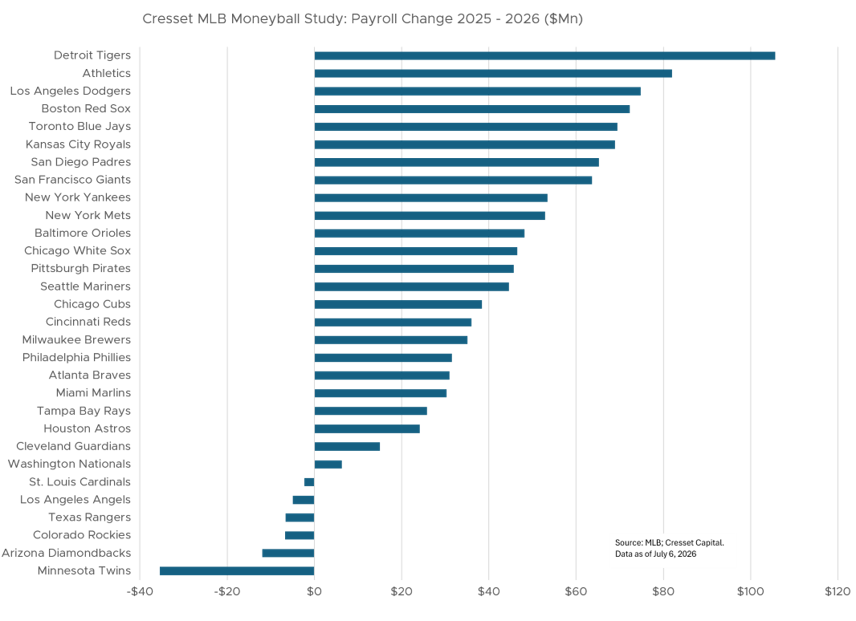
The rule changes, however, were a sideshow compared to what happened to payrolls this year. With the collective bargaining agreement expiring Dec. 1 and owners and players bracing for a possible lockout, clubs went on an offseason spending spree. Opening Day payrolls surged more than 20% from last year to roughly $5.8 billion, by far the largest one-year jump in recent memory.
The defending champion Los Angeles Dodgers sit atop the league at nearly $396 million after landing outfielder Kyle Tucker on a four-year, $240 million deal, leapfrogging the New York Mets at $368 million, where Juan Soto’s record contract pays him a league-high $62 million this season. The Yankees, Phillies and Blue Jays round out the top five, each north of $300 million, a threshold only two teams had crossed as recently as 2024.
Remarkably, 24 of the 30 clubs raised payroll this year. The Detroit Tigers posted the largest dollar increase, up more than $105 million, anchored by a record arbitration award for ace Tarik Skubal. The Athletics more than doubled their payroll ahead of their anticipated Las Vegas move, while last year’s most notorious penny-pinchers, the Chicago White Sox, Kansas City Royals and Miami Marlins, each boosted spending by 60% or more. Only six teams cut payroll, led by the Minnesota Twins, who shed $35 million.
AMERICAN LEAGUE
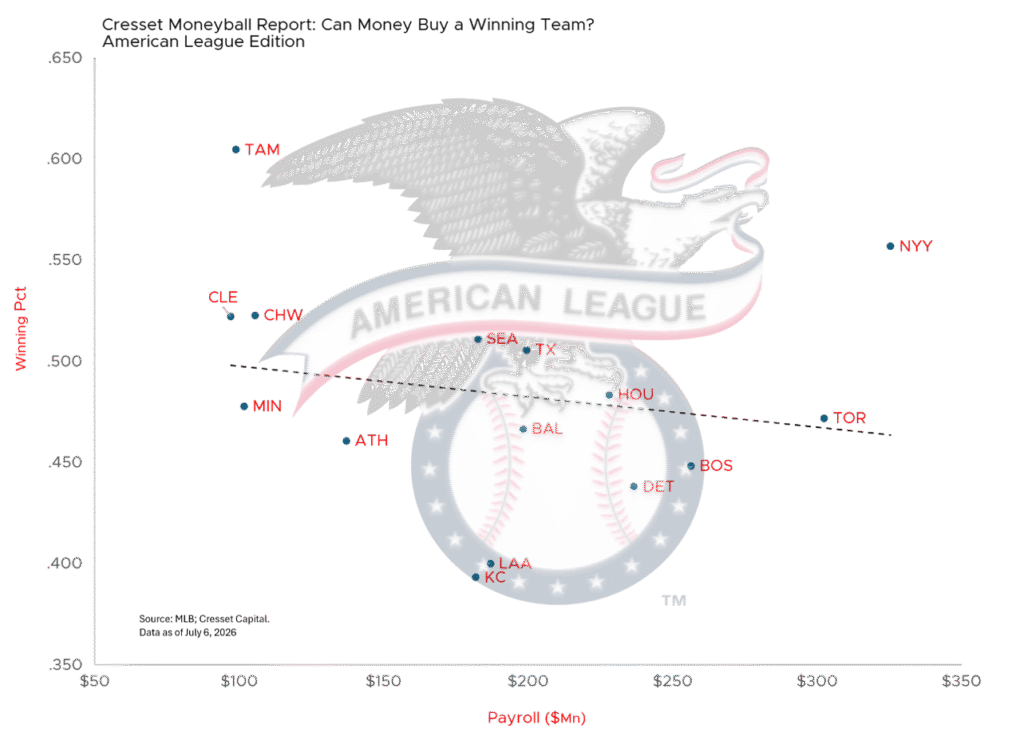
Money explains virtually nothing about the American League standings so far this season. Our model says $0 buys a 46-44 record, while spending $325 million, like the Yankees do, suggests 42-48. That’s because the slope of our regression is negative in the American League this year. In other words, bigger payrolls were rewarded with fewer expected wins, thanks to the Red Sox, Tigers and the Rays. Tampa Bay owns the league’s best record at 52-34 while carrying an impecunious $99 million payroll, the second-smallest in the league, while the Guardians sit comfortably above .500 while spending less than any club in the American League at $97 million. Even the Chicago White Sox, who set the modern record for futility with 121 losses just two seasons ago, have climbed above .500 with the league’s fourth-smallest payroll.
Meanwhile, the league’s big spenders have little to show for their outlays. The Toronto Blue Jays are under .500 despite a $302 million payroll, the Boston Red Sox are languishing at .448 after boosting spending by nearly 40%, and the Detroit Tigers, whose $106 million payroll increase was the largest in baseball, have stumbled to 39-50 a year after owning the league’s best record. Only the New York Yankees, the league’s biggest spender at $325 million, are earning their keep, though even their .557 winning percentage trails the bargain-basement Rays by a wide margin.
Our regression model for the American League suggests a .513 winning percentage if you spent nothing, a record the Angels and Royals would envy despite their nine-figure outflows.
Winners
The Tampa Bay Rays own the American League’s best record at 52-34, an outcome almost nobody saw coming after they were widely projected to finish last in the AL East when the season began. Their formula is vintage Tampa Bay, put the ball in play and let good things happen. The Rays lead the majors in contact rate and carry one of the game’s lowest strikeout rates. Even though they rank near the bottom of the league in home runs, they’re scoring through speed, depth and situational hitting, with Chandler Simpson’s legs, Jonathan Aranda’s run production and Junior Caminero’s emerging power. Pitching has been just as sturdy, anchored by Drew Rasmussen and a healthy Shane McClanahan, supported by offseason additions Steven Matz and Nick Martinez. All of it comes on a $99 million payroll, the second-smallest in the league, as Erik Neander’s front office once again went against institutional norms and built a roster unlike any other.
Our model says the Yankees‘ $325 million payroll should buy a .464 winning percentage this season. Instead, they are playing .557 ball, about eight wins above expectations and the only big spender in the American League earning its keep. Their outperformance starts with Aaron Judge. The reigning three-time MVP hit a career-best .331 with more than 50 home runs last season, and he opened 2026 in the same gear, powering the club to the league’s best run differential by a margin of more than 40 runs over anyone else, with a potent offense and deep starting pitching behind him. Breakout first baseman Ben Rice emerged as one of the game’s best hitters while the club led the majors in home runs, and the pitching staff ranks fifth in baseball in runs allowed per game, with young right-hander Cam Schlittler the current front-runner in the AL Cy Young race. Notably, general manager Brian Cashman barely touched the roster over the winter, retaining nearly every player from a 94-win team, meaning the Bronx got better without spending its way there. Their only issue is health. Judge went down with an injury on May 31, and without him the Yankees hit just .219 while losing 12 of 15, watching the low-budget Rays leapfrog them in the AL East. The wins they banked in April and May are keeping the Bronx Bombers above our trendline at the break.
The Seattle Mariners are outperforming our predictions because their roster is getting contributions from the places a payroll model does not fully capture, including starting pitching, selective offensive production and a few underappreciated role-player breakouts. Randy Arozarena has been the clearest position-player engine, giving Seattle an All-Star-caliber season with a more complete offensive approach, offering efficiency rather than expensive star power. The bigger story, though, is the rotation. Bryan Woo has arguably been their most valuable player, and the familiar core of George Kirby and Logan Gilbert has been joined by bounce-back work from Emerson Hancock and Bryce Miller, giving Seattle one of the strongest starting-pitching groups in baseball. In short, Seattle is not beating our model because it is loaded with obvious, high-priced stars, it is beating the model because Woo, Kirby, Gilbert, Miller and Hancock are preventing runs, Arozarena is giving them a legitimate middle-of-the-order presence, and the rest of the roster is doing enough to turn a mid-tier payroll into an above-line result.
Losers
The Detroit Tigers are disappointing their fans because this was supposed to be the year last season’s rebuild blossomed into a spending-backed contender, and instead they look like an expensive middleweight. Detroit posted the largest payroll increase in baseball, jumping by roughly $106 million to $236.6 million, but the standings have not followed. They’re at 39-50 with about four more losses than our model would have expected. That gap feels worse because the spending was not cosmetic. The Tigers paid Tarik Skubal after his arbitration win, brought in Framber Valdez, kept Jack Flaherty and Gleyber Torres, and added veteran bullpen names like Kenley Jansen and Kyle Finnegan, pushing the club near the luxury-tax line. Unfortunately, the roster has not cohered. Skubal is still excellent, but his season has been interrupted by elbow surgery, and he has not carried the club the way a two-time Cy Young ace was expected to. Valdez has been more serviceable than dominant, Flaherty has been erratic, and the bullpen has been uneven enough that Detroit is now being talked about as a possible deadline seller rather than a division favorite.
The Los Angeles Angels are a team that’s too expensive to be treated like a harmless rebuild, but not deep or healthy enough to play like a real contender. Our payroll model expected something closer to a 43-47 record at this point in the season given their $187 million payroll, yet the Angels are nonetheless falling short of even that, sitting at the bottom of the AL West at 36-54 with a -58-run differential. The problem isn’t that players aren’t producing. Mike Trout has still been dangerous when available, Zach Neto has supplied shortstop power, Jo Adell has driven in runs, and José Soriano and Reid Detmers have given the rotation real strikeout stuff. But every positive comes with a “yes, but.” Trout is on the IL with a hamstring strain, Neto’s power has come with a .231 average and a lot of strikeouts, Adell’s .290 OBP limits the value of his RBI total, and Detmers/Soriano are not enough to cover a staff carrying a 4.63 ERA and 404 walks.
Unfortunately, the roster has sprung leaks everywhere else. In short, the Angels are disappointing not because they lack recognizable names, they are disappointing because Trout, Neto, Adell, Soriano and Detmers have not delivered enough to overcome poor depth, injured veterans, too many empty plate appearances and a pitching staff that keeps giving back whatever the offense manages to create.
The Royals‘ $137 million payroll implies a .492 winning percentage in our model; they are running closer to .410, about seven wins behind where their payroll suggests they should be about now, and one of the American League’s biggest disappointments after a promising 2024 playoff appearance. The offense is the culprit, ranking 27th in runs scored, with offseason additions Isaac Collins, acquired from Milwaukee for left-hander Angel Zerpa, and Lane Thomas, signed to recapture his 28-homer 2023 form in Washington, combining to hit under .190 with one home run between them. Bobby Witt Jr., the 2024 AL MVP runner-up, remains an MVP candidate but has yet to look like himself, Salvador Perez is showing his age at 36, and Vinnie Pasquantino’s exit velocity has quietly slipped. Compounding matters, ace Cole Ragans is out for the season after elbow surgery, and Kris Bubic joined him on the 60-day injured list, leaving the rotation thin with few paths back. It’s a case study in how payroll can’t offset a bad process at the top of the roster.
NATIONAL LEAGUE
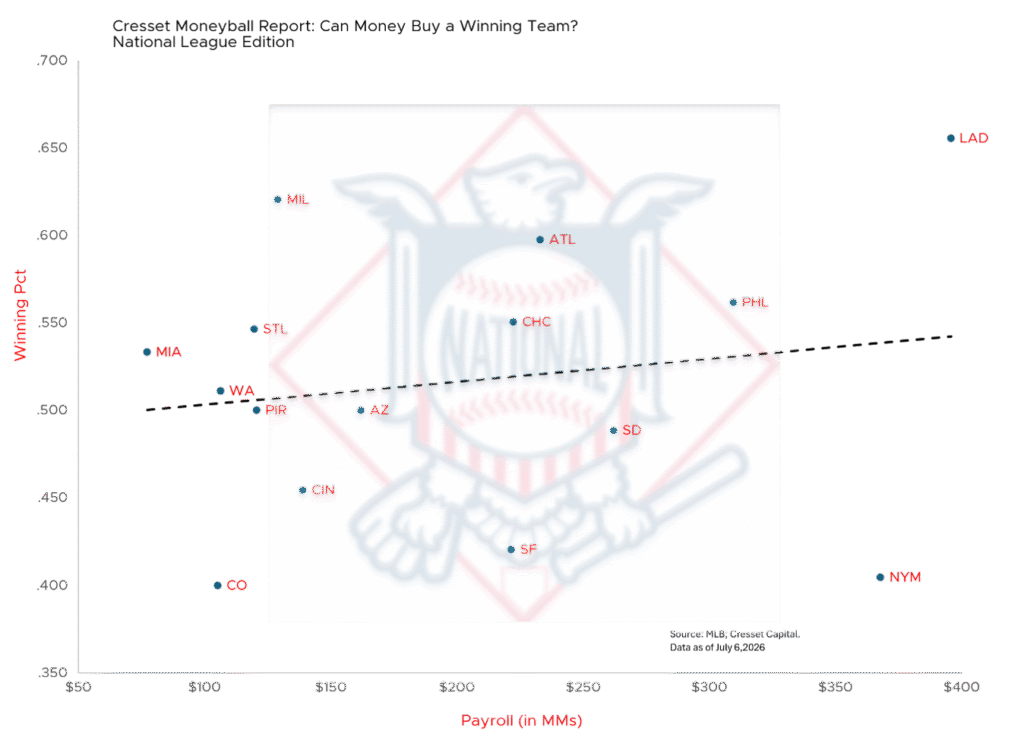
On the surface, the National League is behaving the way a free market should. The defending champion Los Angeles Dodgers, with baseball’s biggest payroll at $396 million, also own the best record at 59-31. The Philadelphia Phillies are playing .562 ball on the league’s third-largest payroll, and the Chicago Cubs are giving their fans a pennant race at .551 while earning their $222 million (fingers crossed). The top of the market, it seems, is getting what it paid for.
Then there are the Mets. Despite their $368 million payroll, the second-largest in baseball, Juan Soto’s league-high $62 million salary and the winter addition of Brewers ace Freddy Peralta, the Mets have stumbled to 36-53, the second-worst record in the National League. Put another way, they are paying $263 million more than the Colorado Rockies for a winning percentage that’s only four points better. The San Francisco Giants are not far behind in futility, sitting at .420 after boosting their payroll 40% over the winter.
At the other end of the payroll spectrum, the bargains keep delivering. The Milwaukee Brewers, as usual, are exceeding expectations, posting the league’s second-best record at 54-33 on a $129 million payroll. The Miami Marlins are punching way above their weight, winning more than half their games while spending less than any club in baseball at $77 million, the St. Louis Cardinals are playing .547 ball for under $120 million, and even the Washington Nationals, a fixture of our Losers column a year ago, have crept above .500.
Our National League regression remains positively sloped, suggesting winning percentage and payroll are positively linked, with the Dodgers defining the line from the upper right. Each incremental $100 million of payroll implies one more win at this point of the season, while the intercept suggests a .490 winning percentage if you spent nothing, a level the Marlins clear comfortably.
The Brewers’ $129 million payroll implies a .504 winning percentage in our model; they are running at a whopping .621, more than 10 wins above expectations and second-best record in the National League. Ace Jacob Misiorowski, the Cy Young front-runner, leads the majors in strikeouts, ERA, WHIP and opposing batting average while setting velocity records nearly every start, including a 105.5 mph fastball that was the fastest ever recorded by a starter. All-Star catcher William Contreras anchors the lineup, manager Pat Murphy keeps rolling out new configurations (47 games without repeating a lineup), and Milwaukee’s small-market player development machine again turned scouting into wins. As a Cubs fan, I’m getting tired writing about the Brew Crew’s successes every year.
LA proves that you can buy a winning ball team. The Dodgers‘ baseball record $396 million payroll implies a .534 winning percentage in our model, yet they’re running at .656, nearly 11 wins above expectations despite already outspending everyone else by nearly $28 million. Shohei Ohtani, unrelenting as ever as both hitter and pitcher, remains the National League MVP favorite. Even though Kyle Tucker is only hitting .248 with seven home runs, well below expectations for a player making $60 million per year, the wins keep coming. Yoshinobu Yamamoto anchors a deep rotation, and even the club’s 18-9 June was called “ho-hum” by one national writer, since the roster is so deep at every level that prolonged slumps have become unlikely. The Dodgers’ owner, Mark Walter, with notable partners, including Magic Johnson, Peter Guber and Billie Jean King, among others, are building an empire.
The Braves‘ $233 million payroll implies a .521 winning percentage in our model; they are running at .598, nearly 7 wins above expectations despite losing Ronald Acuña Jr. to a recurring hamstring and reigning Rookie of the Year Drake Baldwin to an oblique injury. Chris Sale, in his 10th All-Star season at age 37, has been the game’s most consistent starter with a 2.10 ERA, Matt Olson leads the team in hits and home runs, and Michael Harris II and Ozzie Albies have bounced back from down 2025 campaigns. A year ago, the Braves entered the season with the second-best World Series odds and finished 76-86, their first missed playoff in eight years; a first-year manager, a healthier roster and a deeper bench have flipped the script without a single blockbuster signing.
Losers
The Giants‘ $221.6 million payroll implies a .519 winning percentage in our model; they are running at .420, nearly 9 fewer wins than their payroll would imply, and the third-worst record in the National League. President Buster Posey’s second offseason boosted payroll 40% to bring in Rafael Devers, Willy Adames and Matt Chapman, a trio now paid an aggregate $80 million this season to hit a combined .236 while occupying prohibitive long-term contracts that run through 2030, 2031 and 2033 respectively. Compounding matters, the roster construction fits poorly with Oracle Park, one of baseball’s most pitcher-friendly stadiums where power bats struggle and bat-to-ball skills thrive. First-year manager Tony Vitello, hired from the University of Tennessee without MLB coaching experience, has struggled to right the ship, and closer Ryan Walker has seen his ERA balloon to 6.66, leaving the bullpen unable to protect the few leads the offense manages to build.
The Rockies‘ $105 million payroll implies a .504 winning percentage in our model, a reminder that our regression doesn’t care where the money comes from. The team is running at .400, 9 fewer wins than expected and dead last in the National League West. The trend has improved from last year’s franchise-worst 43-119 record, but it still leaves Colorado well on pace for its fourth straight 100-loss season. The rebuild began in earnest with new president of baseball operations Paul DePodesta, the Moneyball veteran returning to baseball after a decade with the Cleveland Browns, and manager Warren Schaefer, promoted from interim after Bud Black’s firing early last season. Coors Field remains part of the problem, where mile-high thin air continues to bruise ERAs and undermine pitching development. Top pitching prospect Chase Dollander, taken ninth overall in 2023, has posted a 6.52 ERA across 21 big-league starts. The Rockies aren’t simply underperforming their star competitors; they’re underperforming what a floor payroll ought to buy in a league where money buys so little on the margin.
Talk about a negative Sharpe Ratio, the Mets‘ $368 million payroll implies a .539 winning percentage in our model; they are running at .404, 12 wins below expectations and the largest negative residual in the League. Owner Steve Cohen, who built a hedge fund empire finding market inefficiencies, has demonstrated the opposite in Queens. He is paying Juan Soto $62 million to spend April on the injured list, Sean Manaea $22 million to pitch in relief, and Kodai Senga $15 million for a 10.08 ERA that reads more like a golf handicap than a pitching stat. David Peterson was unloaded on the Cubs at a steep discount to par. Soto and Francisco Lindor, the two players the Mets built their entire lineup around, have actually been on the field together in the same game only 12 times all season. Manager Carlos Mendoza was summarily dismissed in early July, leaving Cohen with more underperforming assets than a regional bank.