
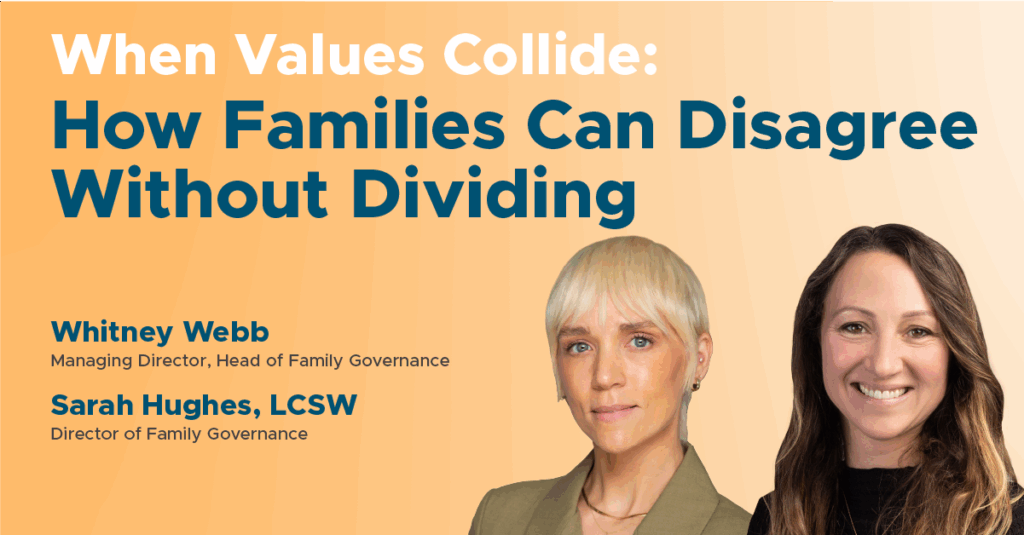
By Whitney Webb, Managing Director, Head of Family Governance, Cresset, and Sarah Hughes, LCSW, Director of Family Governance, Cresset
In a world where politics and religion can divide neighbors, colleagues, and even close friends, it’s not surprising that these tensions sometimes find their way into the heart of family philanthropy.
In the wake of the conflict in Israel and Gaza, one family we work with found their shared commitment to giving tested in unexpected ways. The mother felt a deep calling to support humanitarian and security efforts in Israel, a place tied closely to her faith and identity. Her adult daughter, meanwhile, wanted to direct funds toward aid organizations working in Gaza, where she saw immense human suffering and civilian loss.
What began as a discussion about compassion quickly became a reflection of the world’s broader divides. Words intended to express care began to sound like political statements. The disagreement stretched into silence, and what had once been a joyful family giving conversation felt impossible to revisit.
Weeks later, through a facilitated dialogue process, they cautiously came back to the table. With structure, ground rules, and a focus on storytelling, the family began to move from argument to understanding. The mother shared how her giving to Israel came from a lifetime of connection to her heritage and a sense of responsibility to a community she loved. The daughter shared that her desire to support Gaza had been shaped by her friendship with a Palestinian classmate in college—someone who had felt silenced and fearful to speak about her family’s experiences.
As they listened, they began to hear echoes of shared values: empathy, protection of those they love, and the courage to care deeply. Their disagreement no longer represented two sides of a conflict but different expressions of compassion.
Today, the family continues to give—sometimes together, sometimes separately—but with more respect for one another’s motivations. Their philanthropy didn’t erase their differences; it illuminated the values that unite them. Through dialogue, they discovered that understanding, not agreement, can be the truest measure of family harmony.
Philanthropy as a Mirror
Stories like this are not rare. Philanthropy reflects not only what a family values, but also how it expresses those values in a changing world. Giving can surface profound questions about identity, fairness, and faith.
Older generations often give to the institutions that shaped them—schools, churches, community organizations—while younger family members are drawn to movements that reflect inclusion, innovation, and visible impact. When these perspectives collide, it’s tempting to see conflict as a sign that something has gone wrong. In truth, it signals that people care deeply—that their giving is not mechanical, but personal and meaningful.
The real question isn’t how do we make everyone agree, but how do we stay connected while we navigate our differences?
From Agreement to Alignment
At Cresset, we often remind families that agreement isn’t the goal—alignment is.
Agreement says, “We all support the same cause.”
Alignment says, “We share similar values, even if we express them differently.”
Families that focus on common ground start by naming a few guiding principles—their philanthropic “north star.” For example:
- We believe in creating opportunity for others.
- We invest in ideas that strengthen communities.
- We give in ways that reflect gratitude, not guilt.
When these shared principles come first, family members can pursue individual passions within a coherent whole. A parent might support scholarships at their alma mater, while an adult child funds climate-resilience work. Both are acting from the same core values: opportunity and stewardship.
Navigating Emotion and Belief
When politics, religion, and personal conviction enter the room, emotions activate quickly. We’ve learned that the best antidote is structure, empathy, and story.
Here are a few practices that help families engage in a language of understanding rather than judgement, and in moments of tension, they can move from Who’s right? to What matters most to each of us?
1. Start with stories, not arguments.
Ask, “What experience led you to care about this issue?” When we speak from experience instead of positions, empathy replaces judgment.
2. Listen to understand, not respond.
Hold back your commentary until the other person is finished speaking—listen intently. We often use the quote “In order to hear, one must be heard.” A study at Colombia University supports this with data, identifying that when people feel their perspective is genuinely heard (rather than judged), their relational openness increases, and mutual regard is enhanced.
3. Separate ‘how we give’ from ‘what we give to.’
Agree on process—diligence, transparency, accountability—before debating recipients. Shared process builds guardrails and trust, allowing space for difference.
4. Build in opportunities for both autonomy and connection.
Many families dedicate a portion of their giving to collective decisions and another to individual passions. This allows the needs for self-independence and belonging to coexist.
5. Use facilitation wisely.
A neutral third party can help uncover the values and needs beneath each viewpoint. They can guide conversations, clarify assumptions, hold group norms, and make space for each voice.
Separating As an Act of Love
Disagreement is not dysfunction; it’s a sign of engagement. It reveals the diversity of experience that makes families dynamic. Discussion on philanthropic impact can lead to clarity on shared humanity, but there are times when collaboration and interdependence feel impossible.
I know a family who navigated their deeply divided political and religious beliefs well, that is, until they began running a foundation together. The formal structure and the dominant personalities mixed with the differing beliefs were too much for the family system to bear. After a year, they decided to split the foundation into individual DAFs and created a platform where twice a year each person would put out a call to co-fund particular causes. They found the right mix of independence and interdependence for their unique family.
Another time, I heard a deeply frustrated and disheartened patriarch recommend that the family foundation be split apart because of the tension it caused during election cycles. The adult children, facing the real loss of an institution that they were proud of, realized that the political differences they held did not outweigh their shared respect and legacy. They worked diligently to create and stay true to group norms, and defined clearly what it means to speak respectfully
The Real Legacy: Connection
When politics, religion, and philanthropy collide, families face a choice. They can retreat into silence to maintain the status quo, or they can turn toward conversation and bravely navigate the outcomes.
Families who practice empathy create a legacy of connection as lasting as their generosity. When younger generations witness dialogue that honors both emotion and what truly matters, they learn that care and conviction can coexist.
This is what we see: the families whose relationships and philanthropy endure are those who understand that unity, not uniformity, is the goal.
Whitney Webb is Managing Director, Head of Family Governance at Cresset, where she leads programs on governance, philanthropy, and next-generation education.
Sarah Hughes, LCSW is Director of Family Governance at Cresset and a licensed clinical social worker specializing in family dynamics, resilience, and intergenerational communication.