
Key Observations
- Consumer spending remains resilient, but many households are increasingly relying on savings and installment credit to maintain spending.
- Falling confidence and slowing payroll growth suggest the labor market is becoming a more important risk for the economy.
- Consumers continue to spend, but many are trading down, favoring lower-cost experiences and value-oriented businesses.
- Buy now, pay later (BNPL) financing is expanding beyond discretionary purchases into everyday household expenses, signaling growing financial strain.
- Higher-income households continue to support overall consumer spending, masking increasing pressure on middle-income consumers.
- A cooling labor market is shifting investor attention away from inflation risks and toward the outlook for economic growth.
The aggregate data still suggests the American consumer is fine. Personal spending rose 0.9% in August, its fastest monthly pace in more than a year, and retail sales are running comfortably ahead of last year in nominal terms. But the aggregate hides a story that’s enveloping more U.S. households. Personal income grew just 0.2% in August, and the gap was filled by savings, pushing the personal saving rate to its lowest level in nearly four years. Households appear to be spending down their cushion, and many are making hard choices about what stays in the budget.
Those choices are now emerging in company results, credit markets, household borrowing, and sentiment surveys. They underscore an economy that is bifurcating (K-shaped) rather than collapsing, and a consumer whose resilience depends increasingly on a labor market that, as September’s payroll report showed, is now softening in earnest.
Confidence Breaks Lower
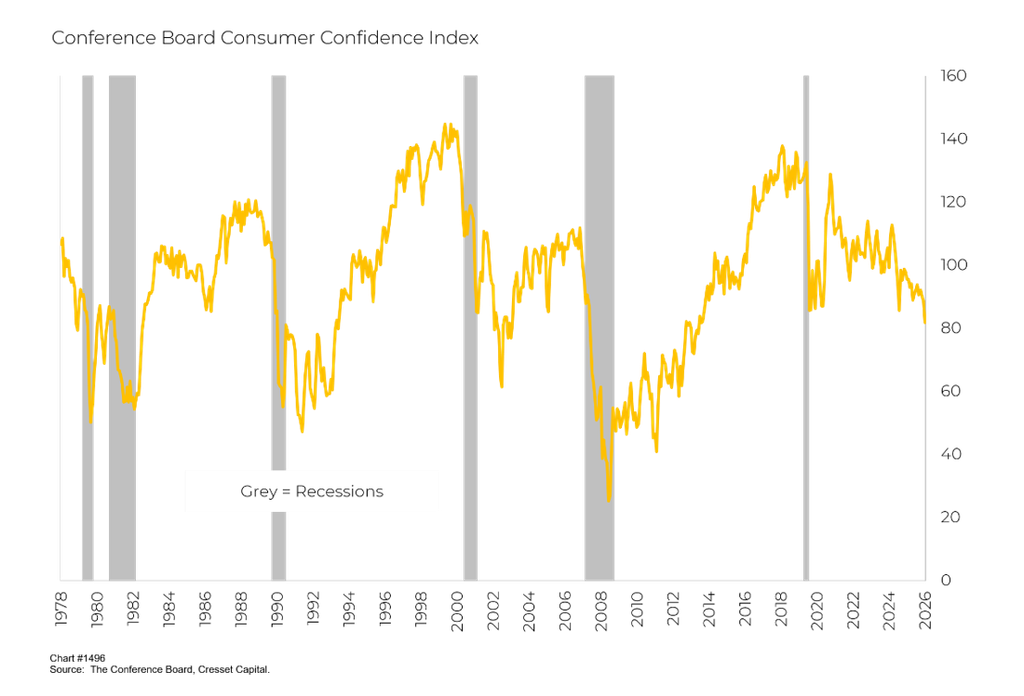
The Conference Board’s consumer confidence index fell 6.7 points in September to 81.9, its weakest reading since 2014 and below economists’ forecasts. The present situation gauge dropped nearly 8 points to its lowest since 2021, while expectations for the next six months slid to a more than one-year low.
The war in Iran has pushed gasoline well above $4 a gallon. According to AAA, diesel prices are near record levels, and heating oil prices have also risen ahead of winter. Inflation expectations for the year ahead worsened, and the share of respondents bracing for higher interest rates hit its highest level in more than four years. That is because the Federal Reserve raised rates in September for the first time in three years, and several policymakers have since argued for more.
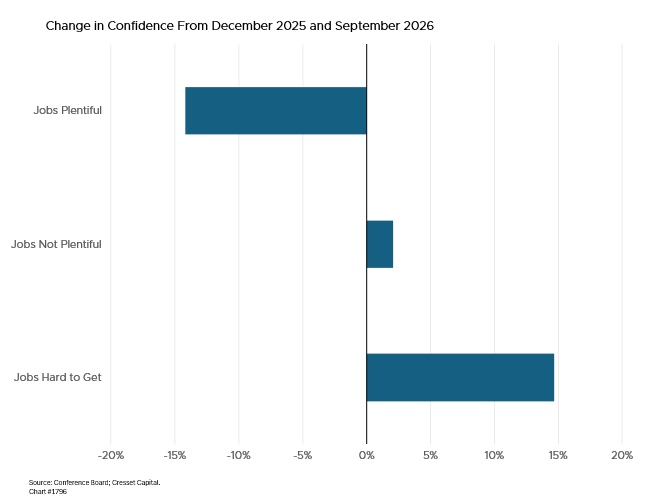
The labor detail matters most. The share of consumers saying jobs are plentiful fell to its lowest since 2021. The gap between “plentiful” and “hard to get,” which is a spread economists watch closely, narrowed to its smallest in more than five and a half years.
Payrolls Confirm the Trend
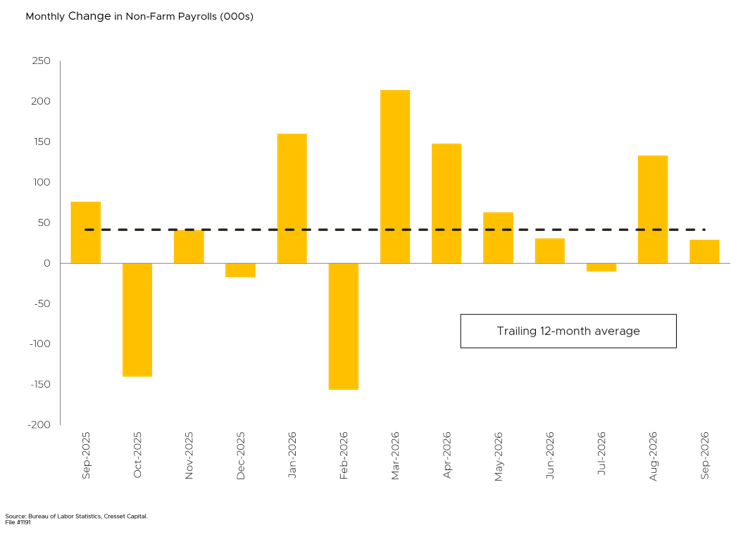
The September employment report validated consumers’ concerns. Nonfarm payrolls rose just 29,000, well below every economist’s forecast and the roughly 90,000 consensus, while downward revisions to prior months compounded the disappointment. The unemployment rate edged up to 4.2% from 4.1%. Average hourly earnings rose just 0.1% for the month and 3.0% from a year earlier, both below expectations. The disappointment landed two days after ADP reported 90,000 net new private-sector jobs, its strongest reading in three months, so investors were caught flatfooted. September’s gain leaves the trailing 12-month average near 41,000 jobs per month.
The Trade-Down Inside the Venue
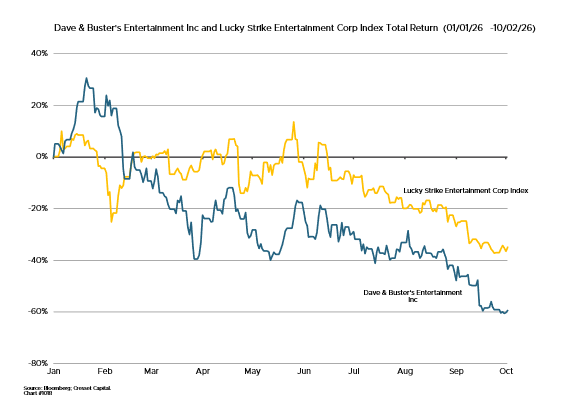
The clearest ground-level evidence comes from out-of-home entertainment, where spending is entirely optional. Dave & Buster’s most recent quarterly results missed expectations across the board. Entertainment revenue fell 8.7% from a year earlier, while food and beverage comparable sales rose 7.6%, the fifth straight quarterly gain. Customers still came through the door, but they’re eating instead of playing, a trade-down hitting the highest margin segment of their business.
Lucky Strike tells a similar story with a geographic twist. Full-year same-store sales slipped 0.2%, but excluding California they rose 0.9%. California locations posted double-digit declines in March, when West Coast gasoline spiked as high as $9 a gallon. Management also flagged softer corporate event bookings tied to AI-related layoffs, a structural wrinkle in an otherwise cyclical slowdown.
The K Runs Through the Restaurant Industry
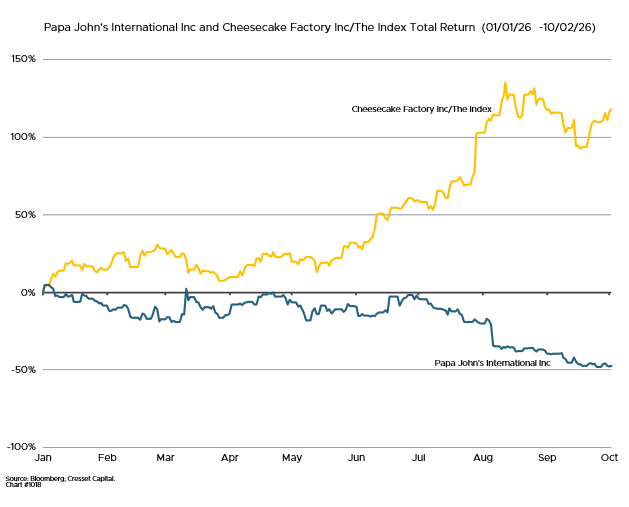
Restaurant data show the bifurcation sharply. Middle-market and value-sensitive concepts are losing traffic. Papa John’s North American same-store sales fell 8.3% in the second quarter, prompting a guidance cut and a dividend suspension. Wingstop comparable sales dropped 7.5% as pressure on its core guest proved worse than management anticipated. Cracker Barrel traffic fell 6.7%.
At the other end, operators with either a sharp value proposition or a premium position are thriving. Texas Roadhouse posted 6.2% comparable growth, Cheesecake Factory 5.8%, and Chili’s 5.1% on the strength of its value platform. Across the industry, Americans are going out less often yet paying more when they do.
Borrowing to Bridge the Gap
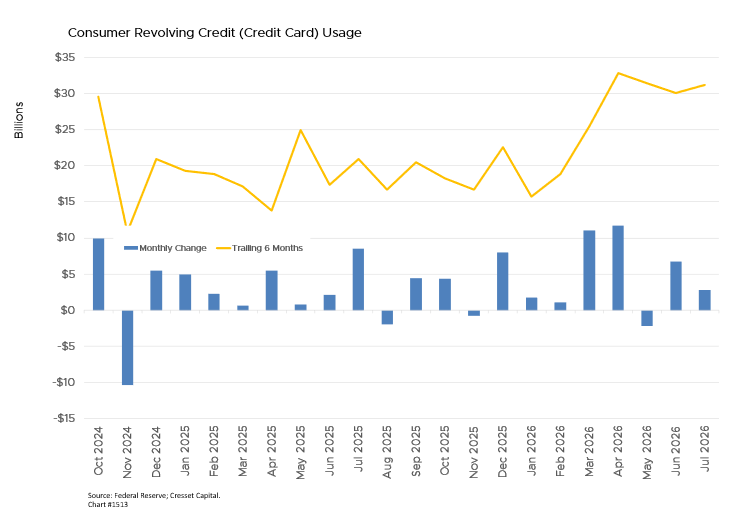
When income falls short of spending, the difference must come from either savings or credit. Current credit data show strain building beneath a calm surface. U.S. revolving consumer credit, mostly credit cards, stands at roughly $1.357 trillion, up 42% from its 2020 trough of $955 billion. Nearly all that increase came by 2023, however. Balances have barely grown since, and even that modest growth overstates new borrowing. Charged-off debt has contributed significantly to the rise in the New York Fed’s measure of card balances since 2024, because lenders are carrying bad debt on their books longer before writing it off.
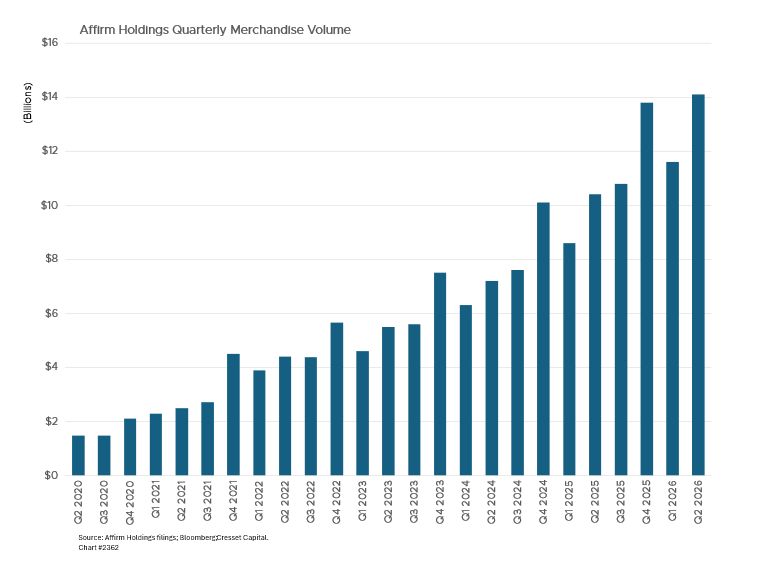
Buy now, pay later (BNPL) has stepped into that gap. BNPL has evolved from a niche checkout option into a mainstream credit product, and Affirm, the largest publicly traded U.S. provider, offers the clearest public window into its growth. Gross merchandise volume rose from $15.5 billion in fiscal 2022 to $50.3 billion in fiscal 2026, a 3.2-fold increase in four years, and reached $14.1 billion in the June quarter alone. Quarterly revenue climbed to $1.17 billion, helped by a shift toward higher-yielding interest-bearing loans. For a borrower near the limit on a credit card, BNPL has real appeal. It carries no revolving balance and does not always appear on credit bureau reports. It has become, for many, the credit product of last resort.
Unfortunately, BNPL is no longer confined to sneakers and electronics. Providers including Flex and Zip now offer installment plans for rent, electricity, health insurance, broadband, mobile phone service, and water bills. That shift from wants to needs is telling. A household that splits its electric bill into four payments is not smoothing a purchase; it’s avoiding insolvency.
What It Means for the Economy
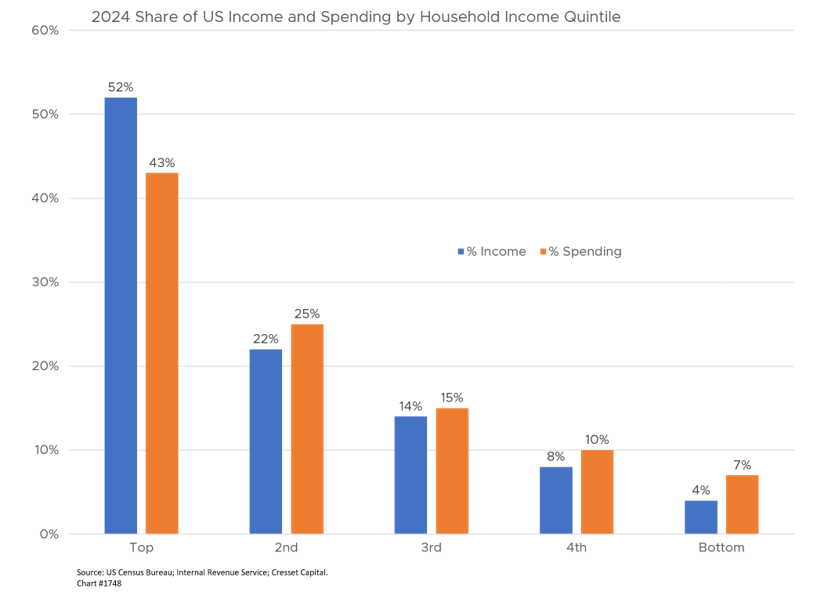
Aggregate spending will hold up longer than the anecdotes suggest. That’s because the top quintile of earners accounts for nearly half of consumer spending, and those households are cushioned by asset values, particularly equities and housing. That is why retail sales and aggregate spending still look healthy even as payroll growth stalls. A K-shaped economy can keep growing while half its consumers retrench.
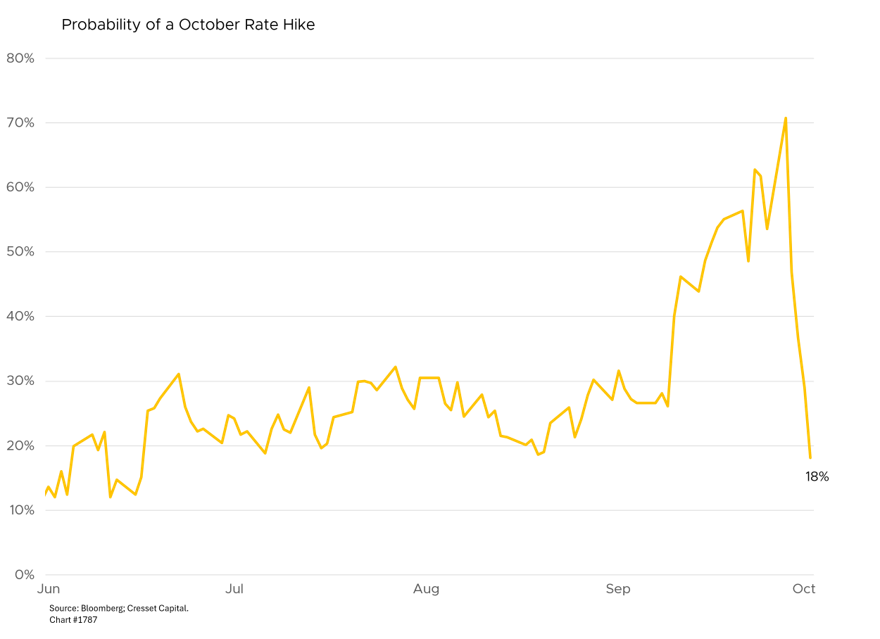
Meanwhile, the Fed’s rate path may be shifting, but relief will come slowly. Energy-driven inflation pushed the committee to tighten in September, yet higher rates land hardest on leveraged businesses and borrowing households already under strain. Earlier this week, New York Fed President John Williams said one more rate hike late this year might be appropriate, though he saw no urgency, and Philadelphia Fed President Anna Paulson also floated modest further tightening. September’s payrolls undercut Chair Warsh’s hawkish tilt. Williams himself called the labor market “not inflationary” and said tariff effects are fading, and with wage growth at 3.0% and hiring stalling, the argument that wages will push inflation higher loses force. The odds of an October hike have fallen to about 18%, from roughly 70% just days earlier.
Bottom Line
American households are making hard choices and cutting back. They are eating instead of playing and filling half a tank instead of a whole one. Affluent consumers are carrying the aggregate, which can continue for a while. But the middle is running on savings and installment credit, paying more for energy, and facing a hiring market that has nearly stalled. September’s payroll report shows a labor market that is cooling meaningfully but not collapsing, and it shifts the balance of risks from inflation toward growth. The pullback in discretionary spending is the early warning, and households financing their electric bills in four payments are the clearest sign of how thin the cushion has become. If the labor market cracks, the Fed will be forced to cut rates. In should be noted that pricing power from high nominal growth offsets corporate margin pressure and so underwriting skill in both private equity and private credit should be front and center for investors.