Key Observations
- Big Tech’s AI infrastructure spending is approaching historic levels, putting greater pressure on companies to demonstrate measurable returns.
- Investors are increasingly rewarding AI monetization over ambitious capital spending plans alone.
- Buybacks have slowed as companies prioritize funding AI investments, shifting the capital allocation story.
- Early signs suggest AI revenue is beginning to outpace depreciation costs, an encouraging milestone for long-term profitability.
- Upcoming earnings reports will focus less on AI announcements and more on cloud growth, free cash flow, and evidence of sustainable monetization.
Big Tech earnings begin in earnest this week, with Alphabet and Tesla reporting after market close on July 22, followed by Microsoft and Meta on July 29, and Amazon and Apple on July 30. The market is no longer rewarding companies for merely mentioning artificial intelligence (AI). Wall Street is demanding concrete evidence of monetization, with investors grading harshly on capital expenditure and cloud margin expansion. This reporting cycle will definitively test whether the $700 billion annual AI infrastructure investment can translate into sustainable earnings growth or if hyperscalers face a reckoning on returns. The data and charts that follow contextualize the central question animating equity markets: can Big Tech justify its extraordinary capex, or are shareholders facing disappointment ahead?
AI’s Historic Investment Wave
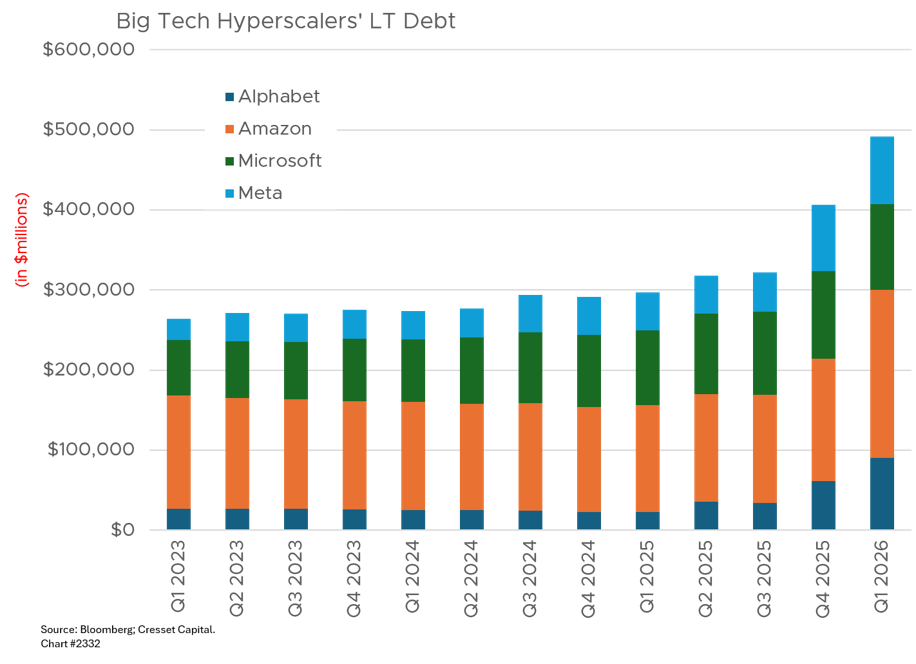
The capital commitment has become almost incomprehensible. Alphabet, Amazon, Meta, and Microsoft collectively plan to deploy more than $700 billion in 2026 alone toward artificial intelligence data center infrastructure. Add Oracle to the tally, and the five largest U.S. technology companies have nearly doubled their debt loads over five years to finance this buildout, accumulating roughly $350 billion in new obligations. The entire effort, when viewed collectively, could require over $3 trillion in total infrastructure investment.
Putting it in perspective, the spending by the four largest hyperscalers in 2026 alone approaches the total cost of building the U.S. railroad network, five times the cost of the interstate highway system, and roughly ten times the entire Apollo program. This is a generational capital allocation decision, and it sits uneasily with a market that tends to reward technology companies for returning cash to shareholders.
Investors are naturally asking: When will this massive capital spending generate meaningful returns? Or are we witnessing an industrial buildout that future competition and oversupply will ultimately render uneconomic?
The New Lens on Earnings
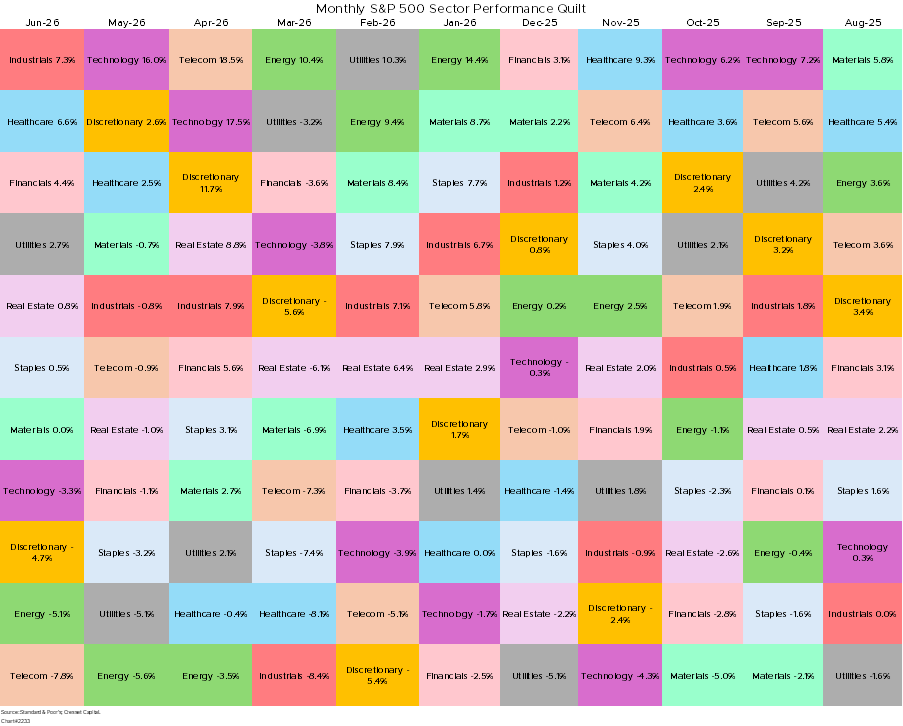
Investor patience, already thin, has grown visibly thinner in recent weeks. The technology sector underperformed the broader S&P 500 in June, sliding more than 3 percent, as investors reappraised the most aggressive AI capital deployers. While the spending trends have not changed, investors are gauging what they’re willing to sacrifice today in exchange for potential payoff.
Buybacks, a long-time tech investor benefit, have effectively vanished. Microsoft was the only one among the four largest AI spenders to repurchase shares in the first quarter of 2026, and at $3.4 billion, that figure represented the lowest buyback level for the group in a decade. Alphabet, meanwhile, raised $80 billion through new equity offerings, including an at-the-market program and a Berkshire Hathaway investment deal, just to fund its capex plans. This is not the posture of a company awash in excess cash. It depicts a company that believes AI spending takes priority over other capital allocation levers, including shareholder returns.
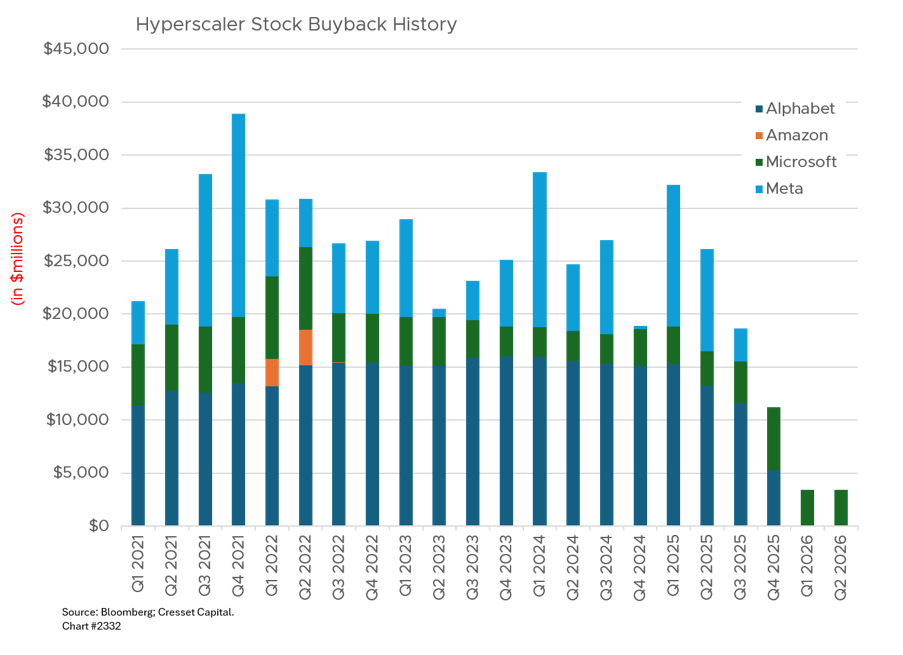
The implications reverberate. Analysts project S&P 500 buyback growth to slow into the low single digits this year, citing AI cost pressures as the primary headwind. When the largest, most profitable companies in the world pull back from share repurchases, equity investors feel it immediately. It signals that either free cash flow is slowing, or capital is being diverted. Often, it is both.
Where AI Spending Begins to Pay Off
When will capex translate into revenue? Alphabet has emerged as the clearest bull case. Google Cloud is accelerating, AI products are generating meaningful engagement and preliminary monetization signals, and the path from infrastructure to revenue feels credible. Microsoft and Meta, despite strong headline earnings, have faced more skeptical reactions because investors can no longer tolerate the presumption that earnings beats are sufficient. Perfection is the new consensus.
Amazon personifies the most contentious AI capex debate. While AWS is accelerating impressively at 28 percent growth in Q1 2026, Amazon’s free cash flow has fallen to near zero, prompting the company to raise $25 billion in debt to fund its AI buildout. Rather than a company generating substantial cash flow alongside capex investment, Amazon fuels investor skepticism: massive infrastructure spending that has temporarily eliminated free cash flow generation. Unlike Alphabet, which can point to cloud acceleration and monetization, Amazon is betting that free cash flow returns before it runs out of financial runway. The upcoming Q2 earnings report will signal whether AWS growth is sufficient to restore the cash generation story that once defined the company’s competitive moat.
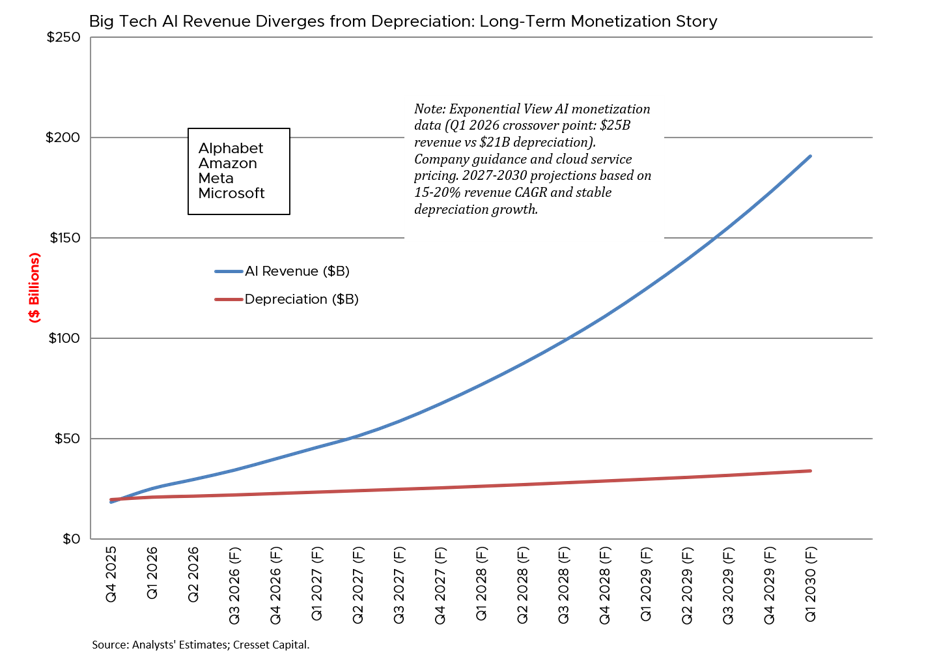
There are, however, early signs that the economics may be turning in the industry’s favor. Data from research firms tracking AI adoption found that global AI sales from hyperscalers and neo-cloud providers reached approximately $25 billion in the first quarter of 2026, surpassing the $21 billion in estimated depreciation tied to their data center investments. That crossover point, where new AI revenue exceeds the depreciation burden of the assets built to generate it, represents a meaningful inflection. It does not mean the return on the entire invested capital base is positive, nor does it resolve questions about competitive saturation or technology obsolescence. But it does suggest that the spending cycle may be approaching economic sustainability.
Why Skeptics Remain Unconvinced
Critics point to the speculative fervor driving capex, the unprecedented concentration of demand among a handful of hyperscalers, and the risk that competitive dynamics will ultimately force prices down faster than volume grows. A few sustained quarters of price pressure on AI computing services would quickly unravel the bull thesis, turning billions in capex into billions in impairment charges.
The bull case rests on several pillars. Nvidia CEO Jensen Huang’s framing of compute as a revenue proxy carries intuitive appeal. The AI infrastructure theme remains durable through 2027 and beyond, thanks to chipmakers like TSMC, which reported a 36 percent jump in quarterly revenue and raised its full-year outlook to 40 percent-plus growth, signaling conviction about demand extending well into 2027.
The most probable scenario involves sustained heavy capex deployment, meaningful monetization over time, but also periodic bouts of competitive pressure and disappointment along the way. Winners and losers will be increasingly differentiated not based on capex ambition, but on the clarity of their path to profitable revenue.
The Earnings Test Ahead
The coming weeks will prove decisive. As Alphabet, Microsoft, Amazon, and Meta report earnings, investors will scrutinize not merely revenue numbers but specific signals that AI infrastructure is generating returns: cloud revenue acceleration, AI product attach rates, the trajectory of free cash flow, and any guidance on when the capex intensity cycle moderates. The Magnificent Seven is already fracturing along precisely these lines, with the market increasingly differentiating between companies demonstrating clear monetization and those trading on the promise of future returns.
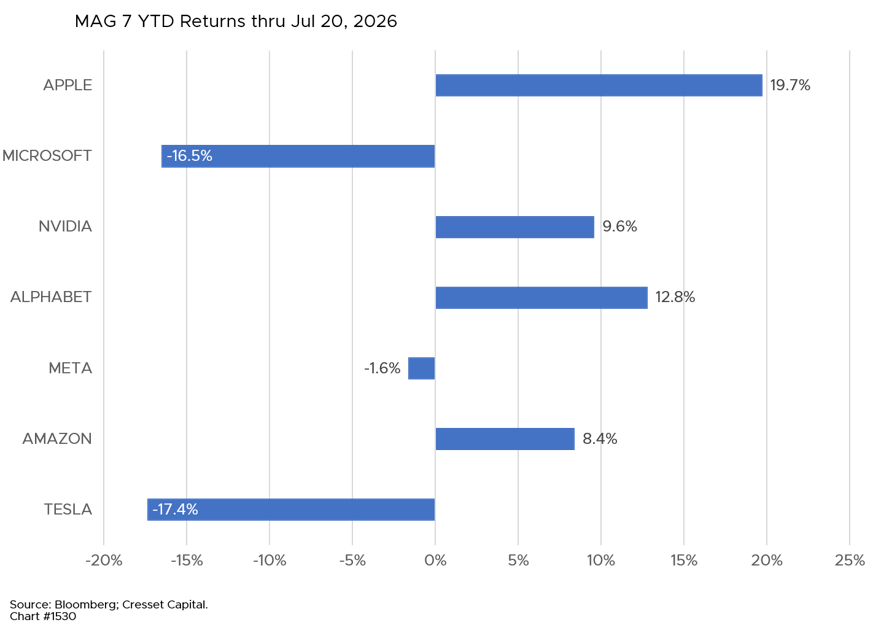
This represents a meaningful shift in how investors ascribe value to Big Tech. For years, investors extended these companies enormous latitude based on proven track records in cloud, mobile, and digital advertising. At this stage, AI is merely a promise. The investment cycle is longer, competitive dynamics are unsettled, and returns are substantially harder to model. Investors, having watched valuations compress after years of expansion, are now enforcing accountability standards that were once considered unnecessary.
Bottom Line
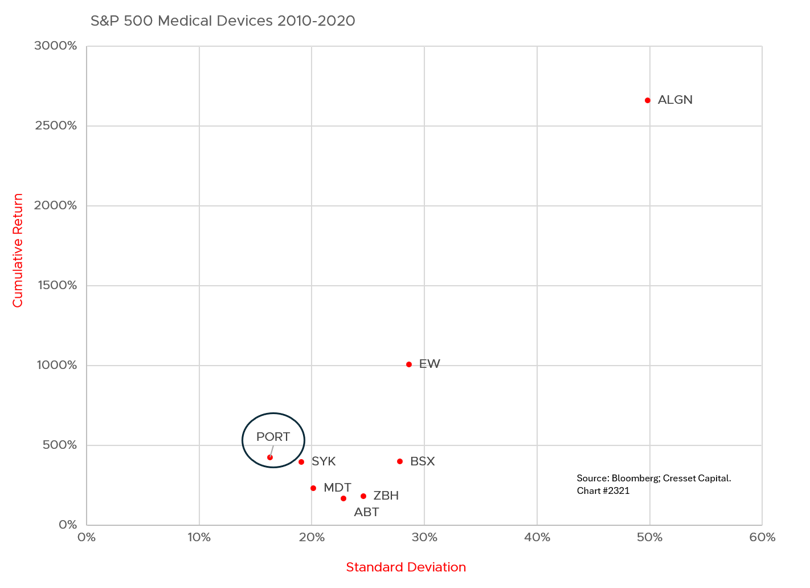
Big Tech can justify its extraordinary AI capital spending, but only if it can demonstrate a clear and accelerating monetization pathway. The inflection point when AI revenues exceed depreciation costs represents real progress, but it is not a sufficient metric of success. Investors now demand evidence that capex discipline remains intact, that free cash flow will eventually recover, and that competitive dynamics will not force painful repricing of AI services. For investors interested in capturing the promise of AI, we recommend owning the entire theme. Like we learned in the early 2000s with the handful of medical device makers scrapping for market share, owning the entire group delivered the promise of medical technology for a fraction of the risk. The cap-weighted medical device group delivered a return in excess of five of the seven constituents with the lowest standard deviation of the group.