
Key Observations
- Structurally higher interest rates are changing the role of bonds in diversified portfolios.
- Persistent fiscal deficits and increased debt issuance may keep long-term yields elevated.
- Higher bond yields reduce the valuation advantage equities have enjoyed for years.
- Bonds and equities may move together more often, weakening traditional diversification.
- We will be reviewing our secular outlook in the coming weeks and reassess our asset class positioning.
We are operating in a fundamentally different regime in which long-term rates remain persistently elevated. Structurally higher rates suggest the traditional role of bonds as a portfolio hedge, diversifier, and ballast against equity volatility must be reassessed. In such an environment, the role of bonds would be materially diminished, forcing equity valuations to be anchored elsewhere.
The Persistence of Elevated 30-Year Yields
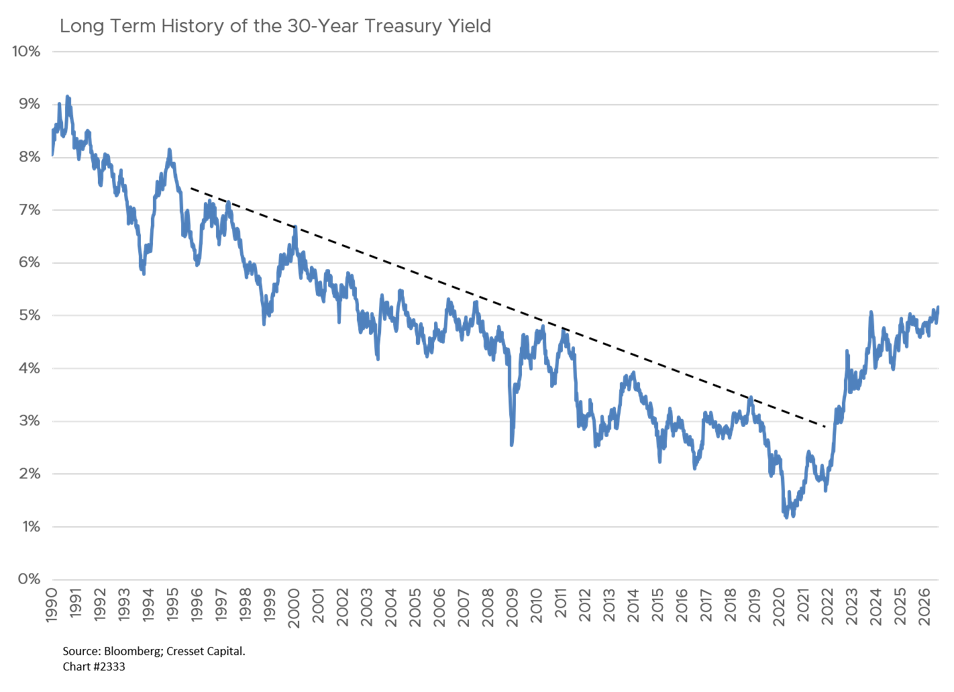
The 30-year Treasury yield’s persistent position above 5% suggests a structural reordering of the bond market, not a cyclical overshoot destined for rapid mean reversion. The move reflects three intransigent dynamics that show no imminent signs of reversing.
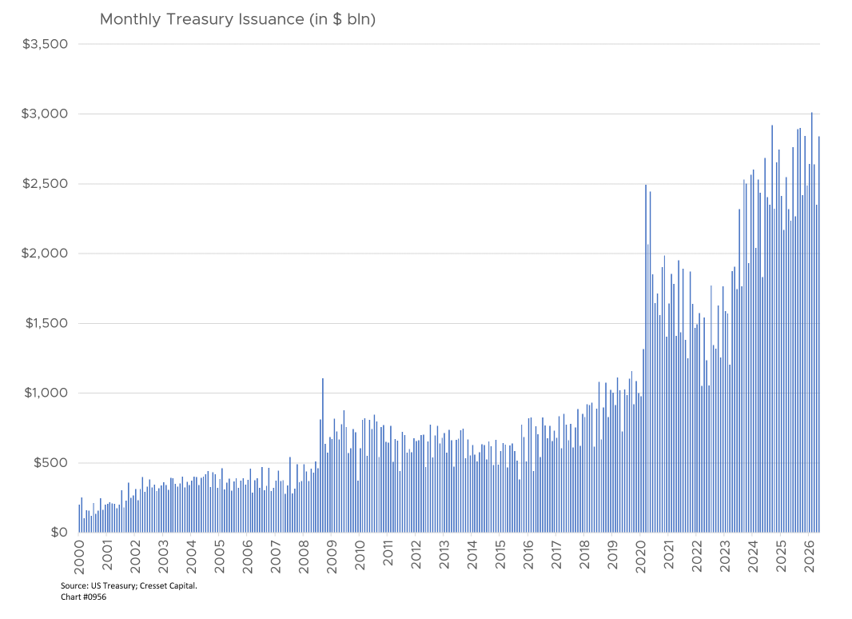
First, the fiscal backdrop remains unambiguous. The U.S. structural budget deficit continues to require substantial Treasury issuance across the curve, with pressure at the long end as the government funds decades of spending obligations. The Treasury Department has been forced to issue record amounts of longer-dated debt, and the market simply demands higher compensation for absorbing this supply.
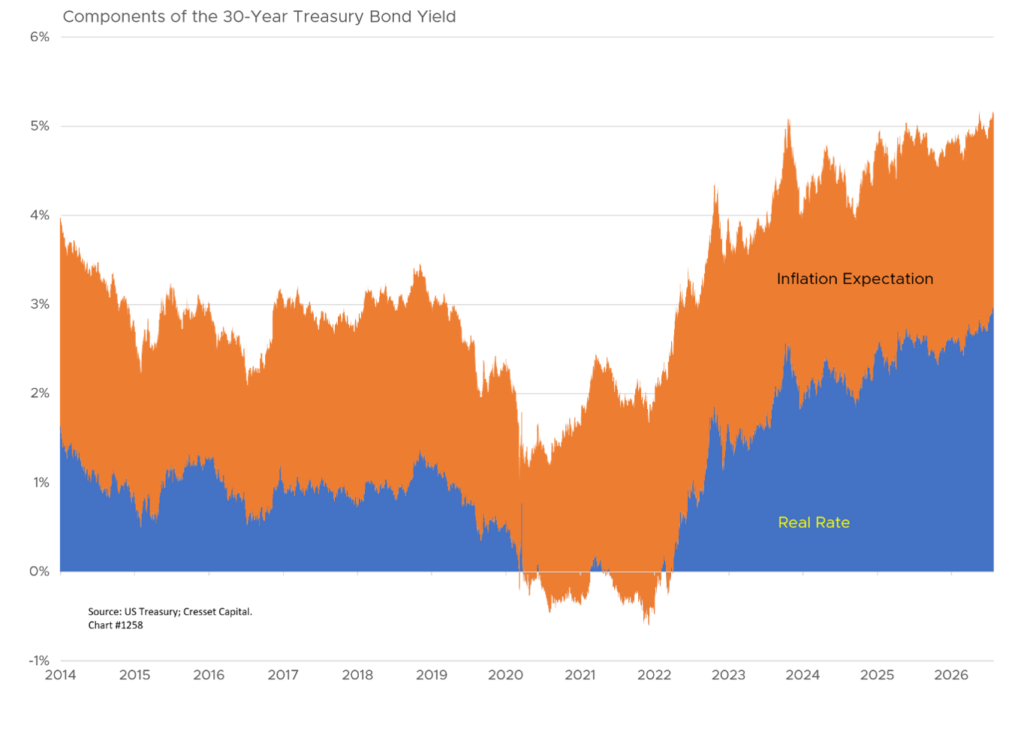
Second, investors have reassessed their long-term inflation and real-rate expectations. The 5% yield embeds both a higher real rate and inflation expectations, reflecting skepticism that either disinflation is a permanent feature or that the Fed will successfully anchor expectations at 2% over a 30-year horizon.
Third, the scarcity of attractive alternatives has ended. Between 2009 and 2022, Federal Reserve intervention kept interest rates artificially low, inhibiting bonds from attracting capital from equity alternatives. Since 2022, rates have normalized, but yields are climbing as bond issuance has been on the rise.
While 5% represented strong resistance for the long bond, it now appears to be support as yield trends are on the rise.
The Case for Structural Elevation
Bullish analysts suggest the recent rate strength is due to transitory factors, the Federal Reserve’s policy tightening cycle, temporary supply-demand imbalances, and cyclical inflation. Yet the fiscal landscape suggests something more persistent is at work.
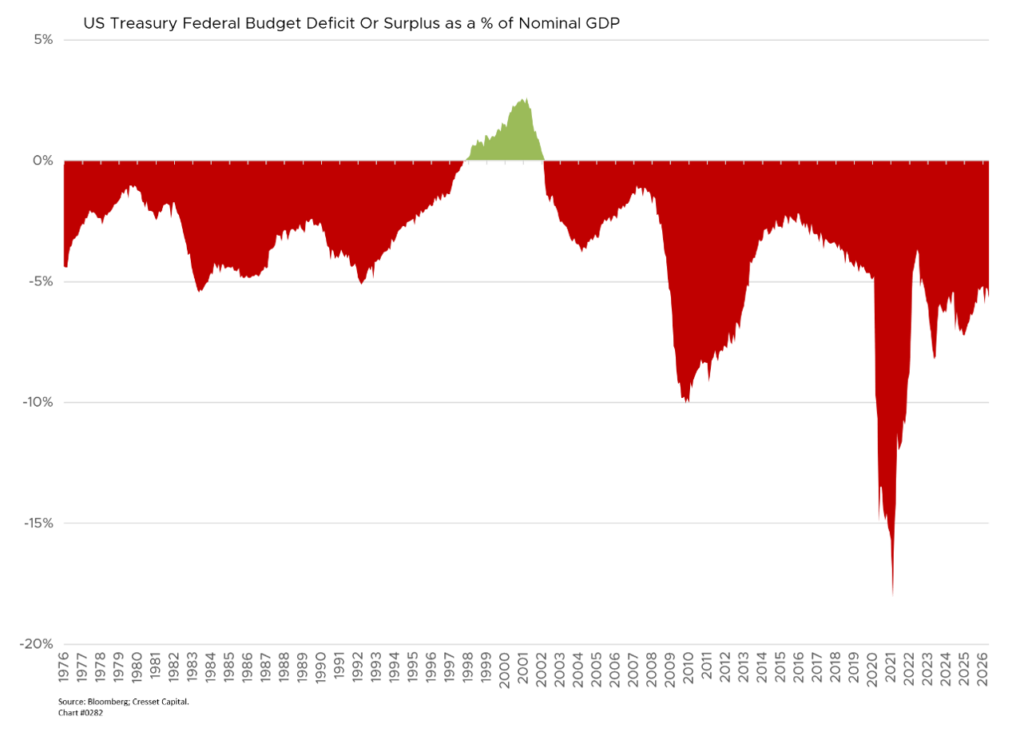
The U.S. structural budget deficit has grown well beyond pre-pandemic norms. Even as the economy recovers and unemployment normalizes, the fiscal deficit has remained elevated in absolute and relative terms. This is not a symptom of cyclical slack in the economy in need of stimulus, but rather the result of structural imbalances, aging demographics, increased entitlement spending, relatively flat real revenue growth, and persistently elevated expenditure on defense and international commitments. The Committee for a Responsible Federal Budget estimates a structural deficit at between 2% to 3% of GDP over the medium term, assuming no recession, no major new spending initiatives, and stable growth. That said, the administration is proposing a nearly 50% increase in defense spending to $1.5 trillion, making it the largest discretionary budget item.
Simultaneously, corporate America has entered a pronounced issuance cycle. Non-financial corporations have returned to heavy debt markets, driven by refinancing needs, capital expenditure commitments (particularly in artificial intelligence infrastructure), and merger and acquisition activity. This wave of supply shows few signs of abating, as hyperscalers and technology leaders continue to raise capital at a record pace to fund competing buildouts of data centers and AI training infrastructure. Unlike cyclical borrowing waves that recede as firms become fully financed, this capex wave is anchored to long-term structural investments with uncertain payoff horizons. Companies will continue issuing for years, not quarters. Q1 2026 was the first time since Q1 2020, during the pandemic, that corporations issued more than $1 trillion in debt.
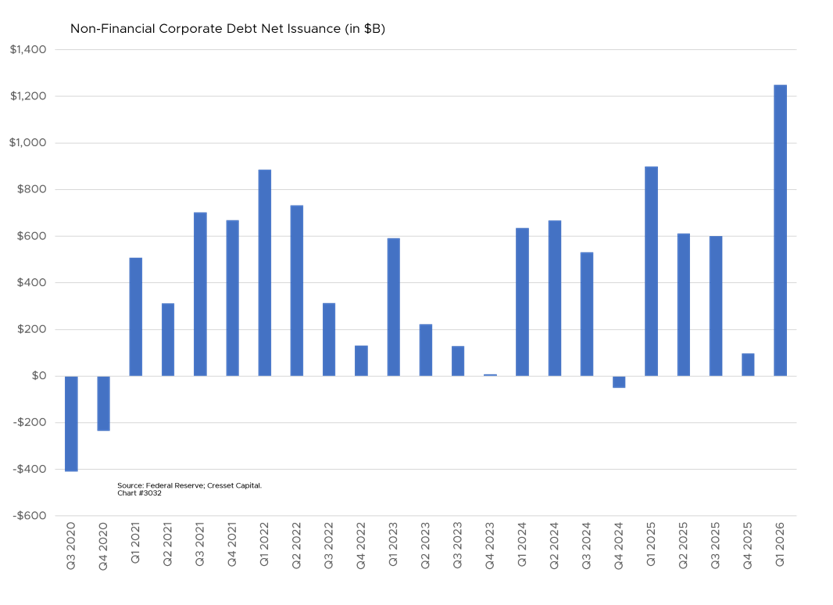
The confluence of persistent fiscal deficits and sustained corporate bond issuance creates a structural headwind for long-term rates. The Treasury market must absorb ever-larger deficits, while the corporate bond market must accommodate a generation-defining capex cycle. This, unfortunately, is incompatible with sub-2% 10-year yields, even if inflation remains contained and the Fed eventually pivots to accommodation.
How Bonds Have Lost Their Diversification Edge
Bonds traditionally performed two critical functions in a portfolio: they provided income superior to cash, and they offered negative correlation or low positive correlation to equities, offering valuable diversification during equity downturns. These functions are being called into question.
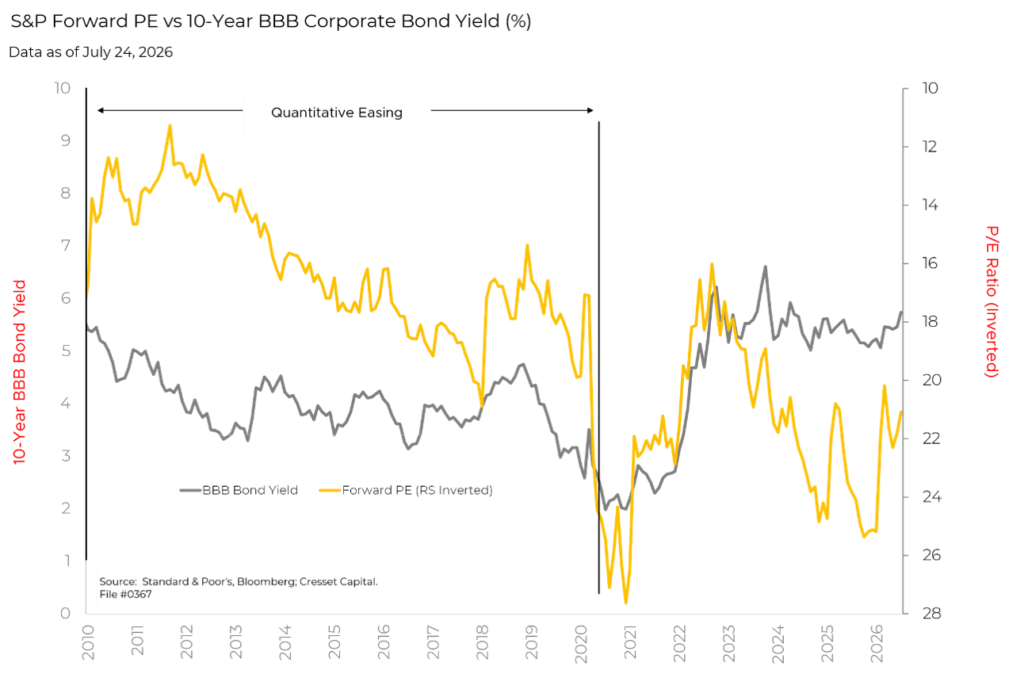
On income and valuation, math is important. A 10-year Treasury yielding 3.5% to 4% leaves little room for equity investors to justify a premium. If equities trade at twenty times forward earnings, a 5% earnings yield, the marginal equity risk premium, the additional return demanded for bearing equity volatility, sits at only 1% to 1.5% above the risk-free rate. Historically, equities offered risk premiums of between 4% to 5%. This means equities have become expensive relative to their earnings. Equities can still outperform bonds, but only if earnings growth accelerates materially from here. There is no longer a cushion for multiple expansion. The market has priced in modest, expected returns, leaving little room for disappointment. By contrast, in prior cycles when risk-free rates were one to 2%, equities offered 4% to 5% risk premiums, a far more compelling return for taking on volatility. The burden of proof has shifted from bonds justifying their place in portfolios to equities justifying their valuations.
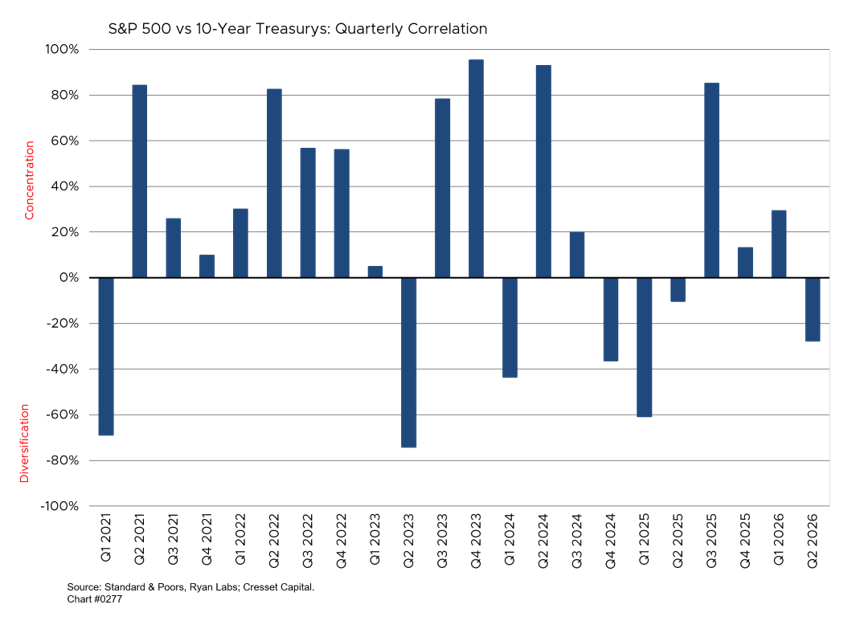
More significantly, the diversification case for bonds has fractured. Bond prices fall when rates rise, and in a world where rates are structurally higher, the trigger for sustained rate increases is fundamentally different than in the past. In prior cycles, rising rates were symptomatic of an economy overheating, which would eventually trigger Fed tightening and a growth slowdown. That downturn would benefit bondholders, even if they had suffered mark-to-market losses along the way. But in a regime of structurally higher rates driven by persistent deficits and structural corporate borrowing, the relationship between rate moves and equity returns breaks down. Rates can rise because fiscal dominance requires higher compensation, not because growth is accelerating.
Equities, meanwhile, may suffer not from a growth surprise, but from an earnings compression stemming from permanently higher discount rates. In such an environment, bonds and equities can fall together for extended periods, negating the diversification benefit that has historically justified a meaningful bond allocation. Over the last five years, bonds moved in tandem with equities more than two-thirds of the time.
The Equity Valuation Cascade
If the traditional bond allocation role is diminished, then the valuation framework for equities must shift accordingly. For decades, equity valuations have been justified on the basis that bonds offered an alternative store of value. When 10-year yields were 1% and 10-year earnings yields on the S&P 500 were 3% to 4%, equities offered a significant risk premium. That premium was real and rational. But it was also, implicitly, a statement that bonds were unattractive, and that equities were the lesser evil.
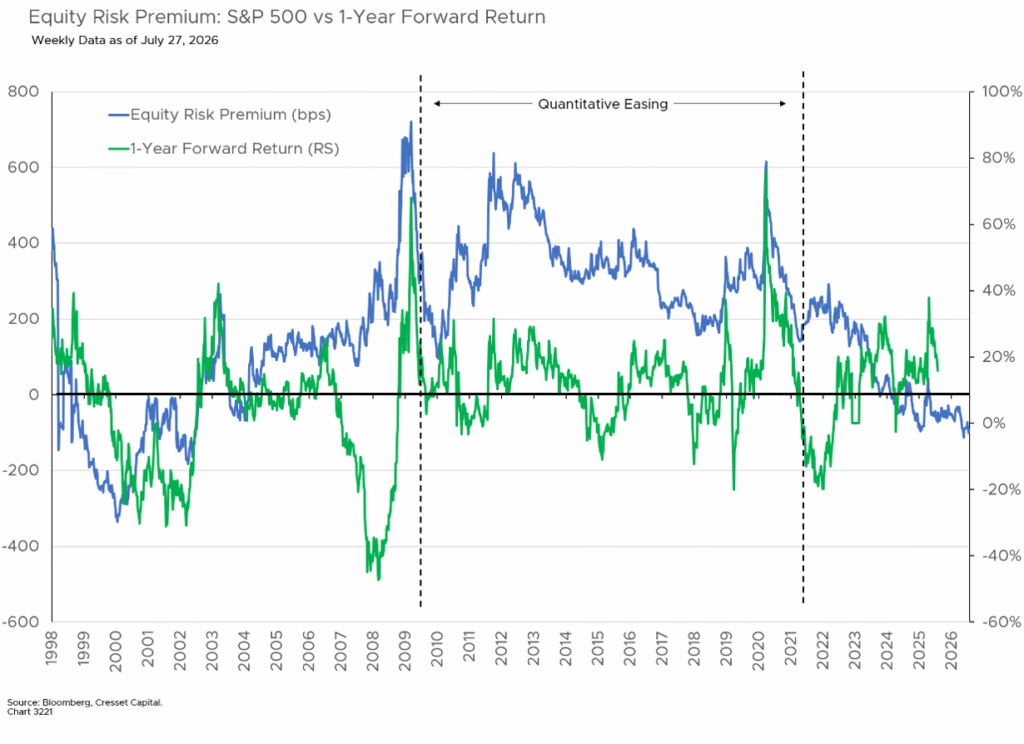
Now consider the arithmetic in a 3% to 4% long-rate environment. Assuming the market trades the S&P 500 at 20 times forward earnings, the earnings yield sits at 5%. The equity risk premium, the premium an investor demands to take on equity volatility and uncertainty relative to a risk-free bond, has compressed to roughly one to 1% to 1.5%. Historically, long-term equity risk premiums have averaged 4% to 5%. By that standard, current valuations embed a meaningful assumption that either growth and earnings will accelerate significantly from here, or that investors are willing to accept historically compressed risk premiums in exchange for equity-like returns.
On what basis should the market justify current equity valuations if bonds now offer 3.5% to 4% with no volatility? The traditional answer, that bond prices will eventually fall as rates decline from here, is no longer persuasive in a regime of structurally elevated rates. If rates remain permanently higher, that safety valve disappears.
This does not necessarily mean equity valuations should fall immediately. Rather, it means current valuations are now fragile and contingent on a specific outcome; sustained earnings growth that is robust enough to justify the modest risk premium equities offer above bonds. The market has already priced in this growth scenario. There is no valuation cushion for disappointment. If earnings growth fails to materialize, or if economic weakness emerges, equities have no cushion from multiple expansion to soften the blow. The multiple is already modest relative to historical norms. Valuations would need to reset downward to reestablish an adequate risk premium.
By contrast, an investor in 3.5% to 4% bonds receives their return regardless of earnings performance. Bonds do not require growth to deliver their promised yield. This is the core tension: equities are betting on sustained earnings acceleration, while bonds are betting on stable cash flows. At current valuations, equities have limited room for error. The burden of proof rests entirely on earnings delivery.
Reconstructing the Bond Allocation
The upshot is not that investors should abandon bonds entirely. Rather, it means the rationale for bond holdings must be more precise and less reflexive. Bonds still serve specific functions. They provide ballast in acute market dislocations including deflationary tail risks, and just as important, they offer investors specific dollar amounts on specific dates.
But the old model in which bonds were simply “the diversifier” that provided returns independent of equity performance is outdated. A meaningful bond allocation must now be justified on specific grounds, including liquidity needs, liability matching, or the view that rates have overshot on the high side and will decline. The diversification argument was valid when bonds and equities were negatively correlated most of the time. It is no longer a given in an environment where both are pressured by higher long-term rates.
Bottom Line
Structurally higher long-term rates have fundamentally altered how investors should construct portfolios. The diversification case for bonds has fractured. In past cycles, rate increases signaled growth acceleration and Fed tightening, dynamics that eventually benefited bondholders even after near-term losses. Now, rate increases reflect fiscal dominance and structural deficits, which can coincide with equity weakness. Bonds and equities can fall together, eliminating the diversification benefit that historically justified a sizable bond allocation.
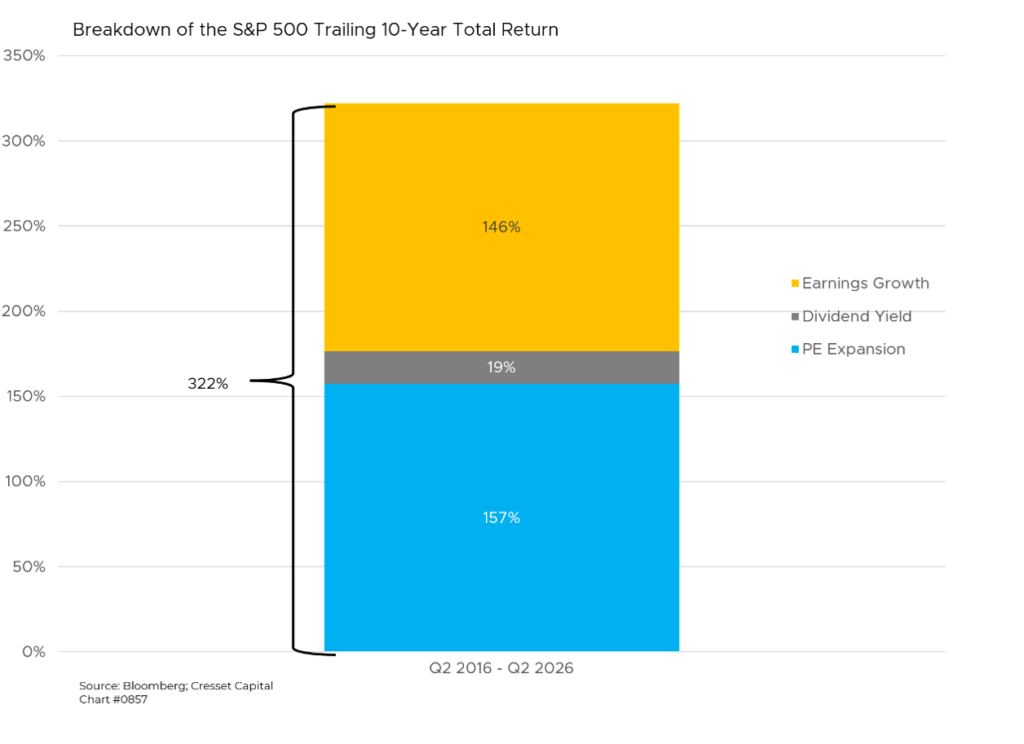
At the same time, equity valuations have become contingent and fragile. The risk premium is historically compressed, leaving little cushion if earnings growth disappoints. Equities are priced for sustained earnings delivery, not for the multiple expansion that protected portfolios in prior cycles. Over the last 10 years through Q2 2026, nearly half of the S&P 500’s 322% cumulative return can be attributed to multiple expansion.
In the coming weeks, the Cresset team will be developing our secular outlook, looking for changing trends