
Key Observations
- Consumer spending is losing momentum as retail sales weaken, savings decline, and households become more selective in discretionary spending.
- Lower- and middle-income consumers are experiencing the greatest financial pressure, while affluent households continue to support aggregate spending.
- Labor market conditions are softening as payroll growth weakens, job openings decline, and downward revisions point to deteriorating employment momentum.
- Inflation trends are improving, but persistent services inflation and elevated borrowing costs continue to limit the Federal Reserve’s flexibility.
- A narrowing margin for error favors quality over cyclicality, selective duration over cash, and alternatives for portfolio diversification.
On the surface, the U.S. consumer looks resilient. Retail sales on a year-over-year basis peaked at 7.2% in May 2026 and still registered 5.0% in July. Headline CPI has pulled back from its May peak of 4.25% to 3.4% in July, and core CPI sits at a well-contained 2.5%. The unemployment rate ticked down to 4.1% in July. The economic picture appears benign: a soft landing in progress, inflation fading, employment stable. However, recent data tells a different story, and it is the directional shift, not the level, that matters most for positioning into year-end.
July’s retail sales print was the clearest warning shot. Nominal retail purchases fell 0.6% last month, the largest single monthly decline since May 2025, driven by a pullback in online stores and auto dealers. Economists had expected a modest increase. The drop followed a period of elevated spending that analysts attribute partly to World Cup-related activity, Amazon Prime Day timing effects, and tax refunds, suggesting that some of the first half 2026 strength was pulled forward.
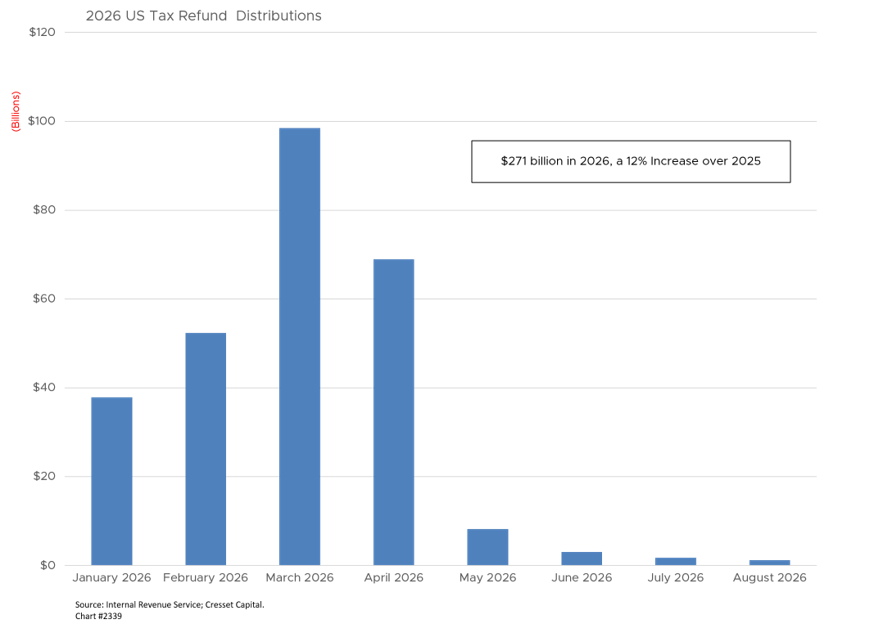
The U.S. personal saving rate is declining, posing a structural challenge to spending sustainability. Americans are increasingly hunting for deals, embracing do-it-yourself projects, and saving less amid persistent inflation and elevated gas prices. McDonald’s comparable U.S. restaurant sales rose only 0.8% during its most recent quarter, below analyst estimates, as check sizes rose but visit frequency declined. Restaurant traffic fell approximately 2% in the first quarter of 2026.
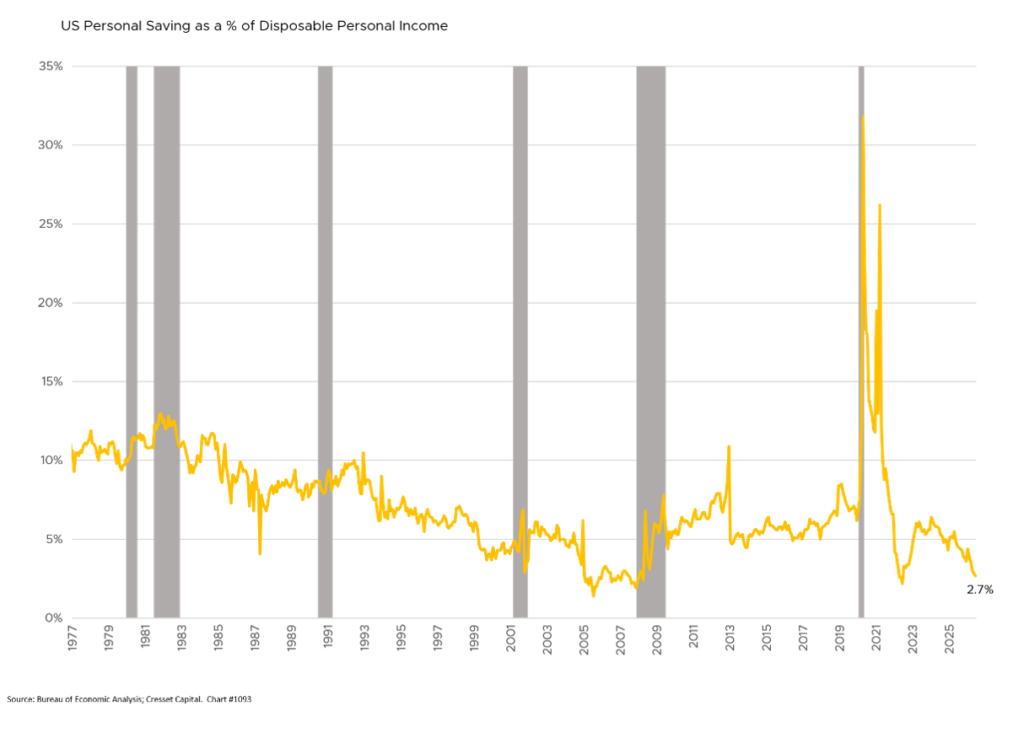
Consumer Spending Is Losing Momentum
Consumer confidence metrics confirm the trend. The Conference Board Consumer Confidence Index stands at 90.8, down from 93.8 in April. The University of Michigan Consumer Sentiment Index is at 55.2, having bottomed at 44.8 in May, a level historically associated with recessionary anxiety, not soft landings. The divergence between the two surveys is notable. The Conference Board, which weighs labor market conditions more heavily, is holding up better than Michigan, which captures forward-looking financial anxiety more acutely.
The bifurcation within the consumer is arguably the most important structural feature of this cycle. Affluent households account for nearly half of total U.S. consumer spending and continue to drive aggregate figures. Lower- and middle-income consumers are under measurable stress, with softening demand most pronounced in those cohorts, though there are signs the pressure is beginning to migrate upward into middle- and higher-income segments. Rising credit delinquencies among lower-income households are an early indicator of this stress.
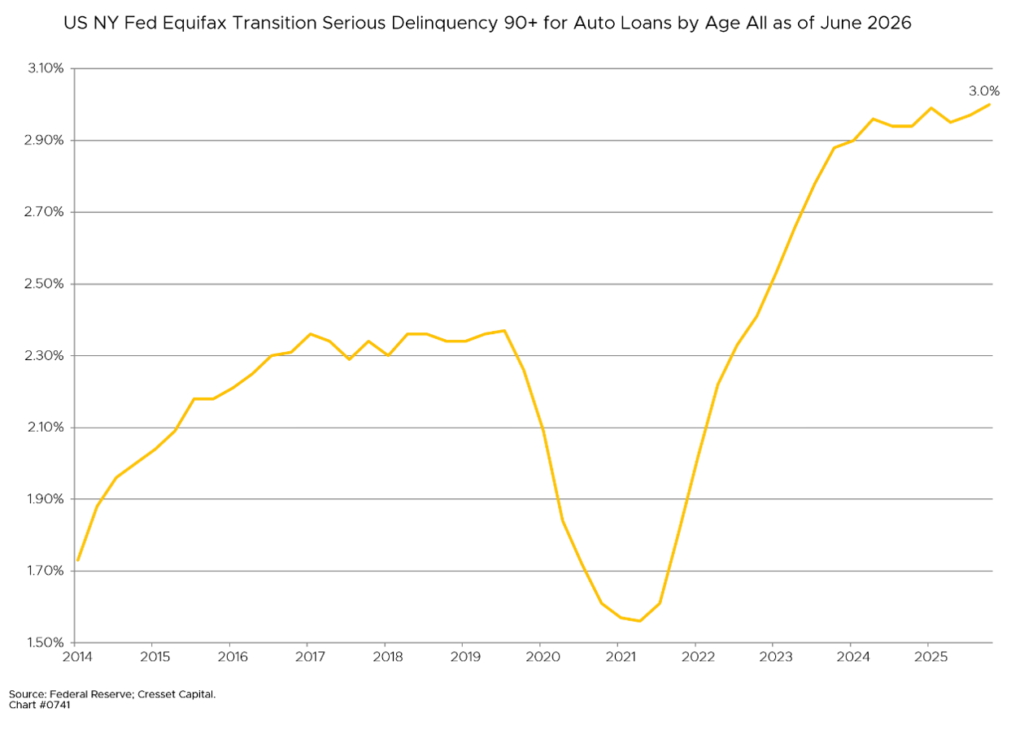
The Labor Market Is Weakening
The unemployment rate at 4.1% is not alarming in isolation. But like spending, recent data is deteriorating. Nonfarm payrolls shed 23,000 jobs in July, an outright negative print, and prior months were revised down by a combined 103,000. ADP private payrolls added only 44,000 in July, the weakest reading since the start of the year and below every estimate in Bloomberg’s economist survey. Job openings fell to 7.36 million in June from 7.54 million in May, with declines concentrated in health care, leisure and hospitality, and business services.
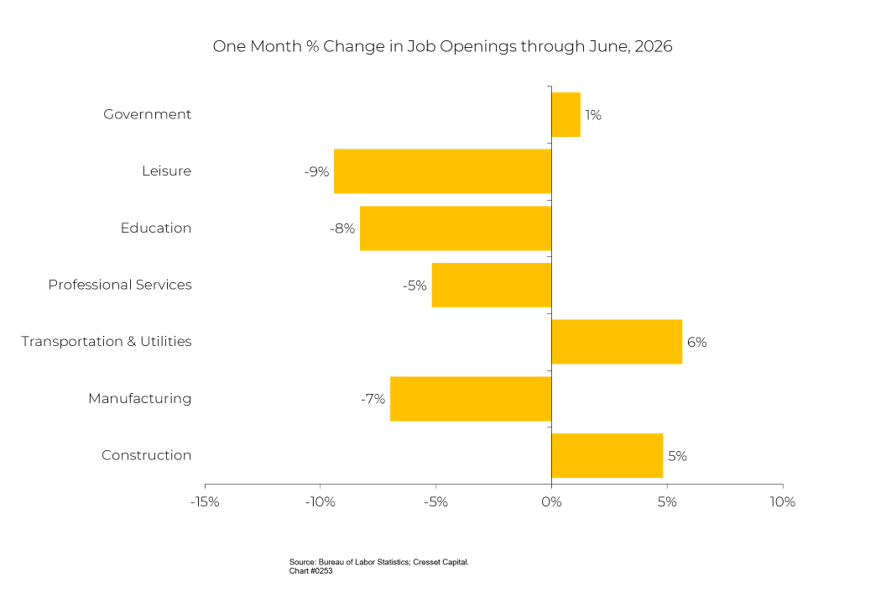
Initial jobless claims have remained below 200,000 for three consecutive weeks, the longest such streak since 1969, which provides some comfort. But the headline unemployment rate’s decline to 4.1% partly reflects falling labor force participation rather than genuine job creation, a distinction that matters for income sustainability.
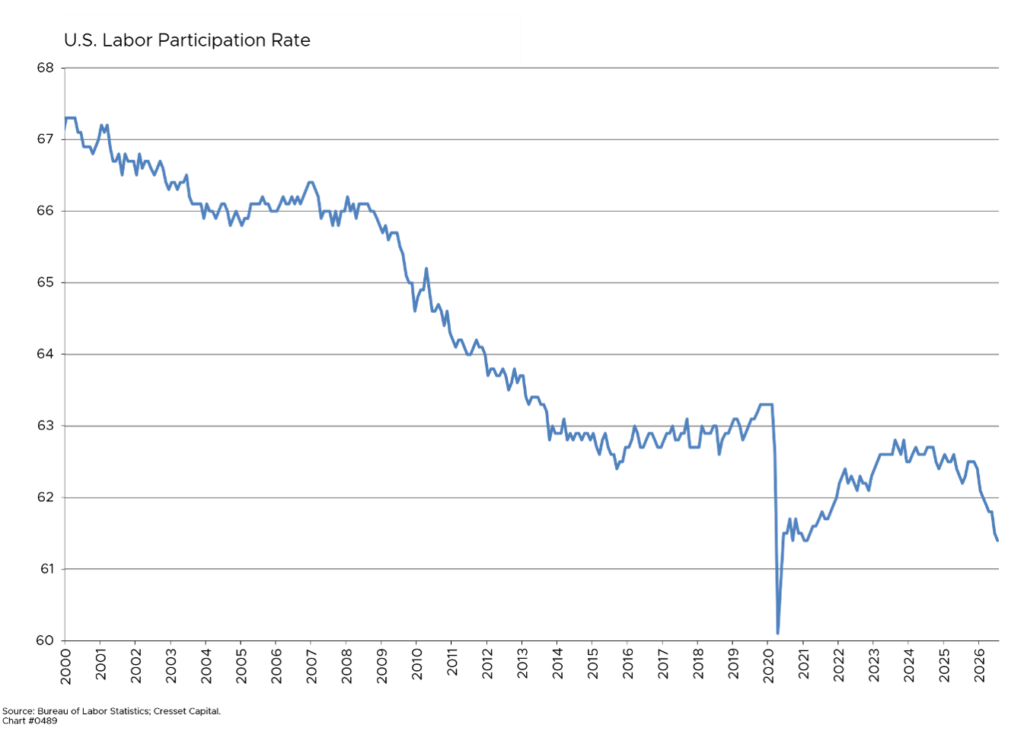
The quality of labor market support for consumption is eroding. Household income is increasingly dependent on job retention rather than accelerating wage growth or new hiring. Job gains are concentrated in health care and social assistance, sectors that are less cyclically sensitive but also less indicative of broad economic momentum. The labor market is certainly not collapsing, but it is shifting from a tailwind to a neutral or slight headwind for consumer spending power. We expect the labor market will soften modestly further as companies implement efficiency-driven workforce reductions to offset elevated input costs.
Inflation: Easing, but Risks Remain
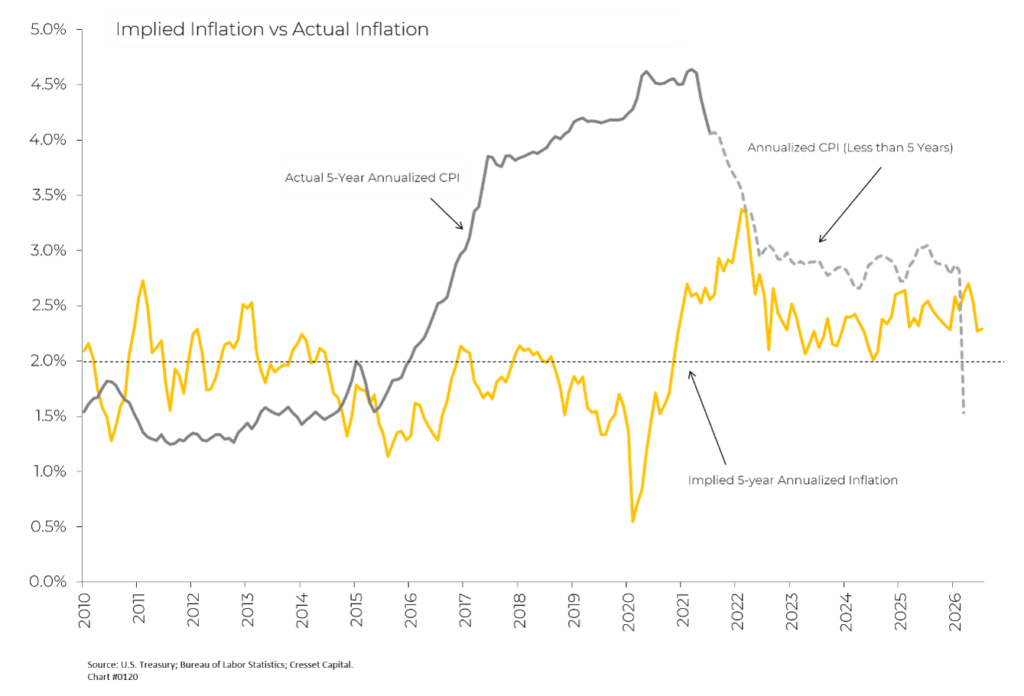
Core CPI at 2.5% year over year in July is encouraging. The PCE deflator turned negative month over month in June, down 0.11%, and core PCE printed only up 0.13% month over month, consistent with the Fed’s 2% target on an annualized basis. The tariff- and energy-driven inflation spike that pushed headline CPI to 4.25% in May appears to be working through the system. The summer CPI readings are encouraging, but we would like to see more evidence of sustained disinflation.
The risk is that headline inflation’s apparent tameness masks persistent services inflation and the ongoing drag of 30-year mortgage rates near 6.7%, the highest in over a year, which continues to suppress housing turnover and household formation. Treasury investors anticipate headline inflation at 3.4% by year-end 2026, declining to 2.4% by the end of 2027. That trajectory is constructive but leaves the Fed with limited room to ease aggressively without risking a re-acceleration.
A Data-Dependent Fed
The Federal Reserve cut rates 75 basis points in the second half of 2025, from 4.50% to 3.75%, and has been on an extended pause since December 2025. The most recent FOMC meeting produced an 8-4 vote to hold, with several participants favoring removal of easing bias language due to upside inflation risks, while others argued cuts would be appropriate once disinflation is re-established or labor market weakness becomes more pronounced.
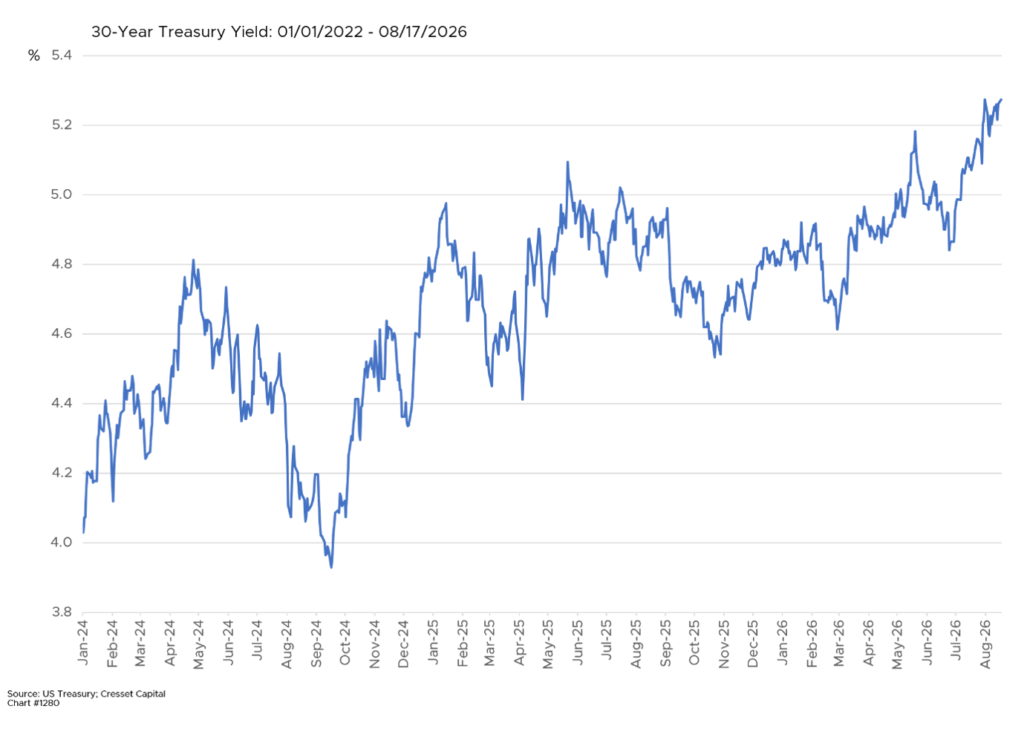
The base case among investors is that the Fed remains on hold through year-end 2026, with easing resuming in 2027. However, the current Treasury curve, with the 2-year at 4.2%, the 10-year at 4.7%, and the 30-year approaching 5.3%, depicts a positively sloped curve with an elevated long end, suggesting persistent inflation risk and fiscal supply pressure rather than imminent easing.
Bottom Line
The U.S. consumer is not in free fall, but the data as of mid-August 2026 is consistent with a consumer that has begun to retrench at the margin, drawing down savings, pulling back on discretionary purchases, and increasingly dependent on job retention rather than income growth for spending power. The labor market’s headline stability masks deteriorating flow data. While core inflation is well behaved, the Fed’s hands remain tied by a headline CPI that is still well above target and a long end of the curve that is pricing in fiscal and inflation risk. For investors, the year-end setup favors quality over cyclicality, selective duration over cash, and alternatives for diversification. A soft landing is still our base case. But the margin for error is narrowing.