
Key Observations
- NVIDIA’s earnings have become a broader market event given the company’s outsized S&P 500 weight and its role as a proxy for the health of the AI capital spending cycle.
- Elevated expectations mean another earnings beat may not be enough, with forward guidance and the magnitude of any upside surprise likely to drive the stock’s reaction.
- NVIDIA’s growing investments in customers, infrastructure partners, and potential competitors are raising questions about circular financing, demand durability, and regulatory risk.
- Falling AI token prices have not yet weakened GPU demand, as lower costs are expanding AI usage and supporting continued growth in inference and enterprise spending.
- The transition from Blackwell to Vera Rubin and increasing competition from custom chips will test NVIDIA’s pricing power, margins, and system-level competitive advantage.
- Investors should focus beyond a single quarter’s stock reaction and assess whether the structural drivers of AI infrastructure spending remain intact.
NVIDIA reports fiscal second-quarter results on Wednesday, and because NVIDIA now represents one of the largest weights in the S&P 500, this is not a single-stock report but is closer to a macro event. Most equity portfolios, whether through direct holdings, index funds, or thematic technology exposure, carry meaningful NVIDIA risk, and the stock’s reaction has repeatedly set the tone for the broader market in the day and week that follows. We treat this print as a read on the health of the entire artificial intelligence capital-spending cycle, not merely a check on one company’s quarterly numbers.
The Beat-and-Raise Question Is Changing Shape
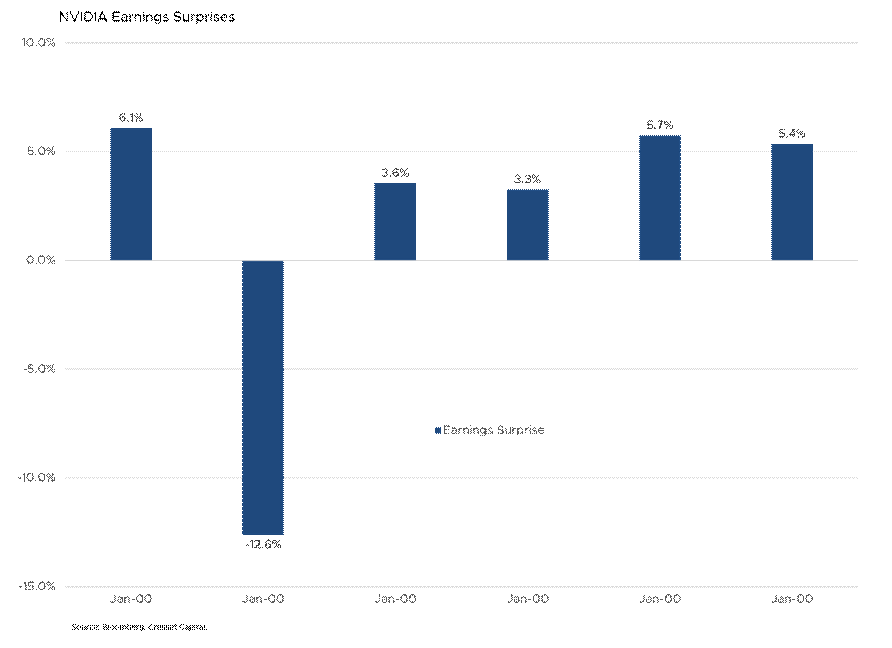
NVIDIA has beaten consensus earnings estimates in each of the last eight quarters, including a 35% beat last quarter that was the largest in recent memory. Consensus EPS for this quarter has climbed 51.7% over the past 12 months, from $1.42 to $2.15, reflecting how thoroughly Wall Street has revised expectations upward. Analysts are modeling revenue of $94 to $95 billion, several billion above the company’s own guidance midpoint of roughly $91 billion, with Q3 guidance potentially reaching $107 to $108 billion.
The debate has shifted. It is no longer whether NVIDIA beats, since that outcome is close to assumed, but whether the size of the beat and the strength of forward guidance are enough to reignite a stock that has been essentially flat since the May report while the broader market and even the semiconductor index have moved on their own paths. A merely “in line” quarter, even a technically good one, risks a negative reaction if it fails to clear the bar of increasingly high expectations. One supportive counterweight is valuation. NVIDIA’s forward price-to-earnings ratio near 20 sits well below its five-year average of roughly 63, meaning the stock has grown into its earnings even as the multiple has compressed. This leaves more room for a favorable surprise to matter than a purely sentiment-driven read might suggest.
Circular Financing Has Become the Newest Source of Investor Unease
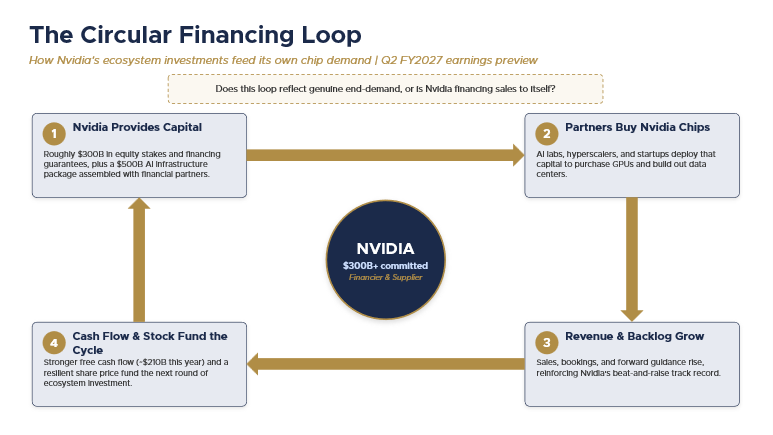
One of the most recent issues heading into this report is NVIDIA’s expanding role as a financier of its own customer base. The company has reportedly committed on the order of $300 billion to artificial intelligence (AI) ecosystem partners through equity stakes, financing guarantees, and other backstops, including a $500 billion AI infrastructure financing package assembled alongside major financial institutions. It raises the question: is NVIDIA lending money to customers so those customers can buy more NVIDIA chips, or does this dynamic overstate the durability of demand? Analysts’ views are mixed but generally constructive, viewing the supply and demand imbalance as structurally favorable. Meanwhile, the sum-of-the-parts analysis suggests the stock trades at a 34% to 50% discount to intrinsic value, suggesting the market may already be pricing in more circularity risk than is warranted. Investors should listen closely to how management frames these arrangements on the call, since the market’s tolerance for financial engineering around demand generation is not unlimited.
Buying the Competition
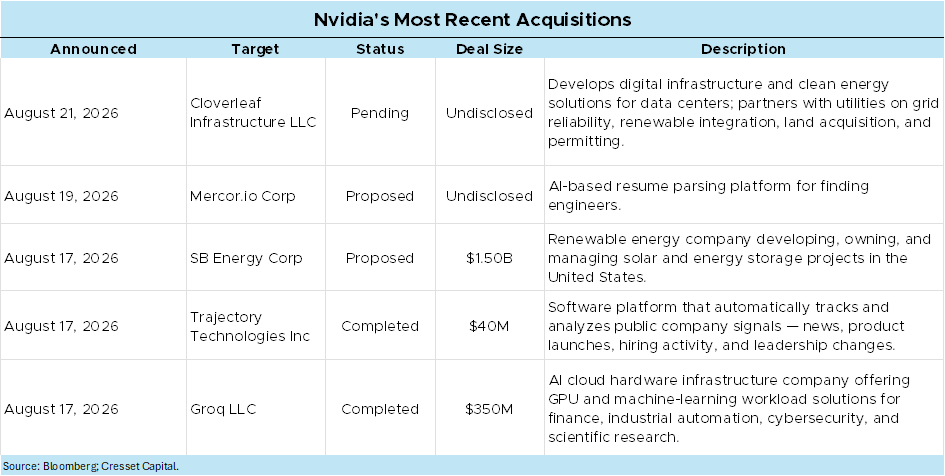
NVIDIA is willing to quash incipient threats before they mature. Beyond its venture investments in dozens of private AI companies over the past 18 months, NVIDIA has increasingly targeted would-be competitors directly. Its largest such move was the roughly $20 billion agreement late last year to license the technology and hire the key employees of chip company Groq, a licensing structure deliberately chosen to sidestep antitrust review. NVIDIA is reportedly now in talks with Korean AI chip designer Rebellions about a similar arrangement and separately is said to be in advanced discussions to invest in data center power specialist Cloverleaf Infrastructure.
The strategy raises questions for investors, including whether another inference-focused acquisition so soon after Groq signals genuine strategic need or simply a determination to keep any credible alternative out of the market. Another question is whether the pace and structure of these deals, particularly one involving a company backed by the South Korean government, will eventually invite the kind of antitrust scrutiny NVIDIA faced a few years ago and has so far managed to avoid. None of this is likely to come up explicitly on the earnings call, but it is a thread worth tracking as part of the broader competitive and regulatory picture, which carries index-level weight given NVIDIA’s size alone.
Falling Token Prices
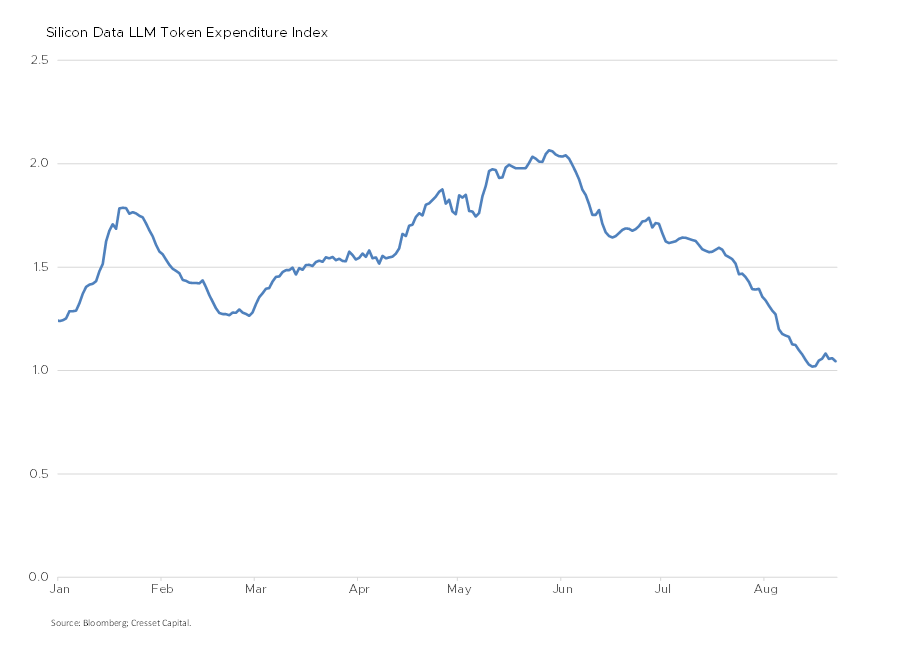
Investors should also consider that AI token prices are falling, raising questions as to the durability of infrastructure spending. Blended pricing across frontier models has fallen sharply, with one widely cited industry measure showing a roughly 67% year-over-year decline, and the cost of a fixed unit of model quality has compressed by an order of magnitude or more since 2023 as training efficiency improves and open-source competition intensifies. In isolation, that trend might appear to shrink NVIDIA’s addressable opportunity, since cheaper inference implies lower revenue per unit of AI work performed. In practice, the effect has run the other way so far. Total inference volume and enterprise AI spending have continued to rise even as unit prices fall, a Jevons paradox-type dynamic in which cheaper compute expands the range of profitable use cases faster than pricing declines, so aggregate demand for GPUs keeps growing.
Meanwhile, the token market has begun to bifurcate. Budget-tier, open-source pricing is falling quickly, while frontier model pricing has risen since the start of the year as leading labs push into larger, more compute-intensive models. Since model training and serving remain the most GPU-intensive workload and the least price-sensitive, NVIDIA benefits, while pricing pressure at the budget tier is where custom silicon and lower-cost accelerators are most likely to cede share over time. Investors should watch whether management addresses this bifurcation on the call and how it may shape the future mix between training and inference demand.
Product Transition
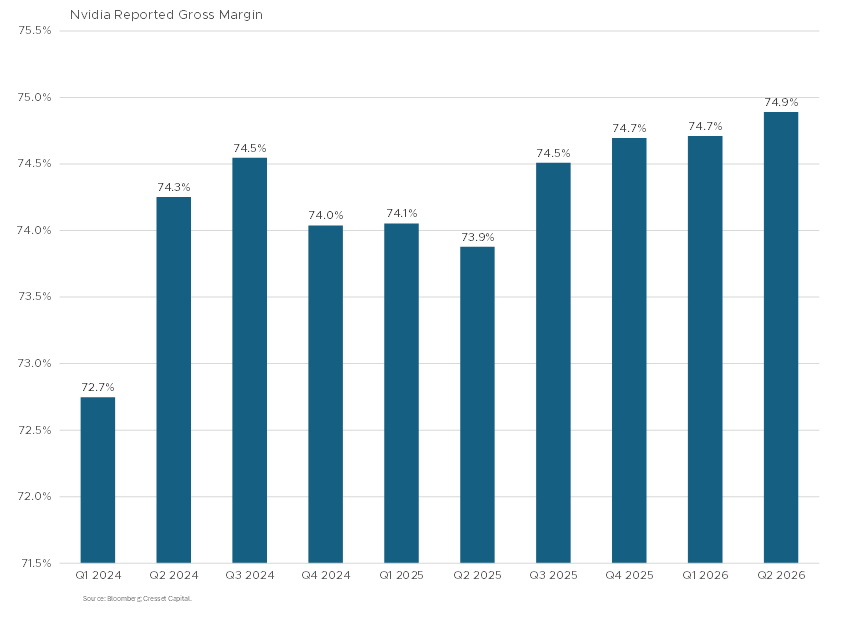
The company’s shift from Blackwell to the next-generation Vera Rubin platform remains the most consequential product cycle event on NVIDIA’s near-term roadmap, with production shipments expected to begin in Q3. Rubin carries a higher average selling price than Blackwell, although gross margin is likely to see near-term pressure in the transition. Management has guided to 75%, but rising component costs could push the actual number a few percentage points lower. Investors should treat a modest gross margin shortfall as temporary. A deviation large enough to suggest that pricing power itself is eroding, rather than simply reflecting normal transition costs, would warrant greater concern. This is a distinction the rest of the AI supply chain is effectively pricing off as well.
Peak Market Share?
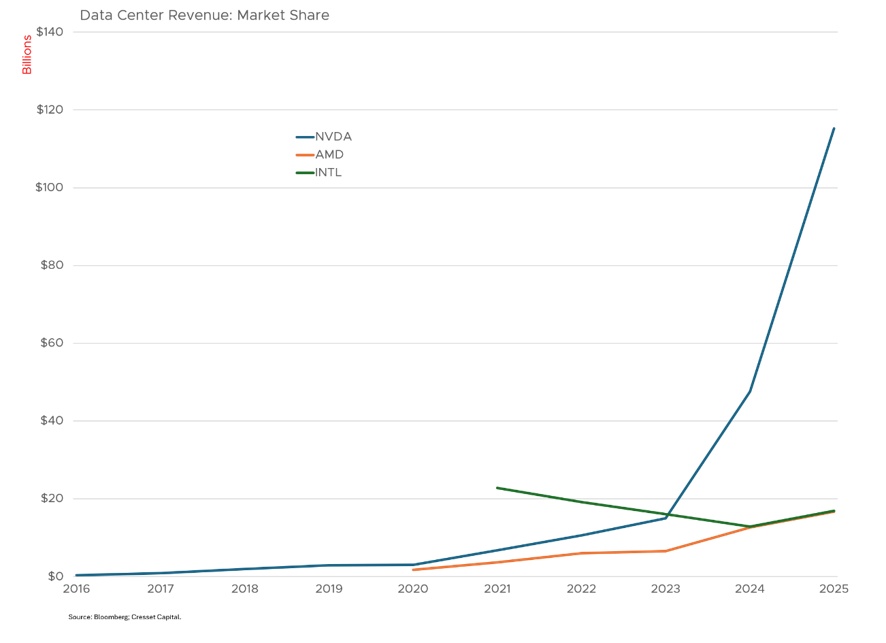
Concerns that NVIDIA’s market share has already peaked continue to weigh on its valuation multiple. Investors worry that hyperscalers, including Amazon, Google, Microsoft, and Meta, are accelerating development of their own custom AI chips, while AMD, Broadcom, Marvell, and upstarts such as Cerebras represent more immediate competitive threats on the other end of the supply chain. Bulls argue that NVIDIA has a powerful system-level moat that is difficult for any single custom chip to replicate. Its advantage extends beyond the chip itself to the broader system and software layer, an important distinction given the significant passive and thematic exposure tied to NVIDIA.
The Open-Source Challenge
Investors are tracking the narrowing gap between open-source and closed-source large language models, since it cuts across issues. Chinese labs including DeepSeek, Z.AI, and Moonshot AI have leaned on distillation and efficiency techniques such as mixture-of-experts with a fraction of the high-end chip access available to U.S. rivals. Now, it appears that China’s open-source models are only a few months behind their American competitors. Anthropic accused some developers of large-scale distillation of its models, and OpenAI’s leadership has separately warned that freely available open-source systems, many built in China, raise the risk of persistent AI-driven cyberattacks as their capabilities approach the frontier.
NVIDIA, meanwhile, sits at the center of the Western response. NVIDIA CEO Jensen Huang’s public case for open-source American leadership is all aimed at preventing Chinese open models from becoming the default choice for developers worldwide. For NVIDIA, the open versus closed debate matters less for near-term chip demand, since open-source models are trained on the same GPU infrastructure as closed ones. The issue is where pricing power ultimately accrues across the AI stack, and the risk worth watching is that a fully commoditized, price-competitive open weight layer eventually favors cheaper, more specialized inference silicon over NVIDIA’s higher-margin general purpose GPUs.
What To Watch on the Call
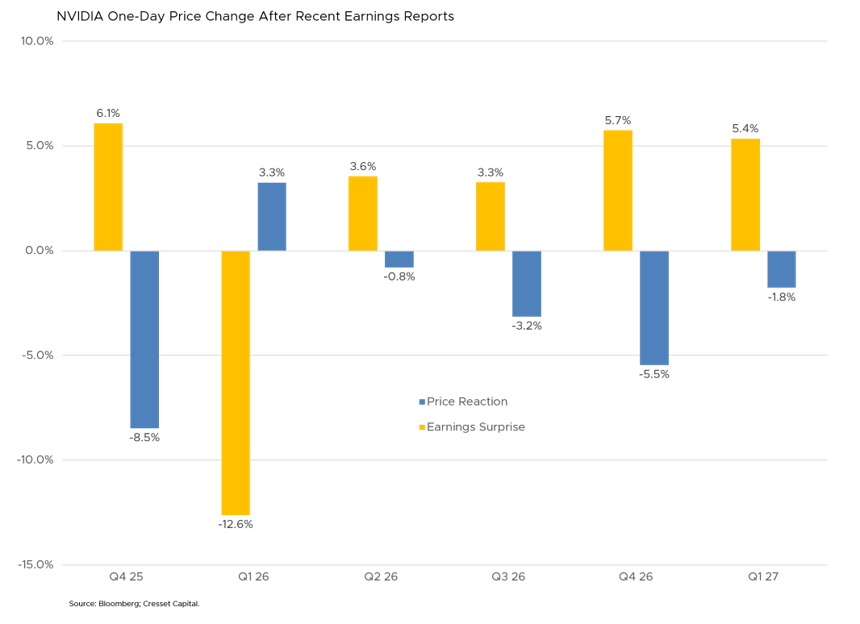
When it comes to NVIDIA’s earnings, perfection is the new consensus. Investors should focus on total revenue relative to the roughly $92.1 billion consensus and whether the beat approaches the upper end of Wall Street’s most bullish scenarios near $94 to $95 billion. The composition of data center revenue between hyperscale and the broader enterprise category will matter as much as the headline number, as investors look for the company to diversify its revenue sources. Q3 guidance, with consensus near $104 billion, will likely be the single most important figure on the call given how much of the recent debate has shifted toward forward visibility rather than trailing results. Gross margin trends deserve close attention as the Rubin ramp begins, along with any update on the pace of the $80 billion buyback authorization and the company’s broader capital return posture. Management’s tone on circular financing arrangements, its recent string of investments and licensing deals, and backlog relative to supply will all shape how the market interprets the durability of demand into next year. Given recent history, investors should also brace for the possibility that even strong results produce a muted or negative stock reaction, particularly if guidance merely meets rather than clears elevated expectations.
Bottom Line
NVIDIA’s outsized weight in the S&P 500 means this week’s earnings report functions as a proxy for investor conviction in the entire artificial intelligence buildout. The fundamental story, characterized by an expanding total addressable market, a defensible system-level moat, and broadening demand beyond a small number of hyperscalers, remains intact in our view, and a forward valuation well below its five-year average multiple provides some cushion. At the same time, the bar for a positive stock reaction has risen considerably, as the recent run of triple plays followed by down days makes clear, and newer concerns around circular financing, an increasingly aggressive acquisition and investment strategy, and expanding regulatory exposure deserve genuine scrutiny rather than dismissal. We would treat any post-earnings weakness driven by valuation digestion, rather than a deterioration in the underlying demand picture, as a buying opportunity within a diversified technology allocation. Investors should resist the temptation to make outsized portfolio decisions based on a single quarter’s stock reaction and instead focus on whether the structural drivers of AI infrastructure spending remain in place.