Key Observations
- Elevated real yields have improved the investment case for TIPS.
- Current breakeven inflation rates may underestimate persistent inflation risks.
- Real yields and breakeven inflation should guide TIPS investment decisions.
- Shorter-duration TIPS may offer attractive inflation protection with less interest-rate risk.
- TIPS can outperform nominal Treasuries if inflation remains above market expectations.
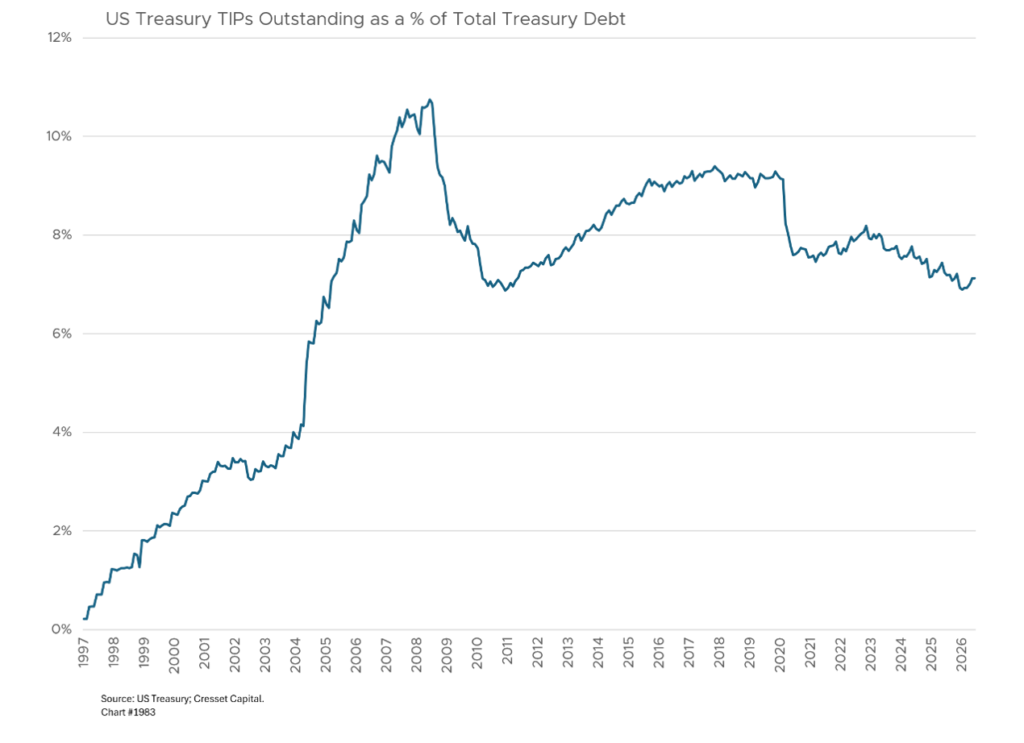
Treasury Inflation-Protected Securities (TIPS) have a singular economic function: to transfer inflation risk from the bondholder to the U.S. Treasury. Unlike conventional Treasuries, whose principal and coupon remain fixed in dollar terms, TIPS principal adjusts upward, or occasionally downward, with the Consumer Price Index (CPI). While yields on fixed-rate Treasuries comprise a real rate and inflation expectation, TIPS create a clean separation between two distinct risks: the risk that real interest rates move unfavorably versus the risk that inflation deviates from market expectations.
Understanding the TIPS Framework
The analytical framework for TIPS rests on two pillars. First, the real yield, or the inflation-adjusted return locked in at purchase. This signals the attractiveness of TIPS independent of inflation forecasting. A 10-year real yield of 2.4% means an investor should expect to earn 2.4% annually above inflation over the next decade. The TIPS real yield is a tangible return that does not require being right on CPI.
Second, the breakeven inflation rate, calculated as the gap between nominal Treasury yields and TIPS yields. The breakeven rate implies the market’s implicit inflation forecast over the maturity horizon. A 10-year breakeven of 2.3% means nominal and TIPS holders break even if average inflation over the next decade runs at 2.3%. If realized inflation exceeds that rate, TIPS win. If it falls short, nominal Treasuries win.
Duration and maturity structure matter. Short-duration TIPS offer minimal interest-rate risk and faster principal adjustment to current-quarter CPI prints, making them suitable for investors seeking near-term inflation protection. Intermediate TIPS represent the benchmark segment, balancing liquidity and interest-rate sensitivity. Long-duration TIPS, like their fixed-rate counterparts, carry substantial price risk if real yields rise, but offer high absolute real yields for patient capital. A complete framework demands matching maturity to the investor’s time horizon and inflation thesis
The Risks Behind the Inflation Protection
The TIPS framework also requires acknowledging tail risks, most notably the prospect of deflation, although bondholders enjoy a par floor. Second is real-yield expansion, which compresses TIPS prices even if CPI is supportive. Real yield expansion is an equal risk for fixed-rate Treasury holders as well. Lastly, liquidity constraints during market dislocations are a consideration, although Treasury obligations are the most liquid credit instruments. TIPS are not risk-free; holders trade real-yield risk for inflation risk.
Taxes are another consideration. TIPS carry unique tax implications that merit careful analysis, particularly for municipal bond investors considering TIPS. Munis typically offer federal tax exemption, while TIPS coupon interest is fully subject to federal taxation. Phantom income is another problem inherent to TIPS. As the principal adjusts upward with CPI each quarter, that adjustment is treated as taxable income in the year it occurs, even though the cash is not received until maturity. In an environment where inflation runs 3.4% annually, a TIPS investor holding a $100,000 position receives approximately $3,400 of phantom income per year.
This mismatch, taxable income without corresponding cash flow, can create significant cash-flow friction for investors subject to high marginal tax rates. The problem reverses itself in deflationary years. Principal adjusts downward, creating negative phantom income that cannot offset other gains. For investors considering selling municipals to buy TIPS, the analysis should isolate the after-tax real yield of TIPS against the tax-exempt yield of munis.
Higher Real Yields Strengthen the Case
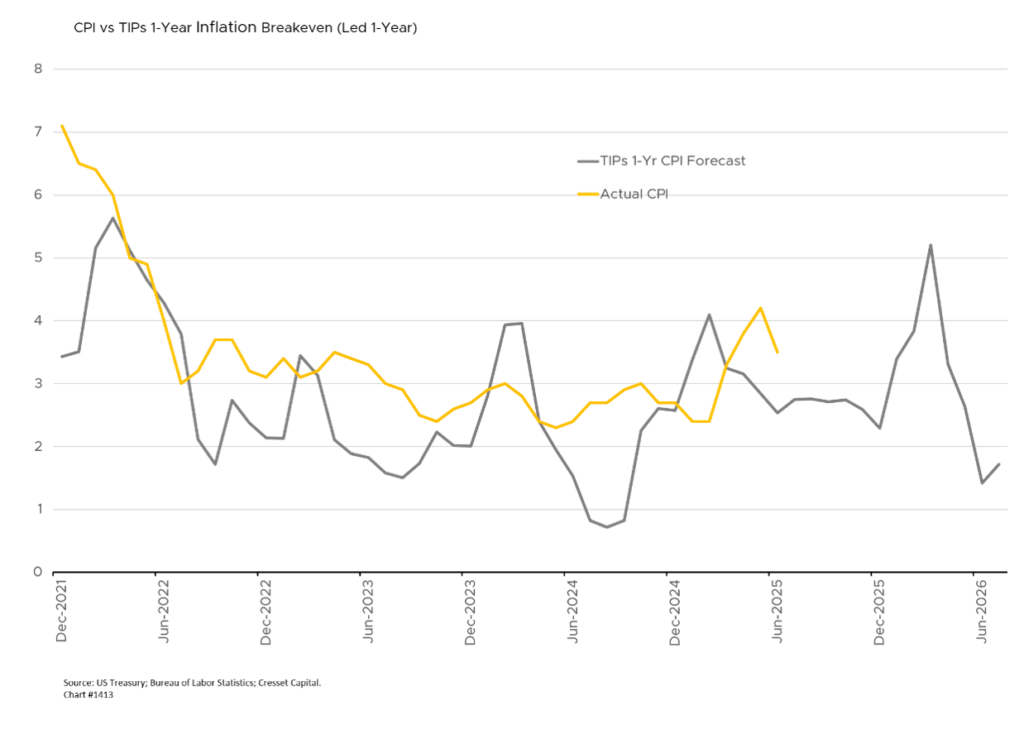
The inflation backdrop has shifted materially over the past 18 months. Headline CPI peaked at 4.3% year-over-year in May 2026, retreating modestly to 3.5% by June, with consensus estimates holding near 3.4% through the remainder of 2026. These readings sit 130 to 180 basis points above the Federal Reserve’s 2% target, indicating structural elevation rather than transitory volatility. Tariffs, labor-market stickiness, and supply-side constraints appear to underpin this persistence.
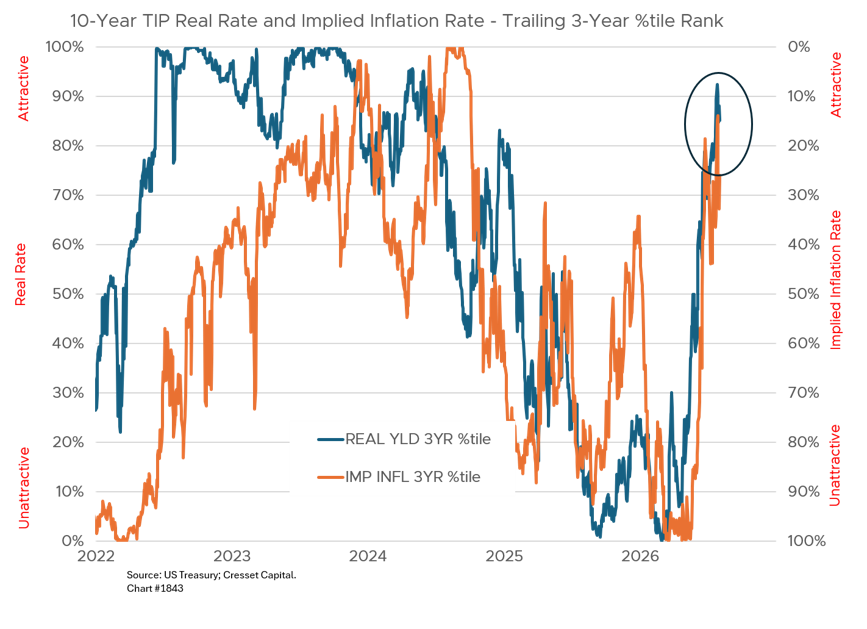
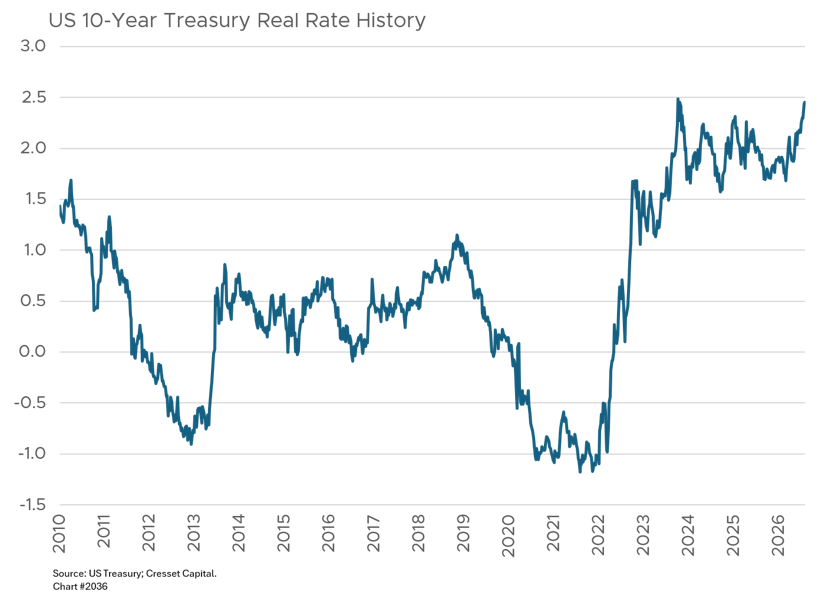
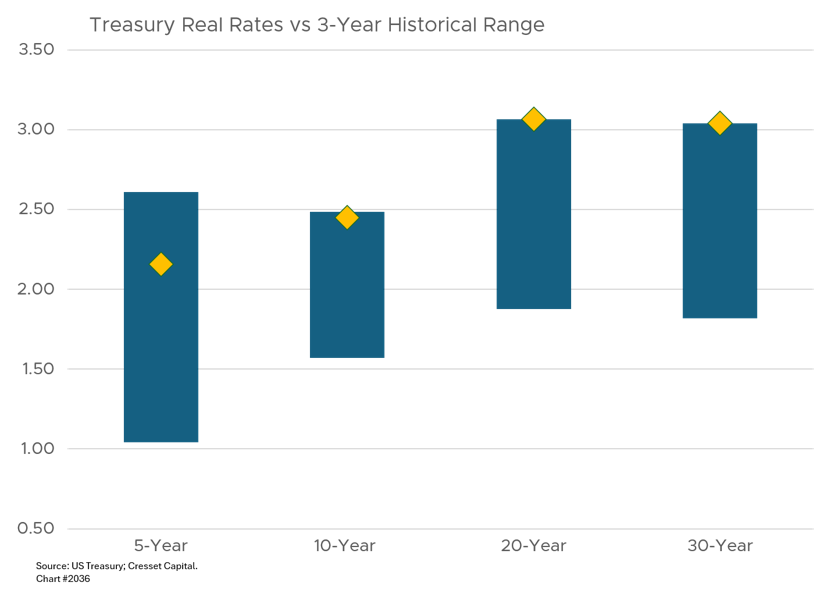
Against this backdrop, real yields have shifted sharply higher. The 10-year TIPS real yield now stands at 2.4%, near a 36-month peak, having surged 78 basis points since September. The 5-year sits at 2.2%, and the 30-year at a particularly elevated 3.0%. This reset represents one of the most important technical developments in fixed income markets this year. For investors entering today, these real yields suggest a meaningful inflation-adjusted return regardless of whether CPI stays at 3.4% or recedes toward the Fed’s 2% target.
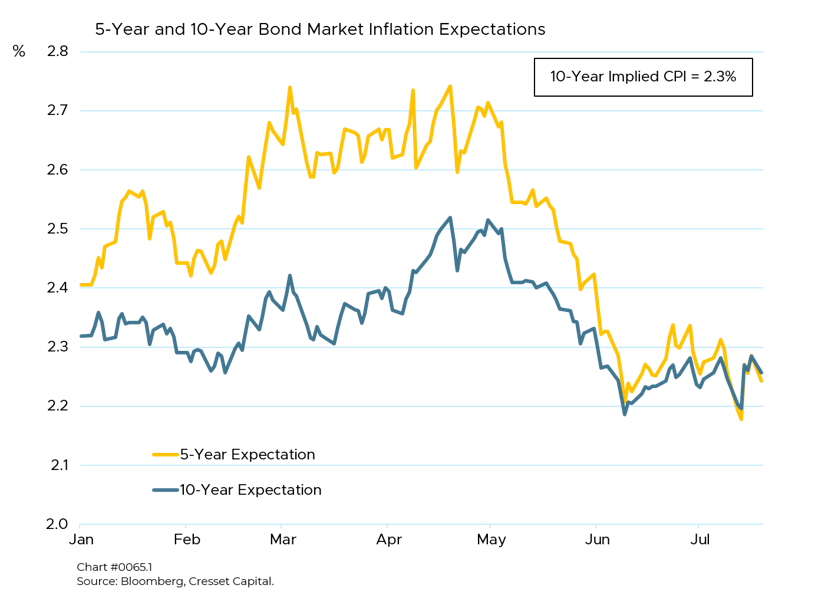
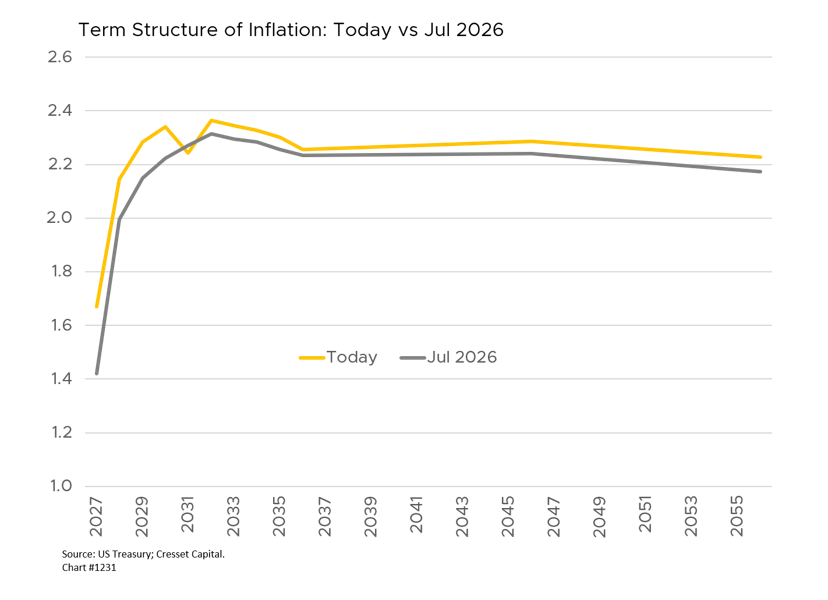
Breakeven inflation rates, however, have not risen in tandem with real yields. The 5-year and the 10-year TIPS breakeven have converged to 2.3%. The horizontal inflation curve is striking and suggests that after a period of above-target inflation, CPI will normalize toward 2.3% on a multi-year average. This view stands somewhat at odds with current conditions.
When TIPS Can Outperform
Herein lies the core relative-value case for TIPS. When a fixed-rate Treasury investor buys today’s 4.7% yield, they’re assuming that inflation will average 2.3% over the next decade, the current 10-year breakeven rate. A TIPS investor, by contrast, locks in a 2.4% real yield and receives principal adjustment equal to whatever inflation actually occurs. If inflation averages 3.4% instead of 2.3%, the TIPS holder captures approximately 112 basis points of additional principal growth that the nominal Treasury investor forfeited when rates were priced for lower inflation.
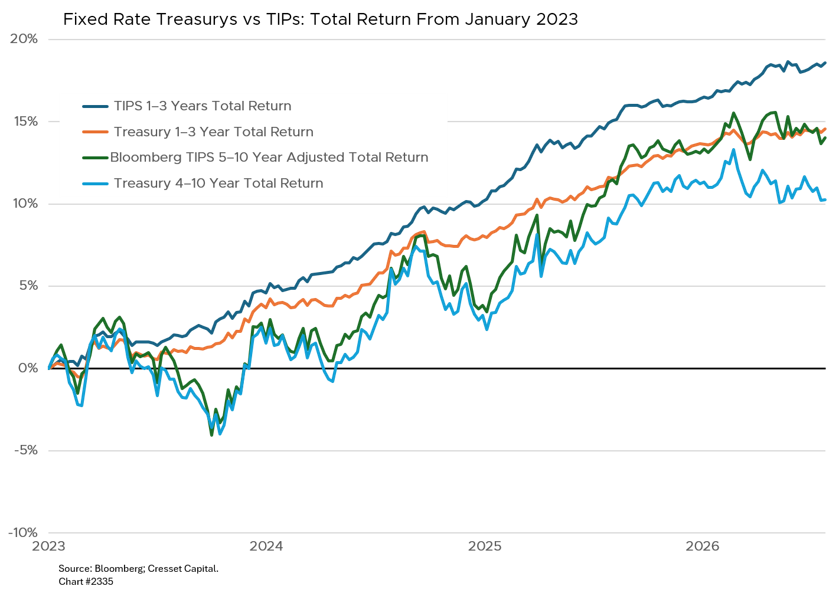
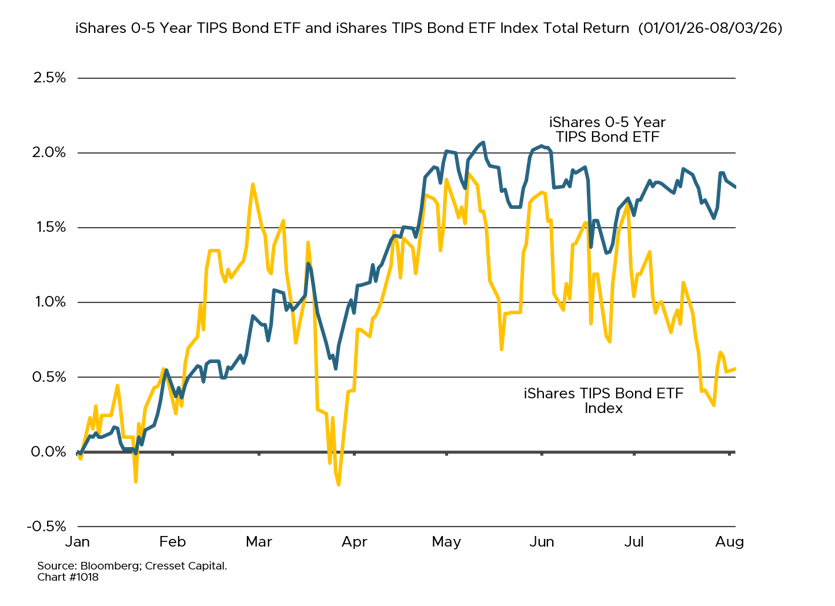
Recent TIPS-fund performance reinforces this dynamic. The iShares 0-5 Year TIPS ETF has returned 1.8% year-to-date, outperforming the longer-duration iShares TIPS Bond ETF, which has returned just 0.58% year-to-date. The underperformance of longer-duration products reflects their exposure to rising real yields, which compress prices. Short-duration TIPS, by contrast, have benefited from the front-loading of inflation accrual while avoiding the price drag of duration extension.
What Could Challenge the TIPS Thesis
The bull case for TIPS depends on two assumptions. One, inflation remains elevated for multi-year horizons, and two, real yields do not expand further from here. Neither is assured. If the Federal Reserve’s restrictive stance proves sufficient to anchor inflation expectations, and if supply-side headwinds fade faster than expected, CPI could decelerate toward 2.5% or below. In that scenario, the 2.3% breakeven would look prescient, and fixed-rate Treasury holders would be rewarded for their inflation skepticism.
Rising real yields also pose a risk for both TIPS and fixed-rate Treasury investors. The 80-basis-point rise in the 10-year real yield over ten months was driven by supply factors, as well as a recalibration of inflation expectations. Several developments could push real yields higher, including tighter financial conditions, growing concern over the fiscal deficit, or a shift in the Fed’s forward guidance. A 50-basis-point move in the 10-year real yield would produce roughly a 5% price decline on both 10-year TIPS and fixed-rate positions.
Bottom Line
TIPS make compelling sense for investors today, but with important maturity guardrails. Today’s 10-year real yield of 2.4% represents a meaningful inflation-adjusted return that compensates for duration risk, and the 2.3% breakeven inflation rate appears overly optimistic relative to recent inflation experience and near-term forecasts. If inflation remains sticky above 3%, a reasonable base case given structural supports, TIPS will outperform nominal Treasuries by the margin of excess inflation. A 5- to 10-year TIPS allocation, preferring shorter-duration instruments to minimize real-yield risk, positions a portfolio for both resilience if inflation persists and reasonable downside protection if unexpected disinflation emerges.
The primary scenario under which TIPS underperform is one in which CPI decelerates rapidly toward 2%, validating the market’s optimistic mean-reversion assumption. This requires either significantly restrictive Fed policy causing demand destruction, or a substantial improvement in supply-side dynamics. Neither is implausible, but neither is the base case. Until inflation data forces a reappraisal of structural conditions, TIPS offer asymmetric value.