
Key Observations
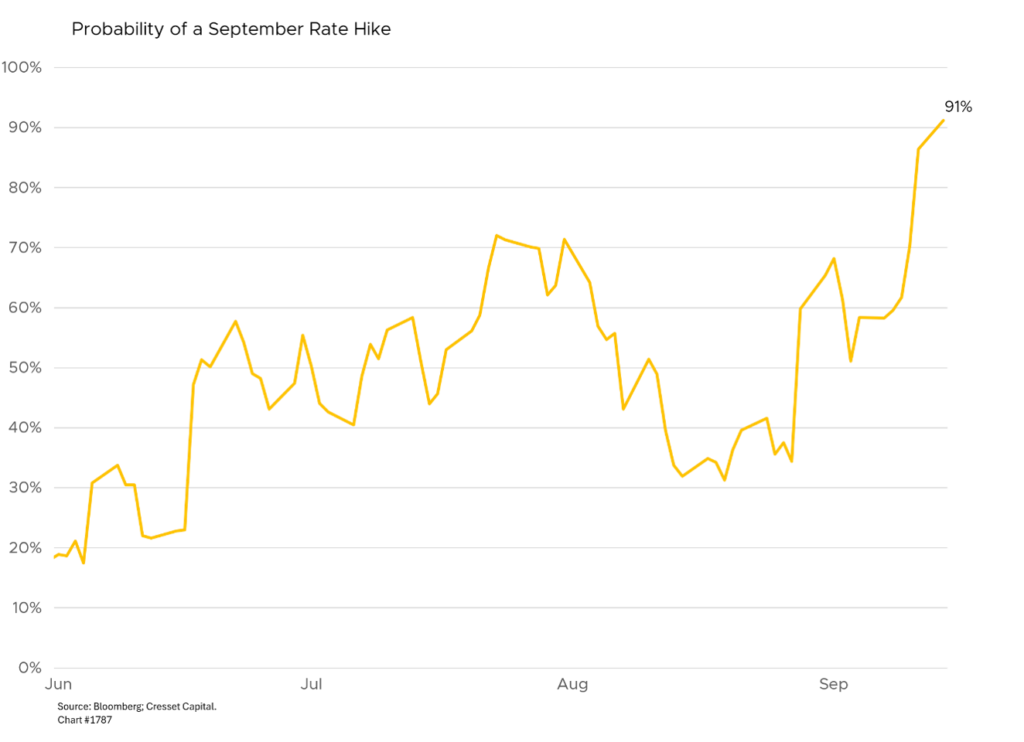
- Markets are pricing roughly a 90% chance of the Federal Reserve raising rates for the first time in three years, even as political pressure for a rate cut intensifies.
- Inflation remains above target, but today’s pressures are increasingly supply-driven, with higher energy costs and AI infrastructure demand contributing to price pressures that monetary policy is poorly equipped to address.
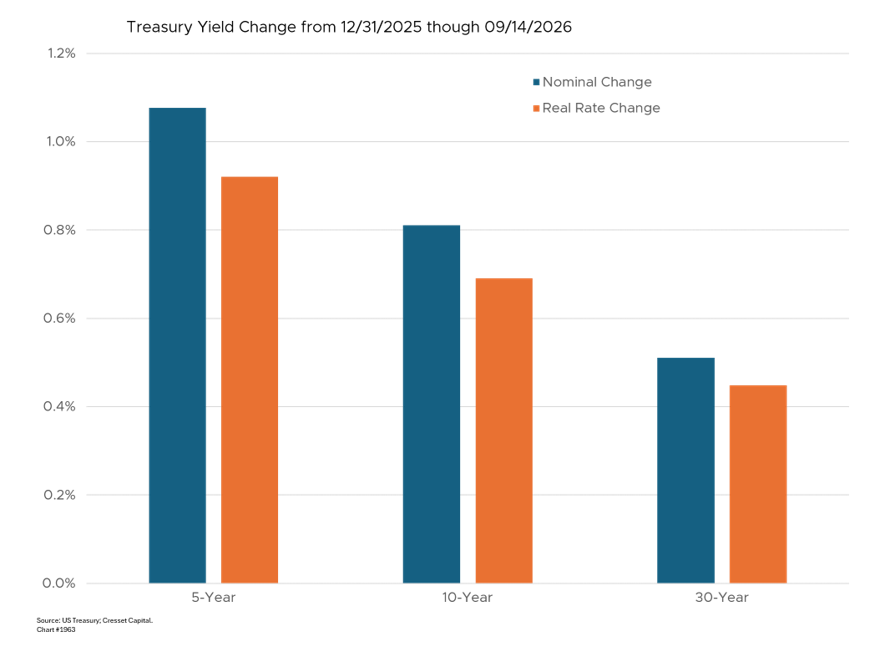
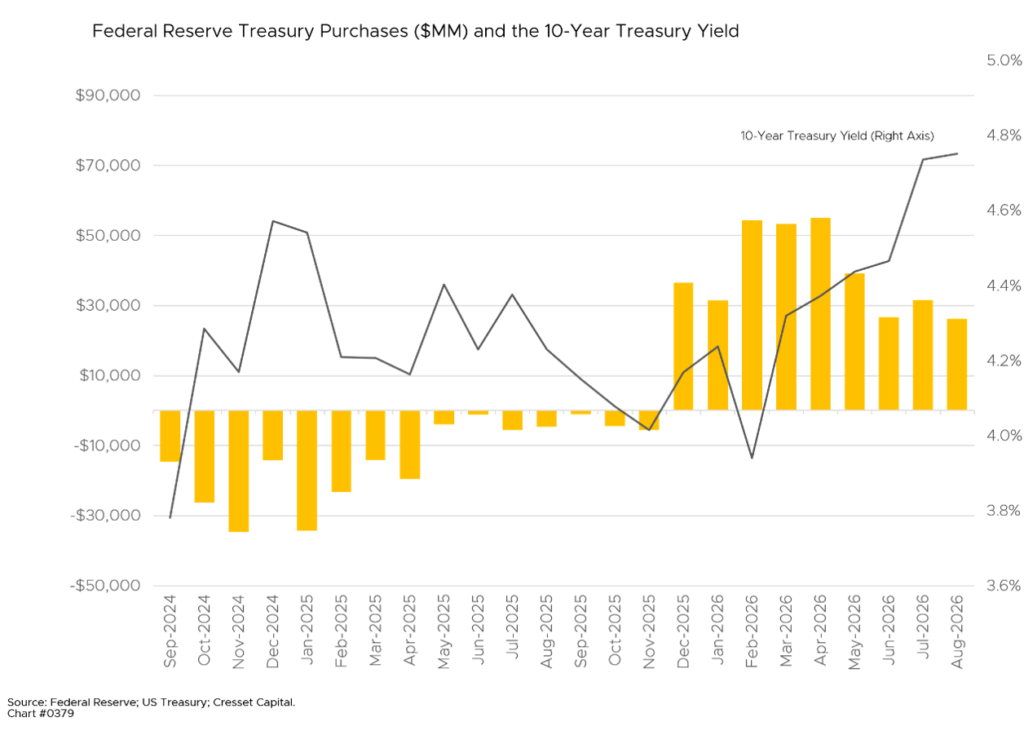
- The bond market has already tightened financial conditions, with the 10-year Treasury approaching 5% and the 30-year near a two-decade high.
- August payrolls remained solid while wage growth cooled, but underlying labor data show growing disparities, particularly for recent college graduates and degree holders.
- Warsh faces a credibility test after signaling that persistent inflation would require action, while political pressure and a divided FOMC complicate the path forward.
- Investors should favor shorter-term maturities while the term premium remains elevated, with energy exposure providing a potential hedge against persistent supply-driven inflation.
Kevin Warsh walks into Tuesday’s meeting with markets pricing a roughly 90% chance of the Federal Reserve hiking rates for the first time in three years. The decision, which should be straightforward, is anything but. President Trump is publicly demanding a rate cut, the FOMC is fractured, and today’s inflation problem is one that monetary policy is poorly equipped to solve.
Supply-Side Pressures Keep Inflation Elevated
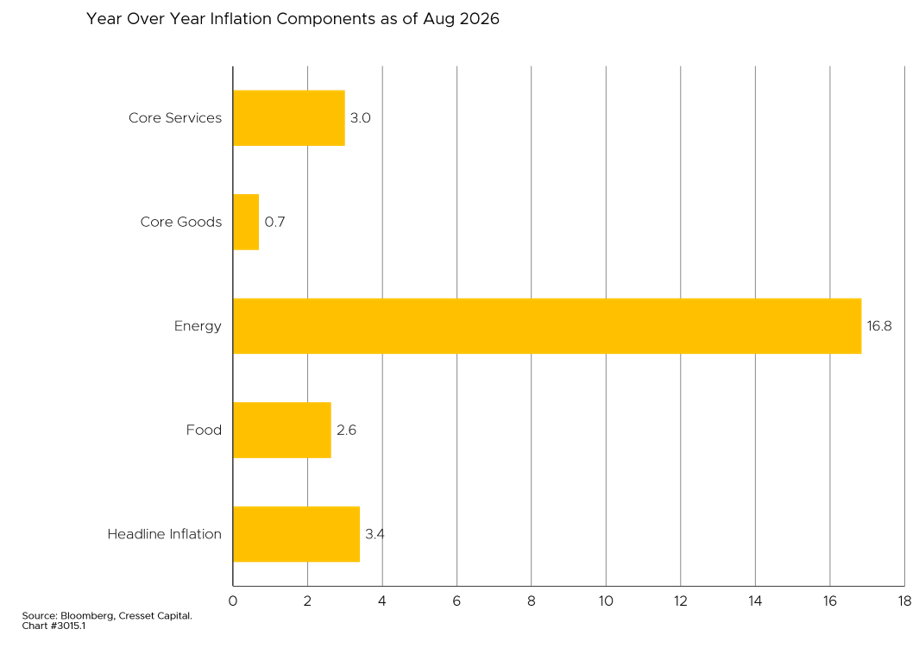
August CPI held at 3.4% year over year, with core at 2.4%. August’s 0.3% core rate ran well above consensus, with fuel alone accounting for more than a third of the 0.4% monthly headline advance. Meanwhile, the Fed’s preferred PCE gauge sat at 3.7% in July and has been above the monetary authority’s 2% target for more than five years.
Today’s inflationary impulse has been fueled by supply constraints, not excess demand. Brent crude has surged from the low $80s in August to more than $100 now, most recently driven by the Houthi capture of Mokha, the effective closure of the Strait of Hormuz, and the shutdown of the Saudi East-West pipeline. Diesel topped $6 a gallon for the first time. At the same time, AI infrastructure is absorbing power, labor and capital. A quarter-point increase in the funds rate will not reopen a shipping lane or add a gigawatt of generation.
However, the central bank cannot look through a fifth consecutive year of above-target inflation without risking the expectations anchor. Six years of “transitory” supply shocks is simply inflation.
The Bond Market Has Already Tightened
The 10-year, at 4.97%, is sitting on the precipice of 5%, its highest level since 2023. The 30-year, meanwhile, is at 5.35%, near a two-decade high. Financial conditions have tightened materially without the Fed lifting a finger.
Doves argue an additional hike is redundant and risks overtightening into an economy where Q2 GDP grew at a tepid 1.5%. Hawks claim the long end is rising because the market doubts the Fed’s resolve, and a hike is the fastest way to bring long-maturity rates lower.
The Labor Market Is Sending Mixed Messages
August payrolls printed a blowout 162,000 with unemployment steady at 4.1% and wage growth decelerating to 3.1%, the slowest since 2021. The combination of solid job creation and cooling wages is close to an ideal supply-side outcome and removes the obvious objection to tightening.
The household survey, however, reflected broader pessimism. While household employment has fallen and participation has slipped, the U-6 underemployment rate, at 7.7%, has stopped improving. Warsh’s own Jackson Hole framing described employment as consistent with the Fed’s mandate, which is a way of saying the labor market is not the binding constraint. Inflation is.
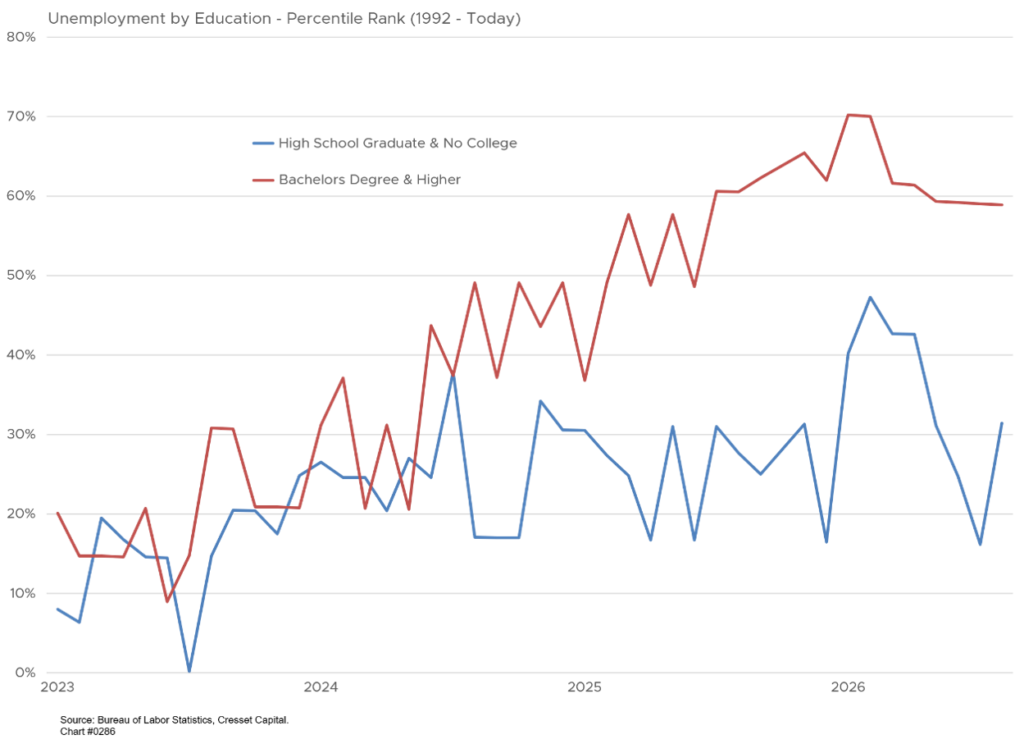
Beneath the aggregate, recent college graduates are facing an uncertain job market in the shadow of AI adoption. Unemployment for workers aged 22-34 without a degree is near the low end of its relative unemployment range, while the same cohort with degrees is faring worse than at almost any point since the post-2009 recovery, with STEM and advanced-degree holders the worst off. August’s payroll composition told the same story, with food services and drinking places supplying 59,000 of the 162,000 jobs added. The drivers are structural rather than cyclical. Retiring tradespeople and reduced immigration have shrunk the supply of manual and in-person labor just as AI absorbs the entry-level white-collar work that typically employs new graduates. Wage pressure is now concentrated in the sectors least responsive to interest rates, reinforcing the supply-side read on inflation and weakening the case that tightening will do much about it.
The Fed’s Credibility Is on the Line
At Jackson Hole, Warsh said underlying inflation had not meaningfully improved and that the Fed would have “work to do.” Markets took that as a conditional commitment, inferring hot inflation data equals a hike. Last week’s CPI report came in hot. Investors are now looking for Warsh to follow through, because the market reaction to holding rates steady could be severe.
Trump reiterated on Sunday that the U.S. should have the world’s lowest rates. Kevin Hassett signaled wariness about hiking on this data and argued the Fed should stay clear of elections. The midterms are seven weeks away and will decide control of Congress.
Warsh was nominated by the president and is four months into the job. Trump has pre-emptively blamed a hostile FOMC rather than Warsh himself, which conveniently gives both men an out. It appears Warsh is leaning on a committee majority and is leading from behind. A Fed perceived as deferring to the White House could face a higher inflation risk premium for years.
Balance Sheet Policy Creates Treasury Friction
Warsh’s balance-sheet views are the most underappreciated risk in this meeting. Long before his nomination, he argued that the Fed’s bond holdings blurred the line between monetary and fiscal policy. By suppressing yields, Warsh argued that the central bank effectively financed congressional overspending. He has been explicit that short-term rates, not the balance sheet, should be the primary instrument. In practice, that means shrinking the Fed’s balance sheet, which still stands near $6.3 trillion, comprising $4.3 trillion in Treasuries and $2 trillion mortgage-backed securities, against a pre-2008 peak of $4.25 trillion, and shortening its average maturity toward bills while letting MBS run off.
The obstacles are real. Quantitative tightening only ended in December 2025, and both prior tightening episodes ended with funding-market stress that forced the Fed to buy Treasuries again. But a chair who wants a smaller footprint and a Treasury secretary buying back long bonds to cap yields are working at cross purposes, and any language Wednesday on reinvestment or composition will move the long end more than the 25 basis-points will.
Bottom Line
There are three risks investors are willing to take in exchange for yield in the income markets: interest rate risk, credit risk, and illiquidity risk. We favor credit risk and illiquidity risk, preferring shorter-term maturities until the term premium stabilizes. We also favor maintaining energy exposure, which comprises about 4% of the S&P 500, as a hedge against the risk that the Fed is fighting the wrong war.