

Key Takeaways
- Persistent inflation may prompt the Federal Reserve to continue raising interest rates, even as the broader economy remains resilient.
- Higher borrowing costs are likely to affect households and businesses unevenly, with affluent consumers better positioned to withstand additional rate hikes.
- Historically, equities have delivered positive but more modest returns during Fed tightening cycles, with higher rates placing pressure on valuations.
- Elevated Treasury yields are making high-quality bonds more competitive with equities, offering income potential and diversification benefits.
- A prolonged period of higher rates may favor companies with strong cash flows, durable margins, and less dependence on refinancing.
- Disciplined portfolio construction and greater selectivity remain important as investors navigate tighter monetary policy and shifting market conditions.
Martin Zweig’s Winning on Wall Street easily makes my top 10 list of favorite books on markets. In it, he gifted investors four words that have served me well throughout my career: “Don’t fight the Fed.” I’m returning to them now because I expect the US inflation problem to require more aggressive hiking and higher interest rates for longer. I anticipate a three-pronged scenario where the Fed keeps hiking, the economy holds up, and markets stay resilient, albeit with lower returns and less room for error.
The Fed raised rates for the first time since 2023 in September and then held in October. Meanwhile, inflation hasn’t cooperated, with consumer prices rising 0.4% in October, seasonally adjusted, and core prices increasing 0.3% for a third consecutive month. Before its next meeting on December 9, the Fed gets scant new inflation data, highlighted by the October PCE, its preferred measure, and a University of Michigan inflation expectations report. Against that backdrop, I expect the meeting to bring the next of at least three rate hikes.
Strength Meeting Strength
Higher interest rates don’t necessarily mean a recession is coming. Growth concerns will likely emerge, but rates hit the economy with variable and unpredictable lags and affect borrowers unevenly. The first to feel the pinch are borrowers who reprice quickly: households carrying credit card balances, buyers financing cars, and small businesses on floating-rate bank loans. Interest-sensitive spending slows first and most.
The top of today’s K-shaped economy is a different story. Many wealthy households have locked in low fixed-rate mortgages, carry little floating-rate debt, and hold large cash balances. For them, higher rates can be a raise. T-bills and money funds pay more, so a hike can add to income and support spending. Interest income earned by households in the US has grown from approximately $1.5T annually in 2020 to approximately $2.5T today.
That is the optimistic case, and it is also why I expect the Fed to do more. A resilient top of the K keeps the economy growing and blunts each hike, so the Fed must push harder to get the same result. The strength that invites more hikes is the same strength that should let the economy absorb them.
Positive Returns, Thinner Margins
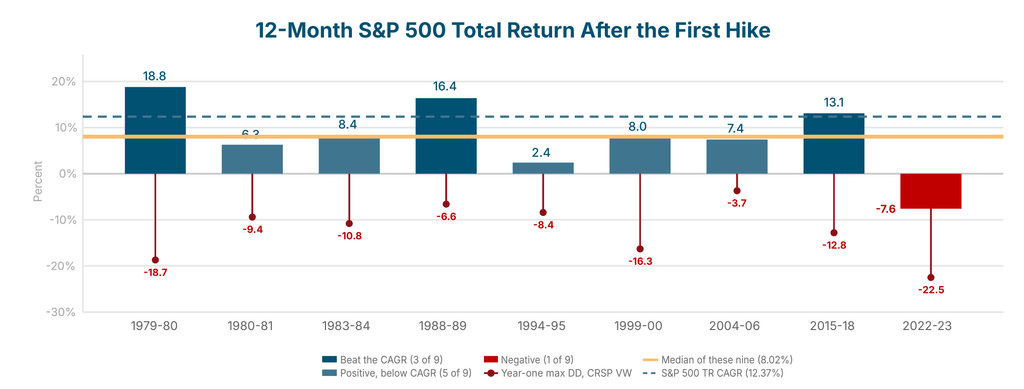
The economy is separate from the stock market, and history shows why “Don’t fight the Fed” matters to investors. Across nine tightening cycles since 1979, the median stock return was +8.0% in the 12 months after the first-hike month, compared with +12.4% across all rolling 12-month windows. Stocks still rose; they just earned about a third less, as earnings typically kept growing while P/E multiples compressed.
During that span, the average maximum drawdown was 10.8%. Rate-sensitive stocks took the brunt, with consumer durables lagging the market in eight of nine cycles.
Safe assets became real competitors. Treasury bills averaged +5.5% and beat stocks in 4 of 9 cycles. Today the opportunity is better further out the curve: with the 10-year Treasury yield above 5% and real yields near 3%, high-quality bonds offer income that cash may not hold once the Fed is done. They also bring something cash can’t: a hedge if growth slows. Higher safe yields raise the bar for risk-taking.
Stay Invested, but Raise the Bar
Positive returns have been common across hiking cycles, so I would still favor equity exposure with lower expectations and higher standards. I prefer businesses that generate cash today, defend margins, and self-finance through a long tightening cycle. Concentration matters too: a few S&P 500 companies drive most earnings growth. Broadening into equal weight, value and international stocks, plus commodities as an inflation hedge, holds the portfolio to that higher bar.
I would scrutinize expensive promises of distant earnings and businesses dependent on repeated refinancing. Private equity faces that test plus its own refinancing problem. Real estate’s problem is whiplash: each shift in rate expectations has stalled deals and price discovery, leaving values below 2022 peaks. That favors disciplined lenders and patient, well-capitalized buyers. Private credit’s floating-rate loans pay more, if borrowers can carry the cost. Every holding gets one question: does it need lower inflation, cheaper borrowing, or faster growth to work?
I expect the Fed to keep tightening. The economy can take it and stocks can too, at lower returns with less room for error. Don’t fight the Fed. Own assets built to fight through higher rates.