


Key Takeaways
- Investors are increasingly questioning whether AI’s long-term potential can justify the significant capital required to support its growth.
- Rising capital expenditures and negative free cash flow are creating greater scrutiny from equity investors and bondholders alike.
- Companies with strong balance sheets, durable cash flows, and credible paths to profitability may be better positioned as financing becomes more selective.
- Even businesses experiencing strong AI revenue growth could face valuation pressure if reinvestment requirements limit shareholder returns.
- The next phase of AI investing may favor companies that can translate technological capabilities into sustainable cash flow.
I love AI. I do not love the business model. Those have always been two different judgments, and the market is finally separating them.
In recent weeks, technology companies have been punished for spending plans investors once celebrated. Is this the AI bubble popping? That is too early to call. What I see is more specific: a clear-eyed reckoning with the capital required to keep the story going. For most of the AI buildout, equity investors were dreaming the dream. Bigger commitments read as evidence of bigger opportunities: more chips, more data centers, more power. Now investors are asking what shareholders actually earn on all that capital.
They have company. Tuesday’s midterms capped a campaign in which data centers showed up in ads from both parties, and voters sounded a lot like bondholders: show me who pays.
The market still believes in AI’s potential, but it is repricing its willingness to finance that potential without proof.
Enter the tech bond vigilantes.
The financing window remains open, but lenders have drawn a line where capital budgets push a company into negative free cash flow. Past that line, operations no longer cover the buildout, and something has to give: cash reserves, asset sales, outside capital, or spending.
This balance-sheet tension is where the equity story and the credit story collide. Equity investors own the upside, so they can afford to dream. A bondholder’s best case is simply getting paid back, so they underwrite the downside. Capital spending consumes cash today; the returns arrive later, if at all. Equipment depreciates, technology evolves, and competition can push prices down before the investment earns its keep. Revenue growth alone cannot settle whether the economics work for shareholders.
A company can have a growing AI business and still deserve a lower valuation. If more of its cash must be reinvested to stay competitive, less is available to shareholders. If the eventual return is harder to underwrite, investors should demand more to bear it.
Capital Reined In
I read this shift as the start of capital rationing, where financing becomes conditional. Strong balance sheets, durable cash flows, and credible paths to monetization should keep access on better terms. Weaker businesses face a higher price, tighter conditions, and smaller checks.
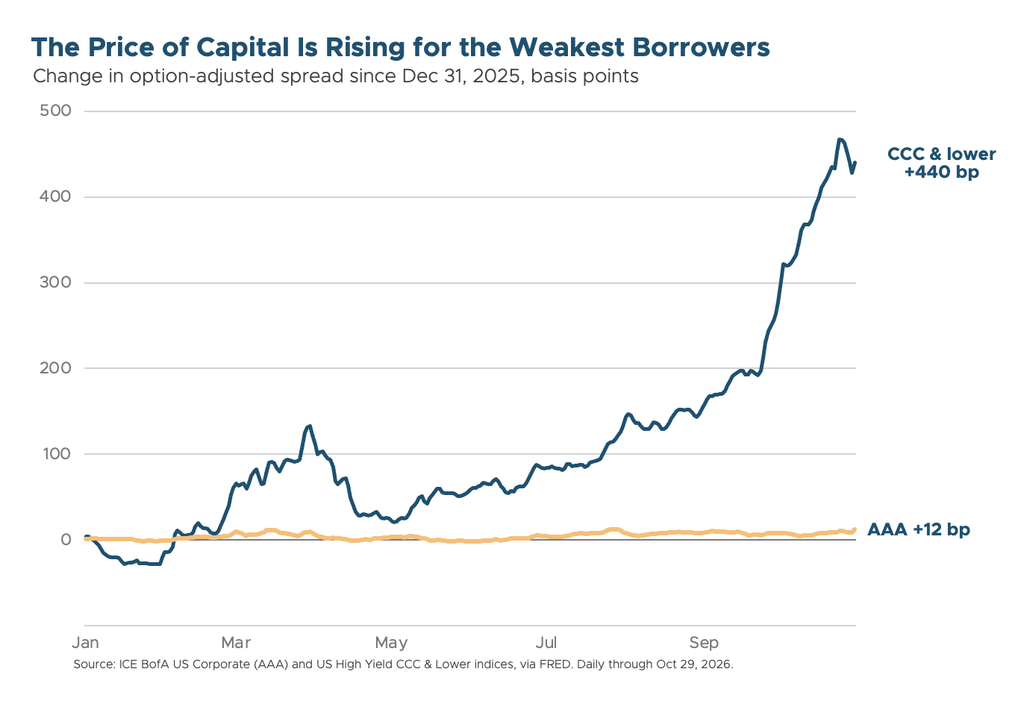
The question has shifted from “How big can AI become?” to “Prove to me the next dollar should be spent.”
AI’s profit pool may still surprise, and a rationed buildout may earn better returns on what gets built. Dreams have no ceiling. Budgets do. Once financing has an upper bound, so does the buildout, and so do the earnings the market can underwrite. The valuations currently at risk assumed abundant financing and extraordinary profitability, with little friction between the two.
The Cash Flow Filter
For investors, the result is greater dispersion and heightened volatility. Their job now is to distinguish companies that can build profitable businesses on AI from those that may lose fortunes building its infrastructure. Some builders will win, and some users will lose. What matters is who captures the value, who bears the cost, and who has the balance sheet to survive the gap.
The filter comes down to three traits: free cash flow that funds AI internally, thin margins that AI can widen, and the market position to keep the gains.
I remain enthusiastic about AI. I am much less willing to assume enthusiasm pays the bills. The next phase belongs to companies that can turn capability into cash flow.
Sources: ICE BofA, FRED (Federal Reserve Bank of St. Louis)