

Key Observations
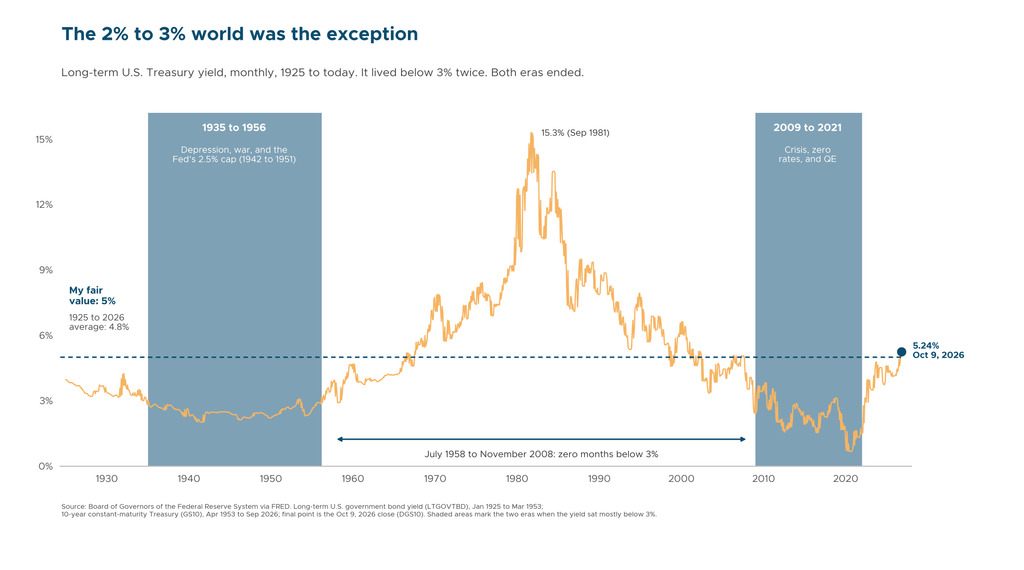
- Higher rates may be here to stay. The low-rate environment of the last economic cycle was an exception, and Joe believes a 5% 10-year Treasury yield is a reasonable level in the current environment
- Inflation remains a challenge. Persistent price pressures could keep the Federal Reserve focused on inflation and interest rates higher for longer
- AI is reshaping markets. Its influence extends across corporate earnings, capital spending, power infrastructure, private markets and expectations for productivity
- True diversification matters. Investors should consider diversifying by sources of return rather than simply owning more assets, particularly when many investments may depend on the same underlying market forces
I am excited to begin my new role at Cresset as Chief Market Strategist. It is an honor to join a firm with such a strong commitment to its clients and thoughtful approach to investing. Over more than three decades in investment strategy, I have navigated a wide range of markets and economic cycles, most recently as Chief Investment Strategist for Blackstone Private Wealth. I look forward to working closely with Cresset’s investment teams and due diligence managers and sharing my perspective on the markets, the economy, and the evolving investment landscape.
At the center of today’s evolving investment landscape are two powerful forces: a new interest rate regime and artificial intelligence. Both represent significant shifts from the last market cycle, with implications for how investors think about risk, opportunity, and diversification.
Higher for Longer is the New Regime
My starting point is that “higher for longer,” or interest rates remaining elevated, is a new regime. The 2% to 3% 10-year Treasury world of the last cycle is unlikely to return. Inflation remains persistently above Fed officials’ targets. Fiscal deficits are larger. Treasury supply matters again. Term premium, the additional return investors demand for holding longer-term bonds, is back. I do not expect the old world to return. In my view, fair value for the 10-year Treasury yield is 5%, roughly the level of nominal GDP in the U.S. (economic growth plus inflation).
Inflation Is Keeping the Pressure On
Inflation is why this regime has legs. September’s consumer price index came in hot, and producer price index, which measures changes in prices that producers receive for goods, showed that upstream cost pressures remain. My base case remains three Fed hikes over the next 12 months. Necessities are rising faster than headline inflation, led by energy, and middle-income households are absorbing the cost. Upper-income households are far less sensitive to rates. Many have locked-in borrowing costs, large savings, and portfolios that earn more as yields rise. The households with the most spending power are not behaving as if interest rates are high enough to meaningfully slow spending. The Fed has to set policy for the aggregate economy, and overall spending in the economy remains too strong.
A 5% 10-year changes the math. It raises the return stocks need to offer to compete for investors’ capital. It creates real competition for capital. It rewards companies with strong balance sheets and durable cash flows. It also gives investors something they did not have for much of the last cycle: income that matters.
AI Is Reshaping the Investment Landscape
The second force is AI. Many of the market’s most powerful themes now trace back to it. Mega-cap earnings, the concentration of market performance across a small number of companies, capital spending, power infrastructure, private market enthusiasm, and productivity hopes all connect to the same story. I believe AI is real. I also believe that when too many roads lead to one place, investors should pay attention.
That is why true diversification matters more now. A portfolio can own a lot of different assets and still carry one source of risk. It can look diversified and still depend on falling rates or continued enthusiasm for one dominant theme.
Diversification Beyond Asset Classes
Portfolios should be diversified by source of return. Dividends can provide income and discipline. Quality can matter more when capital is no longer free. Duration earns a place too, selectively. If the Fed raises rates again, I expect the yield curve to flatten as concerns about future economic growth increase. That is why I would own moderate- to longer-duration, high-quality fixed income: if the Fed ultimately has to slow the economy more aggressively to bring inflation under control, those bonds can provide an important source of diversification. None of these is a complete answer by itself. Together, they can make a portfolio less dependent on one story being right.
Inflation is not done. The Fed is not done. AI is not done either. My goal at Cresset is simple: help clients see the regime clearly, build portfolios, and stay diversified in the ways that actually matter.