COLD OPEN PROMO
Eric Becker
Today’s guest is one of the most fascinating turnaround leaders in retail, anywhere in the world.
James Daunt
I halved the headcount at Barnes & Noble immediately.
Eric Becker
He came in with a radical idea: stop telling stores what to do, and start trusting booksellers to actually sell books.
James Daunt
If you care about books and are interested in books and are vocationally a bookseller, stay with us, and we will teach you and turn you into a good bookseller.
Eric Becker
I’m so excited to have James Daunt, the CEO of Barnes & Noble, on The Long Game.
SHOW OPEN
Eric Becker
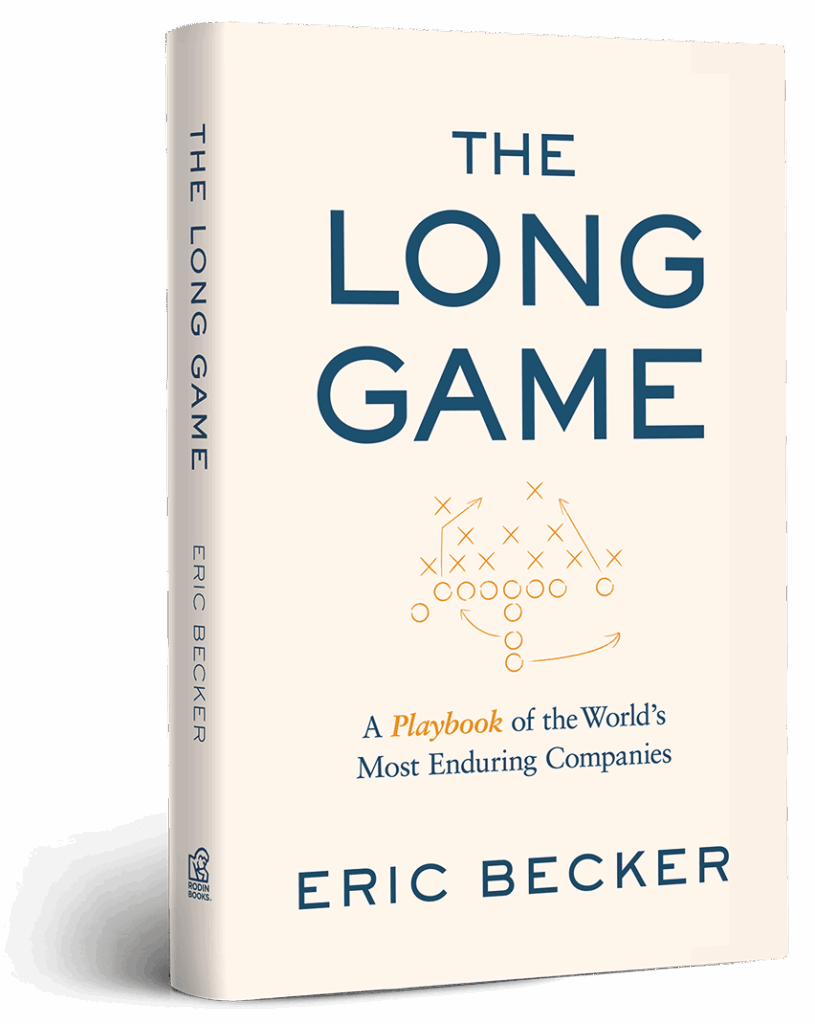
Welcome to “The Long Game Podcast.” I’m Eric Becker. I’m an author, an entrepreneur, and I’m founder and chairman of Cresset, a family office that we built to serve founders, multigenerational business owners, and families.
For all the entrepreneurs and aspiring entrepreneurs, for leaders and CEOs, The Long Game is for you. It’s the practices. It’s the leadership skills. It’s the culture that can stand the test of time.
I’m Eric Becker, and this is “The Long Game.”
INTRO
Eric Becker
Barnes & Noble started as a single New York City bookstore in 1886. It grew to become the largest chain bookstore in the U.S., peaking in 2008 with 726 bookstores. Soon after, though, the mammoth bookseller fell on hard times.
After unsuccessful battles with online giant Amazon, Barnes & Noble was forced to shutter 150 stores.
Many thought the chain was doomed.
That is until a no-nonsense CEO, James Daunt, stepped in. He unleashed a surprise strategy of restoring authority and creative decisions from the bottom up, back to the local bookstores. The chain opened 61 new stores in 2025 and plans to open 60 more in 2026.
James Daunt
In the stores themselves, I think the bookselling teams find what I’m articulating easy to understand and, obviously, from their perspective, sort of quite gratifying, because everything about it seems to be about devolving responsibility to them and giving them, equipping them to do their job better.
In head office, it’s something slightly different, because we have extremely large head offices to impose and manage, which is difficult, with homogeneity across the store fleet. So absolutely, overtly, and immediately and clearly articulated, it was a necessity to remove the majority of the head office functions. You don’t need them if you’re not using them. If you’re telling stores they can do whatever they want, you don’t need the 10 people who were previously telling them precisely what to do.
Eric Becker
A founding Long Game principle is maintaining a myth-busting mindset. The perception is that long-term companies are slow to change. But I know that to be completely opposite. One-hundred-year-old companies are some of the most nimble in the world. They are agile and know how and when to adapt to change. And James started making radical moves right from the beginning.
James Daunt
I halved the headcount at Barnes & Noble immediately. I mean, buyers, buying, just gone, because all of those functions were no longer necessary. Didn’t actually have any resistance to that. It’s a full-employment world. Most of these people were just retailers, and they just went off to work for other retailers. But they weren’t booksellers, so it didn’t really matter.
Eric Becker
Once the head office was restructured, James turned to a more complex challenge: raising the selling standards in the stores themselves.
James Daunt
The articulation of clear standards and expectations, which had not previously been met, then becomes rather more challenging for those who remained, because to be a very, very good bookseller is not easy.
And then the realities within the stores themselves moved from a general celebration that “we are gonna be allowed to do whatever we want” to a steadily and rapidly dawning realization that, actually, that isn’t what he’s saying at all. He’s saying we can do whatever we want as long as we do it well. And if you don’t do it well, then that is a problem.
We also had a culture in which there was a celebration of the store manager. And the store manager was placed on a pedestal. Our store managers are fantastic. Our store managers are tenured to the end of time. And they are amazing. And then suddenly, you’ve got somebody turning up who’s going, “No. No. No. No. Some of you, maybe. But I would like to know which of you are, because in my estimation, you probably run the full gamut from extraordinarily amazing and wonderful and brilliant to utterly useless and probably quite toxic.”
And I am actually gonna find out which of those you are and take action accordingly. That hopefully would involve taking the least good and training and developing and converting them, showing them what excellence is and making them good, and sharing those learnings and understandings. But otherwise, you’re gonna leave.
Eric Becker
James Daunt says the way he drove standards wasn’t top-down from New York. It was by grouping stores together and letting excellence spread from within. And he used a perfect example to illustrate what real bookselling actually looks like.
James Daunt
We put all our stores into clusters of five or six stores. Within the clusters, generally speaking, you’re gonna have at least one good one in every five or six. Occasionally not, but mostly you do. And within those clusters, we identify which the good ones are. And within the store, which roles are really good. Within the five or six, you may have one store that has a great kid’s section, a store that runs its receiving room really well, another one which does events really well, another one which merchandises really well.
You identify what’s good within the cluster, and then you set those standards around that so there’s an understanding of excellence and a general improvement. And you’re not being told by somebody with a hoity-toity English accent, let alone a New York accent, what to do. It’s happening from somebody in Atlanta who speaks the same as you, walks the same pavements, drives the same roads as you. We are able to cluster and get an understanding of excellence.
Just to take a very simple example, we arrange our history sections traditionally alphabetically by author. So, if a customer comes in and wants to read Robert Caro, you just go to C, and there it is. I come in and say that’s an idiotic way to arrange your sections. History has to be arranged chronologically, so that if you’re interested in the 1950s, all the books of the 1950s are together. If you’re interested in the Vietnam War, they’re all together.
That is what good bookselling is. And then if you arrange it like that, you can actually see whether you’ve got the right ranges for each of the subject areas. But that’s difficult. To be a good bookseller, you need to have a level of education and intelligence and application. I’ll teach you, but you’ve got to do it.
Eric Becker
Before Barnes & Noble, James was the CEO of Waterstones, the beloved U.K. bookstore chain, which he rescued from near-bankruptcy and transformed into one of the most admired book retailers in the world.
James Daunt
My experience at Waterstones is it takes about eight years to turn all of your bookstores around.
Eric Becker
Eight years. That’s the long game. And it requires something James feels very strongly about: knowing your people from the inside.
James Daunt
Booksellers are almost all introverted people. The nature of a bookstore perhaps encourages that. They’re the nerdy kids who read. Bookstores are also very friendly and supportive environments. And change is something they need to think through. It’s not something they just embrace. It’s something they need to really internalize. So one of the things we have to do is move at a pace which is acceptable to that tribe. And that’s quite a slow pace.
SEGMENT 2: PUBLISHERS, THE BRAND, & WHAT MAKES A BOOK BETTER
Eric Becker
When James arrived at Barnes & Noble, one of the most consequential things he changed wasn’t on the store floor. It was the relationship with publishers.
James Daunt
I come from the independent bookstore background. I buy my own books, and I do whatever I want within my own store. When you turn up at a chain bookseller who defines which books are going where across the chain, with substantial amounts of money attached to that, the moment of truth for publishers was we’re not playing that game anymore. We’ll buy the books that we like, and we won’t buy the books we don’t like. And each individual store will put the books wherever they want.
All of the certainty is gone. I think if Waterstones hadn’t been bankrupt, publishers would not have accepted that. But they had to because all I did was go around to them and say, “Well, guys, if you’ve got a better idea, let’s hear it, because your idea doesn’t work. It’s bankrupt, this business. My idea might work. Should we give it a go?”
When I turned up at Barnes & Noble, I was able to say, “Your idea really doesn’t work because this business is about to go bankrupt. If you go and talk to your U.K. colleagues, we were in the same position, and we’ve got a thriving and very successful business. So what do you wanna do?”
Eric Becker
Leaders who play the long game know the value of going beyond brand affinity and creating a deeper connection with their customer.
James articulated it in a way I hadn’t quite heard before. He’s not competing with Amazon on price or speed. He’s competing on something much harder to replicate: the meaning and feeling attached to where and how you bought the book.
James Daunt
Another curiosity of bookselling, which is very distinct from any other retailer: the product I sell is identical to the product that everybody else sells. H&M sells a different pair of pants to Zara. But mine isn’t. You come buy your book from me. It’s gonna have all the same words in it, the same cover, the same everything as Amazon.
So, everything that I do quite literally has the expectation and intention of making the book you buy from me better. And I believe that if you buy the book from me in a good bookstore, when you walk out of the bookstore with that book at the bottom of your bag, it’s already doing something. You’ve had a pleasure in selecting it. You’ve had a pleasure in paying for it. You’re walking out of my store. It’s already nearly read. Really wonderful things have happened in that process. As opposed to it coming from Amazon through your letterbox there and no romance attached to it. And when you read it, it will give you less pleasure. The curiosity of the brand thing is when the book turns up in an envelope from me with B&N written on it, some of that magic of the bookstore is still attached to it.
It might be a little bit more expensive. It may take a little longer to get to you. But it’s a better book.
Eric Becker
And on the question of online sales, James Daunt’s answer surprised me. He’s not chasing it. He’s not ignoring it either. He’s just focused on something else entirely.
James Daunt
We are a physical bookseller. We effectively only care about the physical bookstore. What happens, though, with the passage of time as you become a better bookseller is our customers naturally transfer part of their book buying into the online channel as well.
My own belief is that 99 percent of my customers are both customers of mine and of Amazon. I would expect them to be both. Readers are naturally promiscuous. They shop from independents, they shop from chains, they shop from Amazon. As you become a better and better bookseller, you will get a larger share of a growing wallet. People who have access to good bookstores buy more books than people who don’t. It’s not a fixed market. No, I don’t care about my online. I care about my bookstores. But if I run excellent bookstores, my online also does brilliantly as well.
SEGMENT 3: BOOKTOK, YOUNG READERS, & EXPANSION
Eric Becker
One of the things that came up in this conversation with James Daunt was BookTok, the TikTok phenomenon that has young adults buying and reading books at a pace nobody saw coming.
We were curious to know if he thought this represents a genuine resurgence in reading, or whether it’s just the latest amplifier for something that’s always been there.
James Daunt
What is true, but it’s always happened, at least in the 35 years I’ve been a bookseller, is that the means by which you understand what everybody else is excited about and talking about changes. Now it’s TikTok, which is doing a brilliant, brilliant job. But if TikTok wasn’t doing it, something else would be doing it, and it’s always done it. And it’s so much better if there are good bookstores around.
Harry Potter. Twilight. Fifty Shades of Grey. Colleen Hoover. All of these things are the same, and they’ve been going on all my life. Young adults, in particular, are the lifeblood of bookstores. What social media has done is amplified it and made it more national rather than local. Before, you’d have everybody in a school playground wanting to read the same book. Now that just happens nationally. But what has been consistent and constant through all of this is just, it’s so much fun to become excited about the same thing.
Eric Becker
We asked James how technology and innovation fit into his growth decisions and whether AI is changing anything about how he thinks and leads.
James Daunt
What I’m really interested in is running good bookstores. I have no interest in technology and innovation other than if it allows me to run better bookstores. I am definitely interested in how I equip my booksellers with better resources, but I will not allow anything that would substitute the bookseller for technology.
My competitors put in self-service checkouts. I don’t. I rip out tablets and screens where customers can look up books themselves. I am interested in the profession of the bookseller. The technologies that excite me are rather prosaic. I’m very interested in distribution automation, because then I can resupply my stores quicker. If I’m only carrying one copy of Madame Bovary on my shelf and I sell three a year, if it takes 10 days to replace it, I’ve got 30 days when I’m out of stock. If it takes one day, I’ve got three. I would rather it took one day.
All of the technology efficiencies that make my booksellers’ lives better and easier, I believe in those. All of the technologies that substitute, I’m not interested in the slightest.
SEGMENT 4: RELATIONSHIPS IN THE WORLD OF BOOKS
Eric Becker
“The Long Game” is about building a bedrock of relationships while building a business at the same time. And the joy of that is experiencing how those relationships compound over time.
I wanted to know James’s take on the relationship ecosystem in publishing, and what he’s been able to do in it that his predecessors couldn’t.
James Daunt
Relationships are hugely important and massively important within the world of books and bookselling. Almost all publishing in the United States is done out of New York City. It’s a very small world. They’ve all grown up with each other, been educated with each other, and recruit in their own image.
I’m unusual in belonging to that world. I can talk to and engage with publishers, agents, and authors as an equal, which retailers generally don’t do. We are in a highly stratified industry in which typically the publisher is at the top of the apex, and the bookseller is at the very bottom. But I don’t have those insecurities because I happen to come from that same world, which gives me a huge advantage, because I can forge all of those personal relationships.
Do personal relationships matter in the world of books? Really, really, really, they do. Agents, authors, and publishers are all tied in overlapping circles of loyalties, based on friendships, personalities, and rivalries.
SEGMENT 5: THE NEXT HUNDRED YEARS & THE JOKER IN THE PACK
Eric Becker
Books have been around for thousands of years, but will Barnes & Noble and other book retailers stand the test of time? This is what James Daunt sees for Barnes & Noble in its next century.
James Daunt
The nature of the capital investments required to run big and successful bookstores with all of the online and distribution capabilities, if you don’t have Waterstones, Barnes & Noble, Indigo, whichever it is, there won’t be a substitution of independents able to deliver those bookstores.
And therefore, Barnes & Noble really does need to continue to exist. The one real positive of the chain, of Barnes & Noble, is that it’s a very democratic place, which the independent isn’t in the same way. By democratic, I mean everybody is welcome within it. They’re physically much larger, and you don’t have the intimidation and exclusivity which is attached to the independent. In a world ideally: at the top of the apex, public libraries, properly invested and supported. Below that, Barnes & Noble, Waterstones, big chain booksellers open to all, making reading and space available to all. And then, hopefully, an increasingly vibrant independent sector providing something a little bit more intellectual, a little bit more demanding, and a little bit more exclusive.
Eric Becker
I’m always fascinated to learn what CEOs in the long game reveal as keys to their success. James Daunt shared what he thinks every business owner needs to hear.
James Daunt
Ownership. Ownership is the joker in the pack, because a business such as ours requires, to be executed well, the full support and engagement of its employees, in our case, booksellers, and they need to respect, and be respected by, the owner.
If the owner is greedy, if the owner is only interested in dollars, if the owner is going to sell and you’re gonna become part of a bigger conglomerate, there are huge risks attached to an ownership which is not aligned to the purpose of the underlying business.
CLOSE
Eric Becker
What strikes me most about Barnes & Noble’s CEO, James Daunt: He didn’t come in with a complicated turnaround strategy. He came in with a philosophy. Trust your people. Raise your standards. And make the thing you’re selling, in this case, the experience of buying a book, genuinely better.
That’s the long game. It’s about building something with such depth and authenticity that it earns its place in people’s lives. If you’re building something, a company, a practice, a career, I hope this conversation gave you a few things to think about. And if you haven’t already, I hope you’ll go pick up a book this weekend. Preferably at a good bookstore.
Thanks for listening to “The Long Game.” If you enjoyed today’s episode, please subscribe and share it with someone who’s building something they care about.
I’m Eric Becker, and I’ll see you next time.