For Chris Cocks, staying relevant as a 100-year-old company means knowing which principles to protect and which ideas to reinvent.
In this episode, Eric Becker sits down with Chris to explore how iconic brands navigate innovation and rapid technological change. They discuss Hasbro’s approach to deciding when to swing for the fences and when to play Moneyball.
From creative risk-taking to the three pieces of advice that helped him build a career he loves, Chris shares how enduring companies adapt through disruption while staying anchored to the values and products people connect with most.

Podcasts / Hasbro CEO Chris Cocks on the Business of Play
Hasbro CEO Chris Cocks on the Business of Play
September 15, 2026
If you’re building a company, leading through change, or thinking about the future of leadership in the age of AI, this conversation offers a sharp look at what keeps businesses evolving for generations.
Podcasts / Hasbro CEO Chris Cocks on the Business of Play
I think most companies that are around for a hundred years aren't around for a hundred years by accident. It's because they tended to have a growth mindset about new opportunities and new disruptive technologies.”
Key Takeaways
01
How to know when to swing for the fences and when to play “Moneyball” in business strategy
02
How diversification helps organizations take bold risks and withstand disruption
03
How legacy brands like Hasbro create emotional connection for both employees and global fan communities
04
Chris Cocks’ three most important lessons for long-term success
About Chris Cocks
Chris Cocks is the Chief Executive Officer of Hasbro, a global games, intellectual property, and entertainment company behind some of the world’s most recognized brands. As CEO, Chris leads Hasbro as the more than 100-year-old company continues to evolve its portfolio, embrace new technologies, and find new ways to connect with fans around the world.
Throughout his career, Chris has worked at the intersection of technology, entertainment, and consumer experiences, developing a leadership philosophy grounded in creativity, calculated risk-taking, and adaptability. At Hasbro, he brings that mindset to the challenge of stewarding iconic brands while navigating disruption and rapidly changing consumer expectations.
Chris believes enduring companies must understand which principles to protect and which ideas to rethink. His approach to leadership offers lessons on balancing bold bets with disciplined decision-making, building emotional connections with customers and employees, and creating a career and company positioned for long-term success.
Transcript
Full Episode Transcript
COLD OPEN PROMO
Eric Becker
For over 100 years, Hasbro has been the iconic company behind some of the world’s most recognizable games and toys.
Chris Cocks
Whether it’s going back to 1953 and Mr. Potato Head, or like a year or two later, Play-Doh, play is for everyone. Play is timeless.
Eric Becker
And the CEO who’s stewarding it today has a very clear view of what has kept it alive through recessions, wars, and complete reinventions. Chris Cocks says it’s all about keeping the company’s core identity in sight.
Chris Cocks
Whenever we’ve vectored away from it, we’ve tended to gravitate into troubled waters. And whenever we correct ourselves, we always find our way back.
Eric Becker
What gives a hundred-year-old company its confidence to weather any storm?
Chris Cocks
History doesn’t repeat itself, but it rhymes. And that gives you a certain kind of grace under fire.
Eric Becker
Today on “The Long Game,” Chris Cocks and I dig into the principles behind Hasbro’s endurance, stewardship, diversification, and the courage to make bets when you know who you are.
SHOW OPEN
Eric Becker
Welcome to “The Long Game Podcast.” I’m Eric Becker. I’m an author, an entrepreneur, and I’m founder and chairman of Cresset, a family office that we built to serve founders, multi-gen business owners, and families.
For all the entrepreneurs and aspiring entrepreneurs, for leaders and CEOs, “The Long Game” is for you. It’s the practices. It’s the leadership skills. It’s the culture that can stand the test of time.
I’m Eric Becker and this is “The Long Game.”
INTRO
Eric Becker
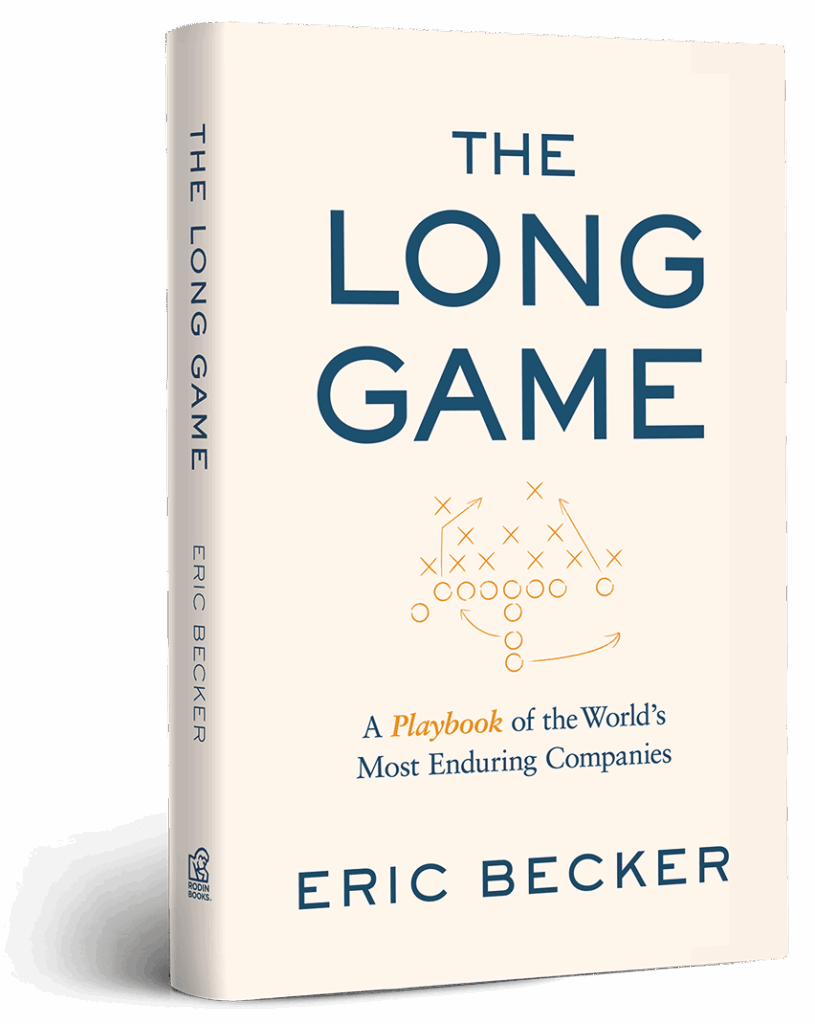
My guest today is Chris Cocks, the CEO of Hasbro. Now, a little context on this conversation. As many of you know, I wrote a book called “The Long Game,” and a big part of that research had been sitting down with the leaders of companies to understand what’s really driven their survival and success across generations. Hasbro is one of those companies. A hundred years old, a portfolio of beloved brands, and still deeply relevant. So, what you’re about to hear is a little different than our other conversations for the podcast because it was recorded as part of the research for the book. But, it was filled with so much great information, I wanted to make sure to include it.
Chris is a fascinating person to talk to about longevity. He thinks carefully about what it means to be a steward of something bigger than yourself and I think that comes through in everything he says. With the history of Hasbro, which is this amazing history, what are some of the things along the way that you have taken something from, where you’re like, I learned that this happened in the company’s history where they made a pivot or survived or made an important decision, and how it’s maybe influencing how you think about the company. That’ll be a good place to start.
Chris Cocks
Yeah. Well, hey. First off, thanks for having me. We just started to put together for our hundredth anniversary, which was last year, so we’re maybe a little late, a book — kind of like a set of leadership principles — and we call it “Play to Win.” And what we’re trying to do in that book is encapsulate — right now it’s a list of about 12 things, but I think we’re gonna try to tighten it down to maybe 10 or so lasting leadership principles that have helped Hasbro stand the test of time and help us grow in good times and bad, and turn things around when inevitably things have gotten tough in our history. And we’re bringing on board current and past leaders from Hasbro, And it’ll go from everything from our first principle, which is focus on play, to driving community, to thinking for the long term. And we’re gonna ground it in our different brands and kind of teach people about what makes Hasbro special by the life lessons that our Saturday morning cartoons over the last fifty years have taught people — whether it’s “friendship is magic” or “knowing is half the battle” or “the matrix of leadership.”
And so, when I kinda go back and piece together all the lessons learned from that, I think three things really kinda pop into place. I think the first thing is know what your center is. Really know what the core of the company is. And it’s not been something that we’ve always fully followed. And whenever we’ve kinda vectored away from it, we’ve tended to gravitate into troubled waters. And whenever we correct ourselves, we always find our way back. And for us, it’s the power of play. Hasbro is a company that’s built on the proposition that play is for everyone, play is timeless, and it’s what builds our brands. It’s what drives our economic engine. And ultimately it’s why the best people wanna join our company. So, I think that’s probably number one.
I think number two is there’s definite power in diversification. When you’re in entertainment, inevitably there are gonna be ups and downs. There are going to be genres or kinds of entertainment that come in vogue. There will be others that kinda fall out of favor even though they might be a timeless play pattern or something that will endure over time. And by having a portfolio of brands and a portfolio of kind of flavors of play, you can ride out good times and bad, and maximize the area under the curve. And then I think last but not least, it’s just not being afraid of new technology or new trends. I think most companies that are around for a hundred years aren’t around for a hundred years by accident. It’s because they tended to have a growth mindset about new opportunities, about new disruptive technologies, and they tended to try to adapt to them, or adopt them, rather than trying to fight them. And whether it’s going back to 1953 and Mr. Potato Head being the first television-advertised toy ever done, or like a year or two later, Play-Doh, Play-Doh is what I call the most successful wallpaper cleaner in history. Initially it was a putty that was invented by a small kind of cleaning company in Cincinnati, Ohio at the bequest of the Kroger grocery store chain.
And over the following decade or two, it became kind of unnecessary because linoleum replaced paper for wallpaper, and natural gas and oil replaced coal. So you didn’t have to clean your wallpaper, and it was easier to do with just soap and water even if you had to clean your walls. But I think what the Kenner team at the time kinda recognized was, hey this is like a really soft and pliable compound that could be fun for kids. So it was finding possibilities. It was thinking more expansively. It was adopting emerging technologies, whether it’s TV advertising, or being one of the first companies to make TV shows, or one of the first companies to translate your IP into movies, or being an early adopter in the digital space — that I think again and again has benefited the company and helped to catapult it forward. Whereas, you know, I think we could have turtled up and not benefited from it. And I think by having those three things, by recognizing what your center is, by having diversification so that when you make a bet you’re not betting the house on it and you still have some safety valves, and then being comfortable making bets because you have that diversification and because you have that confidence of knowing what you are, it’s allowed us to grow and thrive and build probably one of the best portfolios of brands inside of toys and games.
Eric Becker
I love that. So congrats and thank you. And then I think these three are really, really awesome, which leads me to this question of DNA. A lot of times I’ve met with organizations that have stood the test of time, and people, even when I talk to my own sons about it, they’re like, oh, that sounds so old school. But what’s interesting is I found in talking to these organizations, there’s something in their DNA that makes them like survivors. And you know, I think of one company that I interviewed, which was a descendant of the Vanderbilt family, and they have the Biltmore in Asheville, North Carolina. And when COVID hit, they just sprung into action, and they were able to really end up thriving through COVID rather than it being a disaster, which easily could have happened in an entertainment, you know, where the public comes to your space, kind of business. And so do you find that there are things that you think are literally in the DNA of Hasbro that are part of the advantage, not just studying the history and learning it, but like, is there something that even as you came on and took on this role, you could kinda feel that these are part of the DNA of the organization?
Chris Cocks
Oh, yeah. I mean, when you have a company that’s as old as we are and you have brands that have been around for as long as we have, there’s a couple things that kind of pop to your head and kind of infect everyone in the company. I think first is the sense of stewardship, where it’s more than just a brand. It’s more than just, hey, I wanna raise the awareness points by a couple bits or raise my share a little bit. It’s, you know, you’re taking over a childhood favorite of yours that you wanna make sure is around when your grandchildren are growing up. Even if you don’t have any today, you know that it’ll be around. Like, we take for granted that Monopoly is going to be a game that’s going to be in 90% of every American household now and fifty years from now and a hundred years from now. Like, that is just something that we assume. And it’s because it’s a brand that has 99% awareness. It’s in basically 85, 90% of every household. Most households probably have five or six versions of it.
And so you have this kind of stubbornness almost, you know it’s going to persist. You know it’s a historical play pattern. And that changes your mindset, and it becomes more of a growth mindset about how do I make it relevant for the future, rather than how do I make it something that is a temporary kinda sugar high on the business that will come and go. And I think you do that again and again across our portfolio. Play-Doh, like I said, Monopoly is from the thirties, it’s almost 90 years old. Play-Doh is from the fifties. GI Joe is from the sixties. Transformers is from the eighties. Furby is from the nineties. Like, these are things that we all grew up with, our kids are growing up with, and we wanna make sure our great-grandkids are growing up with. So that’s probably the single most important thing.
I think kind of a close second to that is — when you’ve been around for a long time, history doesn’t repeat itself, but it rhymes. So you kind of have this confidence that, Hey, the company went through a recession, we’ll be able to survive this economic downturn. Hey The company went through a couple different wars. We’ll be able to survive whatever geopolitical thing is thrown our way. Hey, yeah, we’ve had a rough patch here or there. Honestly, we probably have kind of a down cycle every twenty to twenty-five years. And you know that as long as you trust in the brands and you trust in the universality of the play pattern and you start kinda correcting yourself back to first principles, you know you’re gonna get through it. And I think that gives you a certain kind of grace under fire, and a belief that maybe a new company or fresher brands might not have.
Eric Becker
Right. In fact, I find with the really young companies, which I’ve had my share of, is that there’s almost like this paranoia that anything could put us out of business at any minute. And it does change the paradigm and freeze the possibilities. It provides more possibilities when you don’t feel like every single thing might be the end of things, but in fact are part of a natural cycle. And it gives you the self-confidence to know we will get through this too. And I think that’s a gift, quite frankly, to have that as a leader.
Chris Cocks
Yeah. It’s just the way I’d frame it, but, you know, like the urgent versus important scratchpad? Having the history and having the tenure of your brands and of your company kind of gives you a relief valve to get out of that kinda nasty urgent quadrant and gives you a little perspective that you can get back to important if you just keep hustling.
Eric Becker
I love that. And I love that you brought up stewardship, which we’ve heard from all the great businesses and great families that we’ve talked to. Stewardship absolutely comes up as a way of thinking, a way of being, and a responsibility. And even in multigenerational families, which is a subsector of all this, in multigenerational families, the ones that succeed over time, they’re imparting this to the next generation. And so there are ways in which even young people coming up in an organization, it’s imparted to them the importance of stewardship, which leads to a higher purpose. And I think that helps people be more successful when they do feel connected and a sense of responsibility to the future. It’s a wonderful thing. What about in terms of culture? A couple things, one, how you think about culture at Hasbro, maybe a couple of the best-known attributes that you think of related to the culture, and then the things you do to protect that culture?
Chris Cocks
Well, I think, probably the best-known and most positive attributes to the culture, Because culture can be a positive and a negative, especially when you’re thinking about a really long-lived company. On the positive side, I think the playfulness that infects the place is absolutely a positive. You know, our attrition rate by industry norms is almost always below industry. I think our latest attrition is maybe in the eight and a half, nine and a half percent range. Our industry usually is like 12 to 18%, depending on if it’s toys or games. That playfulness and that ability to kinda find a best friend at work, you know, “friendship is magic” isn’t just a tagline for My Little Pony. It’s kind of what happens to people at work. And I think we have a nice history on that. I think the Hassenfeld family has always had a very warm and inclusive kind of culture about the place. They’ve always been very trend-forward in terms of, you can just look back to the seventies or eighties and look at who is in our television ads. Look at who they hired. Look at kinda what their worldview was around diversity, equity, and inclusion. And I think they were decades ahead of where most American companies were. And I think again, that’s something that’s very powerful and I think helps to differentiate a creative culture like Hasbro.
And then I suppose last but not least, on the culture side, it’s kind of like this deep passion for the brands and for the fandom associated with the brands. Like, most of us don’t come to Hasbro because we wanna become multigazillionaires. It’s toys and games. Like, you know, we could go try drilling for oil, or go into banking if we wanted to do that. Most of us come here because we grew up playing with one or more of these brands, and we would like to be a part of its history and have a stake in it. And the company does a good job paying well and giving good benefits and giving people an opportunity to create value for their families. But I really think it comes down to, hey, I wanna be part of history with the game or a toy that I love. And wouldn’t it be fun if I came up with one that could stand the test of time and be around fifty, sixty years from now?
So those, I think, are the positive things on the culture. I think some of the maybe more negative things associated with having a long-lived culture is and maybe this is unique to Hasbro, but I think it also is a little bit an artifact of just being an older company, you get set in your ways a little bit. Like, it’s a bit process-resistant, or resistant to process innovation. Like, we are willing to adapt to new technology or new design trends way faster than we are willing to change the way that we forecast or think about distribution. Like, these grooves in the culture and the way that we work are very deep-seated.
Eric Becker
And isn’t it interesting? Because you would think that the skills and the DNA that it takes to be playful, imaginative, creative, all the things it takes to create the great IP and toys and everything else, that somehow there’s a disconnect between that and then on the business process side, like how distribution is done or how forecasting is done, or maybe there’s some of “we always did it this way.” And it is a little bit ironic that in the same company, you can have great creativity, great innovation, and it’s natural to everybody there. But in how warehousing is done or something else, they’re not getting the same creativity.
Chris Cocks
Yeah. Yeah. I mean, it’s a little bit of an echo of the style of the CEOs that we’ve had. Like, my predecessor, Brian, was brilliant beyond compare, a huge visionary. And he had this just great track record of hitting home runs and identifying really big swings. And that was right for the time. I tend to be more of, I’m gonna use a bad baseball Analogy, I’m more of a Moneyball manager. I’m like, hey, it’s not about home runs. It’s about on-base percentage. And it’s like, hey, let’s get people on base, and let’s build our business incrementally. We can take some big swings, but you don’t plan on the big swing connecting at a super high percentage rate. And I think that is the right position for us to be in with where toys and games are today. But that’s a pretty big change. You know, Steven Hassenfeld was a swing-for-the-fences kind of person. Allen was a swing-for-the-fences kind of person. Al was more of a Moneyball kind of person. Brian was a swing-for-the-fences kind of person. So you start to see that we tend to like our leaders to swing for the fences at Hasbro, but occasionally you need a Moneyball person to help kinda correct.
Eric Becker
Absolutely. I think it really, a lot of it probably and I bet if we went and looked at each of the eras that they were in, it’s like the right person in the right moment in time. Because there are just moments in time when that’s all anyone wants to think about, talk about, and they have the appetite for that kind of risk. And if you end up swinging and having a complete miss, which can be pretty terrible, those are the times for that. And then there are times where people are looking for consistency, looking for the highest probability, and the best way for highest probability is to look at the Moneyball approach to things, which gives you sustainable success with the highest chances.
Chris Cocks
Yep. Yeah. And that’s kinda what we’re going through. And so my track record has been more about, okay, let’s correct and let’s get back to first principles. So I’m still, I’m not gonna take too much credit for being a turnaround artist because I’m still pretty new in it, but I definitely see the patterns that have happened across the company.
Eric Becker
It makes sense. Let’s shift gears for a little bit and talk about community. You know, one of the things I’m curious about is, you have all these amazing portfolios of brands, games And when you talk about Monopoly, it made me think about how each of these things, there are communities around them of consumers. And I’m curious, do you see the communities as: we provide the game, we provide whatever that particular product brand or experience is, and then the community gets built around it, and they become in a sense a co-owner, but the community is theirs? Or do you see the community as an extension of it? So are you looking to engage and build community around these brands and things? Is that part of your business, or is it just something that comes with the business?
Chris Cocks
Oh, I think it’s part of the business. And different parts of the business are maybe a bit more front-footed on it than others. You know, in no, not ’99, February 2001, we bought Wizards of the Coast. At the time, and that was where I started with the company, like, eight years ago At the time, Wizards of the Coast was known for Pokémon. So it started the Pokémon craze. It invented the trading card game. About a year or so after we bought Wizards, Pokémon kind of revoked the license and started doing it themselves. But we had Magic: The Gathering and D&D and a couple other more midcore/hardcore gaming brands. And what I think Wizards has kind of done for us is they live in that community-based, hardcore, lifestyle gaming space.
And coming from Wizards, I have this very deep appreciation for a super fan and for community. Like, other brands will say they’ve got super hardcore fans, and I know they do. But Wizards is like tip-of-the-spear kinda hardcore fans. And so they kind of almost push the rest of the company to understand the value of community and adopt that in a more visceral and faster way, and not just kinda give lip service to it. And again, I think that just goes back to one of the first principles, by having a diversified portfolio and having exposure to a bunch of different play patterns and kinds of consumers, it helps to strengthen the whole, because you can borrow from relevant DNA and get exposure and management reps in different areas that will help you overall. Like, I think that helped us think more expansively about how to engage digitally with fans, how to think about social media, how to think about selling directly to consumers, than if we would’ve just been a toy company bound by the constraints of the Child Online Protection Act and being kinda nervous and defensive about it.
Eric Becker
It is interesting. Yeah. So I think it’s something that you’re maybe a bit more front-footed on as a result.
Chris Cocks
I would think so.
Eric Becker
I mean, my boys who are 34 and 29, they’re big Dungeons & Dragons fans, and I feel like they feel like a sense of ownership in the way they talk about, I guess the brand or the game. They talk about it like it’s part of their community, part of their friends’ community. And it does seem like that versus maybe other brands or other things, it does engender a very passionate consumer or a very passionate participant. That’s my observation.
Chris Cocks
Oh, yeah. Like, D&D is a good example. You know, for D&D, I’m gonna give you rough numbers, but, we make $150 to $200,000,000 a year on D&D. D&D probably generates sales in excess of $2,000,000,000 a year. And that’s because there’s this huge marketplace of miniatures and fan-made toys and adventures and streaming series and all this kind of other stuff where there’s real ownership from the fans that drives that. I mean, you can just go look behind me, yeah, I’m like an example of that. I’m sitting in a room with, gotta be boastful I’m sitting in a room with probably $25,000 worth of D&D stuff, of which Hasbro has probably gotten paid a thousand dollars for. So, like, that’s an example of co-creation and building a fan-generated economy on it.
Eric Becker
Yeah. Incredible. That’s pretty cool. So let’s talk a little bit about innovation and technology, and also how you think about how something becomes part of the future of Hasbro. So the first would be, you talked about first principles. Is there a framework, if someone in the company is pitching a new idea, an area to invest in, an area to innovate in, is there a framework or a lens that you use so that, under your Moneyball way of thinking or that analogy, it helps you have a higher chance of success with something new?
Chris Cocks
Yeah. Yeah. I mean, I’m full of hokey slogans. We call it “the fundamentals with an emphasis on the fun.” So basically, anytime we have a new toy, whether it’s a significant product extension or a new brand that we wanna go after, we have a scorecard that has like 10 or 12 kind of metrics that we need the team to check the boxes on and do the research and make sure they have the business plans and underlying thinking for. And it’s just a fancy way of kind of going after the four P’s and making sure that you’re consumer-focused and consumer-obsessed. So it’s like, okay, is it fundamentally a fun play pattern? Is it easy to understand? Is it differentiated versus the competition? Is it priced such that it’s accessible for the market? If it’s a retail-based product, is it easy communication on shelf? Is it a good deal for the retailer, do others profit in addition to us? Do we profit from it? Like, are we making any money off of it? Do we understand the fundamental business model? And so it’s just going through a litany of development milestones where a typical toy takes eighteen to thirty-six months to go from a bill to a lot. And so they basically have a bunch of fundamentals gates that they have to get through.
Our games business is inherently similar. Those tend to be larger capital commitments that we’re making. Like, a typical toy. just to give you a scale, we’ll invest $50 to $60 million a year in tooling and new R&D on toys every year. For our digital games business, we’ll commit $125 to $150,000,000 a year to drive that. And whereas a toy development is, call it, eighteen to thirty-six months and maybe at most a couple million dollars for a line, a video game is somewhere between $90 to $200,000,000. Wow. And so we kind of just scale up those milestones and that process commensurate with the seriousness of the capital commitment. So there’s a concept development, a pre-production, a production, an alpha, a beta, a commercialization set of gates that inherently have to check the same boxes as their fundamentals, but perhaps the testing and the bars are a bit more rigorous.
Eric Becker
Well, that’s very interesting. So, in doing this research, I guess for probably ten years, the interesting thing that does come up over and over again is moments of truth and moments of trust. And many times they come up at the same time. And a moment of truth would be that, if you think about life and all the details of any individual day — it does seem like there are just certain moments that you have to recognize that are really important. And if you make the right decision, it can kind of change everything. And if you miss a moment of truth, you look back on it and you’re like, if I had recognized that, I could have really moved the needle or made a much better decision. When you think about Hasbro, whether it’s before you or even in your own experience with it, is there anything that comes to mind as a moment of truth that needed to be recognized and was or wasn’t? And secondly, did it go hand in hand with maybe a moment of trust where someone had to trust leadership was taking us in the right direction, or you had to trust someone else? Did those resonate in some way as you think about the company?
Chris Cocks
Oh, yeah. Yeah. Yeah. Well, I’ll use a couple examples. So for my predecessor, Brian spent maybe five or six years working Hollywood to find someone to believe in the Transformers, to turn that into a movie. Wow. He got every wacky pitch and every wacky curveball you could possibly get thrown at you. At one point, the production executives at Paramount didn’t want the robots to talk, because they didn’t understand why anyone would wanna listen to talking robots on screen. But he was able to successfully find real believers behind the project, Michael Bay and Steven Spielberg. He was able to find allies inside of Paramount. And there were multiple moments of truth and moments of trust. That generated, I think the first Transformers movie was a $1.2 to $1.5 billion box office, almost twenty years ago. And it spawned one of the top 10 movie franchises ever, and hundreds of millions of incremental profit and value for Hasbro shareholders. So certainly that was a big one and a seminal moment for him.
You know, for me, my moment of truth kind of came, my first and probably biggest one so far, probably three months after being CEO. We had acquired a film and TV studio called eOne. It was clear that the integration of the acquisition hadn’t gone well. There was very much an us-versus-them kind of mentality between the two sides, and the pandemic really threw the whole business model for a loop. And I was in an off-site with my leadership team, and most of my initial leadership team was inherited. We came up with what the mission for the company was, which was inherently play-based, it was all about building joy and connectivity through the power of play. And everyone was gravitating towards it. And it was like that moment where you could just tell the room was vibing, except for the leader of eOne, because someone asked, like, but how does this connect with, like, The Rookie, like, their hit TV show or Naked and Afraid, another hit TV show they had? And that question really hit me like a sledgehammer. And it was like: it doesn’t. And there’s a reason why it doesn’t. It’s because the two entities don’t belong together.
Eric Becker
Yeah.
Chris Cocks
And I had some suspicions, but that really was kind of a catalyzing moment of saying, we need to, despite the challenges that the pandemic’s had and that the entertainment market has, we’re gonna need to bite the bullet and spin this off. And that, we took about three or four months working with our internal management team and our board. But that moment of truth led to a very profound moment of trust, where we ultimately spun off the business. We took a significant loss on it, but I really think that catalyzed our return to our center and our first principles. And I think it’s a pretty powerful signal both to the market internally that we take those principles seriously. And I think that’s gonna be what propels us to success over the next couple years. I hold no ill will to the eOne team. Like, they’re consummate professionals. They executed like they should, but sometimes two don’t fit together.
Eric Becker
And so, how valuable that planning exercise actually gave you the moment of clarity that, you know, something you had suspicions about or thought about, it just sort of made it crystal clear. And that’s oh, that’s amazing. Right? That’s awesome. So with the time that we have left, I’d love to talk a little bit about something that I am very passionate about, which is paying it forward, as leaders, as entrepreneurs, as business people, for the next generation. And so, what would be, if we think about the category of advice to young entrepreneurs who are just first-time founders, or someone who’s joining a young team earlier in ours, yours, and my careers, what would be some of the things that you would tell them that you think would be great advice in order to build something that matters, in order to build something that stands the test of time, to increase their chances of success? What would be some of your advice to help us pay this forward?
Chris Cocks
I think some of the best pieces of advice I’ve gotten: The First Hundred Days was a big book for me that I believe is really profound wisdom, which is: hey, when you’re new at something, recognize that you’re not that good at it, and you’re probably going to be in the red for the first sixty or seventy days that you try it. And if you can structure your first hundred days such that you can minimize that time in the red to maybe thirty or forty days, and then build out some quick wins to build credibility and really kind of test either the role that you’re in or the value proposition that you’re trying to drive And you can exit that first hundred days kind of net in the black, that makes such a huge difference about success or failure, either in a new company or a new role. So I think that’s probably advice number one.
Going back to my time at Xbox, I think advice number two, and this kinda came from another book I read from, God, maybe it was Great Places to Work. It was something by the Gallup organization — find a best friend at work. And going back to every great work experience I’ve ever had and where I’ve had the most success, I always have this track record of making at least one best friend at every one of those experiences. And where I didn’t have as much success, I realized I didn’t make a great friend there, and it really didn’t feel like the best of times. And I think that says something About the culture where you’re working. It says something about the ability to work together and get things done. Because at the end of the day, it’s always a team sport. It’s always about working together. And again, I think if you’re in a place that you figure out you’re not gonna be able to make friends very easily, that’s a spider sense that tells you something about your fit or about the culture that it is, and you either need to try hard to change it or figure out where you wanna put your resources, because maybe it’s not the best place for you.
And then I think the last thing, the last thing that I’ve had the privilege to discover, is I’ve worked on some things where I really didn’t like what I did. I have a huge amount of respect for Microsoft, but I was trying to sell people tablets based on Windows 8 and Windows 10 when they could have bought an iPad. And I did not like that, because I had an iPad at home. I did not want this thing that I was making. I’m proud of some of the accomplishments we did we did a lot of engineering and cost innovation. But life’s too short to work on stuff you don’t believe in. Or that you feel like the impact doesn’t matter. Especially if you have a lot of horsepower and capability and upside. Don’t waste your time working on stuff just for the paycheck. Try to find something that really matters to you. So that would probably be my big advice to someone starting something new or trying to build something new. Try to accelerate your time to value. Try to find a place where you can make your best friend at work and the culture really kinda syncs with you. And then marry it up with something that you value the impact on a personal level. You can do those three things, it’s probably gonna work out for you. And what’s the worst case? You’ll end up having three new best friends, and you’ll find something else to take on in a couple years.
Eric Becker
I like it. I like it. So the last one that you said, when you talked about what it was like to try and work on a project that didn’t ultimately resonate, that you didn’t have conviction about. So maybe in 2010, I ran this contest where I had 80 board members. I was managing a portfolio of companies for a private equity firm, and I had 20 CEOs and 80 independent board members. most of them were retired or ex-CEOs. And I ran this contest, and I asked them: what is the best question you’ve ever asked or been asked? And the winner of that contest, which I’ll share with you, was this gentleman, his name was Gary Kiesling, and he said, “Every day I ask myself: what am I tolerating but shouldn’t be?” And so when you gave that third piece of advice, that really immediately made me think of Gary Kiesling and that question. Because if you’re in a situation like that, how do you know it’s time to get out? Everyday answers are, what am I tolerating that I shouldn’t be? I’m working on something that just doesn’t resonate with me. It doesn’t have the meaning. And so his question really ties in beautifully to your advice.
Chris Cocks
Yeah. I mean, well, sometimes you just gotta suck it up. Like, I get it. Sometimes you’re getting paid for a reason. So eat your vegetables. But there’s gotta be other trays at the buffet. Like, eventually you need to get to something that nourishes you a bit more.
Eric Becker
Absolutely. Is there something that’s a go-to favorite question of yours?
Chris Cocks
I’ll tell you that the master, the person who I was always in awe of about asking a tough question, is that inevitably you’re gonna get bullshitted by people, and you’re gonna suspect that they don’t know what they’re talking about or they’re wrong. And kind of like the classic frame is to go and precision-question them and put them on the defense. And there was this guy at Microsoft named Chris Capossela. He’s basically the CMO of Microsoft. And he did the same exact thing as precision questioning, except in a super positive and high-energy way. where he would very authentically say, “That’s super interesting. Can you tell me more?” And inevitably, within like two minutes, whoever was BS-ing would fold like a deck of cards. It would be incredibly apparent that they didn’t know what they were talking about. Yet Chris would always walk away not like the guy who asked the really tough precision question, but the guy who was actually intellectually curious and wanted to know more. Because, you know, how are they making one plus one equal twenty-five?
Eric Becker
That reminds me of, so I grew up in Baltimore, and my dad was the first one in our family to go to college and to work his way through school and pay for school at University of Maryland. My dad hired his fraternity brothers to dress up like Santa Claus, and he rented them to department stores like a Kelly temporary service agency. And it became so successful, he started his own Santa school, and he went into the business of providing Santas to department stores, which became shopping centers, which became malls. And my dad became the king of Christmas in America, doing 400 malls. Anybody who took a child to have their photo taken with Santa, that was my dad’s business. But what’s so funny about what you just told about the gentleman at Microsoft when my dad found himself in that situation, he would start to sound like Santa Claus. He would start to ask questions almost like, “Ho ho ho. You know? Tell me more about that.”
And I always found if I was in a meeting with my dad and he started to actually sound like Santa, I knew that it was actually his way of asking a really tough question, but making it light so that people didn’t feel he was challenging them. It was pretty funny.
Well, you’ve been really generous with your time, and I really appreciate it. This has been everything that I was hoping for in terms of both I would say validation of things that I’ve learned and now I’m seeing in a pattern, and even some new things, which are wonderful. So I really thank you for taking the time and spending some time.
Chris Cocks
Thanks a lot.
CLOSE
Eric Becker
What stayed with me most from my conversation with Chris Cocks, the CEO of Hasbro, was his point about stewardship, that the leaders who endure aren’t just building for today’s results, they’re caretaking something that belongs to the future. And I loved his three pieces of advice: accelerate your time to value, find a best friend at work, and never spend too long working on something you don’t believe in. Simple. But hard-won.
If today’s conversation resonated with you, that’s exactly what “The Long Game” is about, finding the lessons inside organizations that have stood the test of time, so that the companies being built right now have a better shot at doing the same.
Thank you for listening. See you next time on “The Long Game.”
Subscribe to The Long Game Podcast
By providing your email address, you consent to receive messages from Cresset regarding our services. View our Privacy Policy.
Listen On



Episode Guests

Chris Cocks
CEO, Hasbro
Hosted By

More Episodes




Discover