Scott Kirby, CEO of United Airlines, joins Eric Becker to discuss what it takes to lead the world’s largest airline through periods of crisis and transformation. As United celebrates its 100th anniversary, Scott shares how he approaches leadership with a “startup mindset,” and how the airline is elevating the customer experience through technology and radical transparency.

Podcasts / United Airlines CEO Scott Kirby: Big Bets Leading the World’s Largest Airline
United Airlines CEO Scott Kirby: Big Bets Leading the World’s Largest Airline
June 9, 2026
For founders, executives, and leaders navigating uncertainty, this episode offers an inside look at the mindset, systems, and decision-making behind one of the world’s most complex businesses.
Podcasts / United Airlines CEO Scott Kirby: Big Bets Leading the World’s Largest Airline
Bad stuff is going to happen, and you can either feel sorry for yourself, or you can figure out how to overcome it. And it's always better to figure out how to overcome it."
Key Takeaways
01
How United created a “startup mindset” inside a 100-year-old company
02
How technology is reshaping the future of air travel
03
The leadership lesson behind the “No Excuses, Sir” philosophy
04
How United is creating a culture of “Wow” for its customers
05
Why great CEOs protect time for thinking, curiosity, and challenging conventional wisdom
United Airlines Postgame Play: Your Job Is to “Wow”
About Scott Kirby
Scott Kirby is Chief Executive Officer of United Airlines, one of the world's largest and most influential airlines. A veteran aviation leader with more than three decades of industry experience, he has helped shape the modern airline industry through a career spanning operations, strategy, network planning, and customer experience.
Since becoming CEO in 2020, Scott has led United through a period of significant transformation, overseeing the airline's ambitious United Next growth strategy, fleet modernization efforts, international network expansion, and investments in technology, sustainability, and the customer experience. Under his leadership, United has pursued one of the largest aircraft orders in aviation history while positioning itself for long-term growth in an increasingly competitive global market.
Prior to serving as CEO, Scott was President of United Airlines and previously held senior leadership roles at American Airlines and US Airways (now American Airlines), where he played key roles in major industry mergers and operational transformations. Known for his analytical approach and deep understanding of airline economics, he is widely regarded as one of the most influential executives in commercial aviation.
A graduate of the U.S. Air Force Academy with degrees in computer science and operations research, Scott also holds a master's degree in operations research from George Washington University. Throughout his career, he has focused on building resilient organizations, advancing innovation, and shaping the future of air travel.
Transcript
Full Episode Transcript
COLD PROMO OPEN
Eric Becker
Scott Kirby is the CEO whose bold vision is shaping United’s next century of flight.
Scott Kirby
United is a five-year-old startup embedded inside a 100-year-old company. You have to wow customers with new stuff that no other airline in the world has ever done
Eric Becker
Anyone who is a CEO for an airline has to have nerves of steel.
Scott Kirby
There are times I wish for boring I admit, but it is never boring.
Eric Becker
I’ve heard that you have a “no excuses, sir motto.”
Scott Kirby
Bad stuff is going to happen, and you can either feel sorry for yourself, or you can figure out how to overcome it. And it’s always better to figure out how to overcome it.
INTRO
Eric Becker
If you could think of one industry that is the most challenging to navigate, commercial air travel might be one of the toughest — the sheer volume of people plus their luggage that must be managed every day, all while navigating language barriers, time differences, safety, global crises, technology, regulations, and not to mention the weather.
United Airlines is the largest airline in the world, connecting 175 million passengers a year to every corner of the globe. It has successfully navigated unimaginable twists and turns to now mark its 100th anniversary this year. Scott Kirby is the CEO whose bold vision is shaping United’s next century of flight. He’s an Air Force veteran, served at the Pentagon, and has more than three decades of leadership experience in the airline industry. Welcome Scott Kirby. Thanks for being here.
Scott Kirby
Thanks for having me, and you made my job sound fun, which it actually is.
Eric Becker
Well, what I was thinking actually is in the airline industry, it’s almost like what they say about dog years, probably every year in the airline business is seven actual years.
Scott Kirby
I like to actually, I like to say it’s never boring. There are times I wish for boring I admit, but it is never boring.
Eric Becker
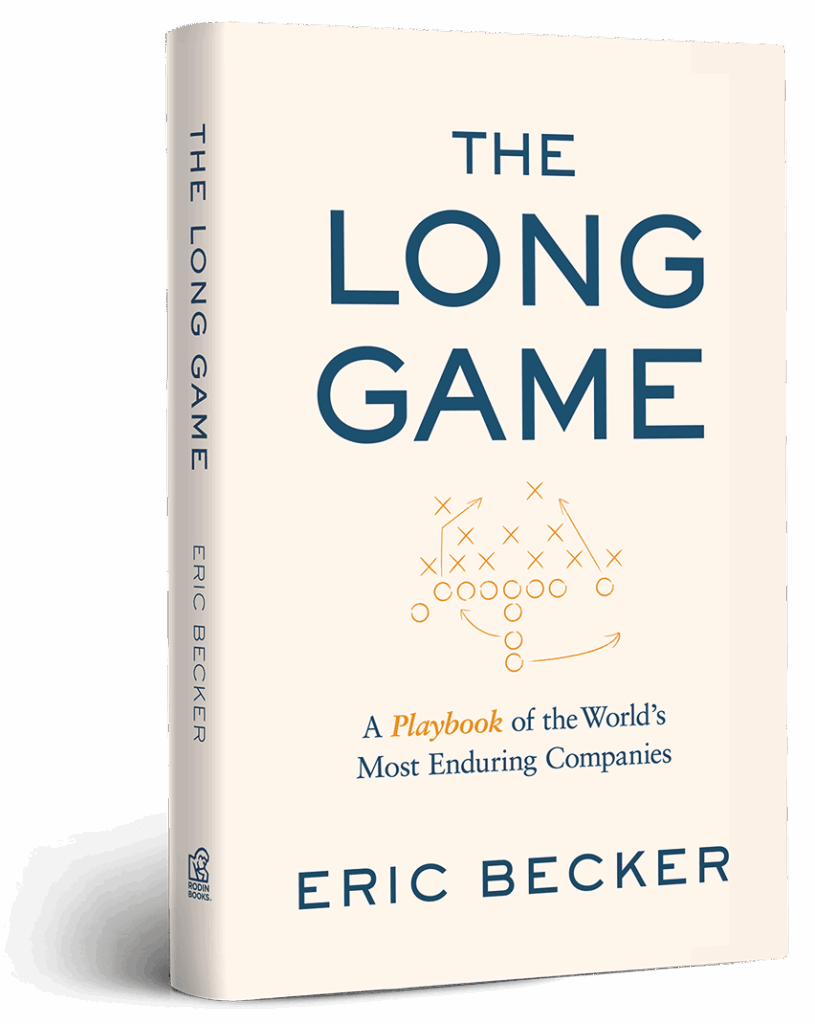
Well, we have an incredible respect and deep passion for companies that have endured for over a hundred years. That’s what “The Long Game” book is all about. These interviews that I’ve done around the world. And really, I believe that the businesses that embody these principles, any company, any stage, we should really be emulating these proven practices that stand the test of time. My question for you is: What does this 100-year milestone represent? I mean, with technology and change, we obviously live in a fast-changing world, but how do you connect this 100-year milestone, not just for United, but also for the future of the airline industry?
Scott Kirby
You know, we’re fortunate at United to have a 100 year legacy that all of us get to inherit. And really, aviation in the last century has been about connecting the globe. And United has been a leader and been at the forefront of that. Been through some ups and downs, but been a leader for really, for a century. And that’s a legacy that we’re all really proud of. But I also like to say that United is a five-year-old startup embedded inside a 100-year-old company. What I mean by that is coming out of COVID was really a chance to reset.
You know, the kind of two decades or after 9/11 really saw United and much of the U.S. aviation industry, and even the global aviation industry — particularly those have been around a long time — go through all kinds of challenges, bankruptcies and, you know, losing pensions for employees and just a host of challenges and all that sort of wears on a company. And COVID actually gave us, remarkably, a chance to reset, create a new culture. Launch in a way that our employees could be proud of the airline and really believe that we’re creating not just the biggest, but the best airline in the world. That, you know, ironic that such a challenging time could be the launch pad for what United is today, but it really was.
Eric Becker
I love that. And I love that you talked about changing the culture. How would you describe, if I was coming to work, I was a recruit and you were recruiting me to United, how would you describe the culture?
Scott Kirby
Yeah, so first what I’d say is the job of the CEO is, I like to say it’s the easiest job of anyone at the company. Some other CEOs quibble with me on that part, but it’s almost 100% about the culture. That’s really, as the CEO, you’re one person out of 120,000 at United and I can do a lot to set the culture and that’s really what my job is about. And what I try to do is create an airline that our employees are proud of. That is my goal. If our employees are proud of United Airlines, I know that they’re going to take care of everything else. They’re going to want the customers to feel the same way they do about the airline, and they really will take care of everything else. So I wanted to be on a winning team that they’re proud of and I’m confident if they feel that way everything else is going to take care of itself.
Eric Becker
And with that mindset, I heard that United has been rethinking long standing practices across operations and customer experience, and that you have an internal initiative that you call “change the unchangeable.” What does that mean? And what are some of these unchangeables that you’ve been breaking?
Scott Kirby
Yeah. Yeah, we have a bunch of, amazing culture is about things that seem small, but that make employees believe that the company is sincere on what we’re trying to do and change the unchangeable is part of doing those kinds of things. A number of examples, but one, my personal favorite example is lost bags. And at every airline I’ve ever been associated with, I think really every airline in the world, we try really hard to make sure that bags don’t get lost and that they make it on the flight with you. But it is complicated and you know, planes get in late, weather, and you know, the ramp congestion; there are bags that miss their flights. We at United, and truthfully every airline in the world, are positively awful once we lose your bag. We’re pretty good at not losing the bag, but once we lose it, we’re positively awful at the customer service of trying to reunite you with the bag. And one of the things we want to do is make that a really positive experience.
So, the goal is anytime we lose a bag or that’s not on the airplane with you, that we know where it is. We’ve tracked it. We know where it is. We tell you where it is on your flight. So, we text you or we send a message to the seat back entertainment system telling you, we’re sorry the bag didn’t make this flight. Here’s where it is. Here’s the three options for us to reunite you with your bag. What do you want to do? And then to get it back to you within six hours. And that’s the goal. And that may sound easy, but it’s really, really hard and really complicated and not what we’ve historically done. But it’s the kind of thing that that vision of trying to get there makes the airline better but also makes all our employees know and believe that we really are trying to do the right thing for customers. And it helps drive culture change as much as it does to solve one problem.
Eric Becker
Love the description of that. You know, I think when you just first mentioned the problem, in my mind, I was envisioning a person by the, you know, the baggage claim belt, and then afterwards, no bag shows up, and they walk into a little office to file a report, you know, comparing what you described as the new experience, you know, 1000 times better, a million times better.
Scott Kirby
Yeah. Yeah. And our goal, actually, my goal for it is that we, that today if we lose your bag, the NPS scores are, you know, like 80 to 100 points lower than if we don’t. I want us to get to where the NPS is actually higher if we lose your bag than if we don’t, because it’s so surprising to you how good we do at recovery. We still want to lose them as little as possible.
Eric Becker
Less, yes.
Scott Kirby
But the recovery feels so different than it does in any airline. Another way of saying it like, want to change, United, want to change what it feels like to fly if you’re a customer. All the things that frustrate you, that create tension about flying, to really change all of those, to really change what it feels like to fly.
Eric Becker
And how do you think about that? So, in my case, I’m a business traveler. I have a son who just became a parent for the first time. So, I could be the business traveler. Next to me could be a young parent flying with an infant for the first time. You have different kinds of use cases. How do you think about each of these and how do you elevate the experience when we’re on board the aircraft?
Scott Kirby
Well, first, congratulations on being a grandfather. Although that was a very creative way of saying I’m a grandfather.
Eric Becker
Thank you.
Scott Kirby
I actually, I think there’s way more commonality between every, all those different pasture types that you describe. And as a father of seven, I actually think of, I personally think of most customer initiatives through the lens of traveling with kids. Because if we solve traveling with kids, it is going to make things better for everyone. Baggage is one of them. Like your description of going to a baggage carousel with kids who are tired, who are hungry, just want to get to…
Eric Becker
Yes.
Scott Kirby
…the hotel and get in the swimming pool or get to Disney or wherever they’re going. Like not having to wait, not having to then stand in a baggage service line is infinitely better if you are traveling with kids. You know, another big initiative for us is what we call “every flight’s a story.” And the goal is this: anytime you have a flight that is delayed, that we have told you in advance what’s going on in clear plain English. And what I’ve told them is pretend that I personally am on the flight and I’ve called the network operating center to say what’s going on with my flight. And whatever they would tell me, I want to tell the customers. And that means you don’t have to come to the airport early, or I hate rolling delays. So getting rid of rolling delays where it’s just 15 minutes, 15 minutes, 15 minutes. Like, if it’s going to be an hour and a half, tell people it’s going to be an hour and a half. Here’s why in plain English. And you have time to go get food, do something else with the kids.
Another one that we’re working on is the equivalent of DoorDash inside the airport for a connecting flight. Again, but this applies to whether you’re traveling with kids or you’re traveling by yourself. You have a tight connection, you’re hungry, you want to get food, but there’s no time to go to a restaurant with long lines and Chick-fil-A. There’s no time. We’re going to create a DoorDash where we can have hot food delivered to the plane that you can pick up on the way to the gates. I really think of it as things that take the stress and the inconvenience out, especially when something goes wrong. Doing that in a
way that makes it that customers know we care, we’re doing our best, we’re communicating with them. I think all of that stuff, I think of it through the lens of what it means to travel with kids, but it applies to everyone.
Eric Becker
And is that when you have said to your team, “your job is wow.” So whether it’s let’s redesign how we think about food in the airport or whether it is you know, Wi-Fi, whatever, whatever that can be. Wow. Let’s have more. Wow. In our business.
Scott Kirby
Yeah. It is. You know, even something as simple as getting TSA wait times up during the last shutdown for customers is “wow” compared to what happens at other airlines because people are stressed out. You know, I flew on another airline with my family during that. We got a text message that said show up at the airport five hours early. I’m like, no way I need to show up at the airport five hours early here where I live.
But having actual times just takes that kind of stress out. A lot of these are small things that can wow customers. We put a scoreboard up for customers at the end of last year that was just your flight statistics. So how many miles did you fly last year? What are your favorite destinations? And the amount of feedback and input that we got from that was just incredible. Little things really matter to make it more of an experience. We really want travel, the flight, to not be a necessary evil to get to your great destination or your great vacation, but to be part of the experience that you actually look forward to and enjoy. And that’s what we’re trying to do. You have to wow customers with new stuff that no other airline in the world has ever done if you’re going to achieve that goal.
Eric Becker
I love that. It’s a different way of thinking. We have a lot of CEOs in our audience, and everybody has different levels of dealing with social media. But when I think of industries where social media is so pervasive, it would be in travel, it would be in flying. It seems like everyone’s filming everything. What have you as a leader learned about social media that you can share with other CEOs of how to think about it, whether it’s sharing stories of your own family or whether it’s how you manage that every element it seems like people are looking at it all the time?
Scott Kirby
Well, we have a great social media team that engages with customers and with the public and we do it with humor, we like to include humor which sometimes means you get a little risqué, or you know, get a little bit of criticism, but engaging with humor is really important for me personally. I’m not on social media, I do post stuff and by the way, I write all my own stuff. Another thing that I would say to CEOs, write your own stuff if you’re going to put it out on social media or you’re going to put a statement out. You know, I had a big letter last week about our attempt to buy or emerge with American Airlines and I personally wrote it. Like you need to speak in your own voice and do it. So write it yourself. But I’m not logged on to social media and spending time on it, and that’s actually one piece of advice I have for people like, you know, when people ask me about work, people ask me about work-life balance, I say, well, are you on social media? And if the answer is yes, which it always is, like you don’t have a work-life balance problem, you have a social media problem.
Eric Becker
I think it’s great advice. Right. That’s right. No, I completely agree with that. Since you mentioned the letter that you wrote about American, I’m curious, what is it, how would you explain the benefits of a deal like that if at some point down the road it comes back? Is the whole idea that what all these things you’re describing, of elevating the experience and investing in technology, is it that the lesson is that you can use scale, United can use scale to benefit the customer, and therefore at some point a consolidation like that brings more scale that allows you to invest more in technology and do new experiences, or is there some other element that makes it a better airline if a deal like that ever came together?
Scott Kirby
Well, I don’t know that it’s scale that creates that, but I know that what customers want is better technology, better service, better reliability, and a better product. And that’s what we’re providing.
And that’s what customers want. And the point of regulatory reviews is to create consumer, customer benefit — and customers benefit. And you just look at a place where we have a lot of overlap with American and Chicago, by the way, it’s not unique to American and Chicago. We’ve had the same thing against other competitors and other hubs, but when we’re providing better technology, better product, better service, better reliability, just huge swings in market share.
Chicago, we’ve had about a 20 point swing in local market share. Essentially, all of the frequent flyers in Chicago, virtually all of them, have switched from American to United, even though we both have big, similarly sized hubs in the city. They’ve done it not because of the schedule, but because of all the non-commodity parts of the business that customers prefer. So I know, like my letter is partly like, I know with 100% certainty that if we could get a merger like that done, it would be great for customers. Customers would love it. And aviation would be better. They would feel better about traveling. And I know that for 100% certainty because I’m the one making the decisions on what we’re going to do. And so, I wanted to at least start the conversation by writing that letter about what aviation could look like and why that would be good for customers. That’s what I believe and we’re going to keep pushing that way, that direction.
Eric Becker
So now, I love it, so now that we’re on the future, really thinking of the future, that really was about the future, how do you see AI and technology? I know there’s a United Airlines Ventures. How do you think about AI and technology, and how that will impact the future of air travel and the experience?
Scott Kirby
Yeah, I think technology is the biggest competitive advantage that United has. It is the halo that ties all the, everything else that we do together. From a customer perspective, it’s probably best symbolized by the app, its head and shoulders. I don’t even know for sure who’s the second best in the world, but United is head and shoulders above the second best. And so how do we keep pushing hard to use technology to make that?
In fact, I had part of the DT, Digital Technologies, team and ops team down here earlier this week at my house, where we do this a lot, where you know, I get teams and we spend several hours with no phones and no interruptions and really focused on talking about the future, and you know, what are we going to do with bags? I talked about it before, is one of them, or this idea of DoorDash inside the airport for connecting customers, and other ideas like that, where we can use technology to really change what it feels like to fly.
And if you have, you know, if you’re having great communication about your flight, even if there’s a delay. Sometimes there are weather, you know, we operate in tough places and when there’s weather, but if we tell you in advance, you know, here’s where it goes. We’re starting to send pictures, like radar pictures, to customers. Here’s the storm moving through and there’s a window, you know, this hour we’re going to try to get everything out during this one window. You can see where the storm lines are coming through. And, you know, if we communicate like that, people understand, they don’t like it when, you know, they don’t have facts, they don’t have information. But if we communicate effectively, I think we can just completely change what it feels like to fly.
Eric Becker
I love that as a frequent flyer myself. So, with the time we have left, let’s do a speed round. We have a lot of leaders in our audience. And so, some questions. One is, I’ve heard that you have a “no excuses, sir” motto. Where did that come from and why do you like it?
Scott Kirby
It was the best thing that I learned at the United States Air Force Academy. Sometimes a hard lesson when something is not your fault and there’s going be consequences, but you have to say, “no excuses.” And it teaches you; it’s a great life lesson too, business and life lesson, teaches you bad stuff is going to happen, and you can either feel sorry for yourself, or you can figure out how to overcome it. And it’s always better to figure out how to overcome it.
Eric Becker
Yes. Love that. So, you mentioned that you’re a father of seven, which is amazing on top of being a CEO, which requires high performance. Let’s talk about a day in the life of Scott Kirby. Like what time does it start and how do you structure your day for high performance?
Scott Kirby
Yeah. So, I think mine’s going to be a little unusual. I’ll start with when I go to bed. I usually go to bed between 8:30 and 9, and I sleep about eight and a half hours as normal. I don’t set an alarm. So, I just wake up when my body says it’s time to wake up. But I always wake up for about eight and a half hours. I work out in the morning pretty much every day. It’s very unusual I miss a day, and almost entirely because I’m traveling, I read while I work out as well, depending on what kind of workout I am doing, but that’s about an hour. Then when I’m home, I usually have breakfast with the kids. I often take the kids to school. The school has a cafeteria where you can take your kids and have breakfast there, a great breakfast. So, I often do that.
I limit myself to no more than four hours of meetings per day because I think my job is to think. I read a lot. I wind up, I read about three hours a day on average, and I spend a lot of time talking to people. So, I don’t have structured plans during the day, but something occurs to me and I just call and talk to people. You know, so pretty relaxed, and I’m usually done in time to help with the kids at night. I have still young kids at home; I become a chauffeur quite frequently at night. I will be doing that tonight. I’m on my way to a baseball practice in an hour. And so, you know, pretty, really somewhat relaxed and very fun life and a good routine.
Eric Becker
That’s a great routine. You mentioned being an avid reader. And so, what would be the very first thing you read at the beginning of a day? Is there like a trusted source that’s sort of like the first thing you look at reading wise?
Scott Kirby
Yeah, I usually read the Wall Street Journal first. I go read the daily paper. Right now, I go and read the more real-time updates about what’s going on in Iran. But I usually read the paper, then I read the New York Times. I read the Wall Street Journal cover to cover. The New York Times, I probably read 10 to 15 articles a day out of that. And then I’m usually onto a book. Magazines, I still read in print, so I mostly read those on airplanes.
Another thing I do when I read is I walk around. I get over 20,000 steps a day each of the last three years. And so, I walk and read. It’s hard to do that with paper, but I can do it on my iPad. Everything else I read on my iPad.
Eric Becker
That’s fantastic. A couple more speed questions before we wrap up. One is when you think of your life and career, what is either a teacher, a coach, or a manager that you worked for in one way or another that was the best person you ever worked for and why was that person great in their role?
Scott Kirby
You know, I’ve learned a lot from people I’ve worked with. My whole life really. I’ve learned more by reading, I think. The kind of people I try to live up to, or I’m inspired by, Winston Churchill and Abraham Lincoln, George Patton, leaders like that. But I go all the way back to when I was a kid, coaches. Many of the coaches that I had when I was young, I learned a lot from. A guy named Jerry Key was the city manager in my small town. I had probably the coolest job a 16-year-old could have. I convinced him to let me keep the gym open at night for the small town. And so, I got paid to play basketball. He used to joke with me that I could never go to the Olympics because I’d already been a paid professional athlete, which of course now you can’t be a professional athlete. But that was great.
The Air Force Academy, what a place, when I was there, had numerous instructors there who had flown in Vietnam. I had a sponsor, who had been shot down in Vietnam. The stories and experiences that those people could impart to you was amazing. I went to work at the Pentagon. I think the smartest people I ever worked with were there at the Pentagon, worked in a group called Economic Analysis and Resource Planning. These University of Chicago PhDs that they’d been working in the Pentagon for 20, 25 years or more.
And I got to hang out with them and hear from them. You know, like Nobel Prize winners from University of Chicago would come into town and want to have lunch or something with them. And I got to go. How cool. Like, I’m 22 years old and, you know, getting to go to lunch with people that have won the Nobel Prize in economics. Just a remarkable experience. I mean, I’ve really, I’ve never, with the exception of I was a short order cook at Sonic, that’s the only time I ever felt like I had a job.
Eric Becker
Amazing. Okay.
Scott Kirby
Everything else I’ve done I’ve enjoyed.
Eric Becker
That’s amazing and great. And it sounds like you’ve found learning opportunities everywhere, which is amazing. I have one last question for you. Many years ago, I ran this contest with board members and CEOs and I asked them, what is the best question you’ve ever asked or been asked? And the winner of that contest was “to ask yourself every day, what am I tolerating, but shouldn’t be?” which is a question I still ask myself every day.
Scott Kirby
Okay.
Eric Becker
So, my question for you: is there a favorite question of yours, something that you find, you know, has really worked wonders or is just a favorite for whatever reason?
Scott Kirby
It’s a good one. Well, off the top of my head, I’ll say the most important question is “why?” And if you can understand why something is happening, you can figure out how to overcome obstacles and solve it. And I’ll use the example, a good example for me, when COVID first started and four or five people died in Northern Italy, I asked the question to myself, like, is there any explanation other than this is a global pandemic? And I couldn’t think of one. And so, I was convinced it was a global pandemic. And we went off, you know, we started a couple of weeks before the rest of the world, we realized it was a global pandemic. We raised $2 billion unsecured at 3%, two days before the NBA walked off the court. And it would have been impossible.
More recently, you know, when the MAU embarked from Asia for the Middle East, I asked myself, is there, like all the experts were saying, this is worst case, this is going to be over in straight to forward moves, open by the end of March. That’s the absolute worst case. And I asked myself, “why do they think that?” And it just didn’t make sense to me. So, we started preparing for oil to be, I wrote a low mail letter to employees, like we’re preparing for oil to be higher for longer. I think asking why, asking why means questioning the experts too. And you know, really thinking deeply about what is going to happen and why do you think it’s going to happen instead of just accepting the answer. If you can understand why, you can do just about anything.
Eric Becker
I love that. And it does remind me from “The Long Game,” we talk about moments of truth and both your example in COVID and recognizing it and what it meant and planning for it. And then just now with the war in Iran, both examples of recognizing a moment of truth and taking the right action. A century in business is a milestone few companies achieve. We know the statistics and doing it in an industry as complex as aviation is even more remarkable. Scott, thank you for pulling back the curtain.
Scott Kirby
Thanks for having me.
Eric Becker
Thank you for coming and joining “The Long Game.” We really appreciate it. Cheers to you and another hundred years for United Airlines. Thanks for being with us.
DISCLAIMER
“The Long Game,” a podcast by Cresset, is intended for information only and is not investment advice. Any company discussed is not a recommendation to buy, sell, or hold any security. Investment involves risk, including loss of principal.
Please consult your advisors before making investment decisions.
Postgame Episode Transcript
COLD OPEN PROMO
Eric Becker
Welcome to the Postgame. I loved my conversation with Scott Kirby, CEO of United Airlines, the largest airline in the world. He’s a man who has spent more than three decades rewriting how we think about aviation leadership.
Scott Kirby
I like to say it’s never boring. There are times I wish for boring, I admit. It’s never boring.
Eric Becker
Some of the most enduring companies often unexpectedly choose the road less traveled when faced with a crisis.
Scott Kirby
United is a five-year-old start up embedded in a 100-year-old company.
Eric Becker
Scott’s version of that is captured in his employee letter, where he declared that United would not be cutting costs or deferring investments. He would be expanding their technology lead, building new clubs, upgrading hub infrastructure. That is not the typical playbook. That is the long game.
SHOW OPEN
Eric Becker
Welcome to “The Long Game Podcast.” I’m Eric Becker.
I’m an author, an entrepreneur, and I’m Founder and Chairman of Cresset, a family office that we built to serve founders, multi-gen business owners and families.
For all the entrepreneurs and aspiring entrepreneurs, for leaders and CEOs, “The Long Game” is for you. It’s the practices. It’s the leadership skills. It’s the culture that can stand the test of time.
I’m Eric Becker and this is “The Long Game.”
INTRO
Eric Becker
United is celebrating 100 years, a centennial. 100 years of carrying passengers through wars, recessions, deregulation, 9/11, pandemics, and everything in between. Yet Scott’s orientation is that as a founder on day one, he’s not just managing legacy; he’s building the future.
[Clip from Scott Kirby]
Coming out of COVID was really a chance to reset. You know, the kind of two decades or after 9/11 really saw United and much of the U.S. aviation industry and even the global aviation industry, particularly those have been around a long time, go through all kinds of challenges, bankruptcies and, you know, losing pensions for employees and just a host of challenges and all that sort of wears on a company. And COVID actually gave us, remarkably, a chance to reset, create a new culture, launch in a way that our employees could be proud of the airline and really believe that we’re creating not just the biggest, but the best airline in the world.
Eric Becker
And a perfect example of that is lost baggage. In the past, if bags were lost and didn’t make the flight, the passenger would get off, go to baggage claim, wait by the belt. Eventually 20, 30, 40 minutes later — no bag — go to that baggage office nearby, stand in line, and then fill out a form. Now through a complete technical breakthrough, you’re on the flight, the plane takes off, you get a message: unfortunately, your bags were delayed. But now it gives you choices. Would you like the bags delivered? Where would you like them delivered? And they will turn around and take that information while you’re in flight via messaging and make that happen. So much so that Scott even described lost baggage as a “wow” moment.
[Clip from Scott Kirby]
Today if we lose your bag, the NPS scores are, you know, like 80 to 100 points lower than if we don’t. I want us to get to where the NPS is actually higher if we lose your bag than if we don’t, because it’s so surprising to you how good we do at recovery. We still want to lose them as little as possible.
But the recovery feels so different than it does in any airline. Another way of saying it like, we want to change, United, want to change what it feels like to fly if you’re a customer.
Eric Becker
So, I asked Scott about, as a father of seven, what it’s like traveling and how we’re all having different experiences. There’s the business person traveling next to the dad and mom with the seven kids. And he said, every flight is a story, which is amazing how these different experiences can be knit together and how the services, whether it is a flight attendant providing the kids with kits with things that they can do for activities while they’re flying, or maybe it’s the way that they say hello and spend a little time with that business traveler — that each person can have their own experience and have it elevated from what our expectations of aviation have been for many, many years, which is pretty amazing.
[Clip from Scott Kirby]
I think there’s way more commonality between every, all those different pasture types that you describe. As a father of seven, I actually think of most customer initiatives through the lens of traveling with kids. Because if we solve traveling with kids, it is going to make things better for everyone. I think all of that stuff — I think of it through the lens of what it means to travel with kids, but it applies to everyone.
Eric Becker
It’s kind of like playing the game at the highest level that if he could solve for that particular use case, then everything else would be better in the traveling experience. So, I think that’s an interesting lesson that maybe when we’re looking at a whole host of potential challenges, maybe pick one of them that you think if you solve that, it could actually make everything better.
While in the Air Force, Scott learned the phrase “no excuses, sir.” And it has shaped how he leads.
[Clip from Scott Kirby]
It was the best thing that I learned at the United States Air Force Academy. Sometimes a hard lesson when something is not your fault and there’s going to be consequences, but you have to say, “no excuses, sir.” And it teaches you, it’s a great life lesson too, business and life lesson. Bad stuff is going to happen, and you can either feel sorry for yourself, or you can figure out how to overcome it. And it’s always better to figure out how to overcome it.
Eric Becker
It means no finger pointing, no long list of reasons. It doesn’t really matter who might have caused the problem. Let’s take ownership and move straight to a solution. Doesn’t matter whose fault it is. It’s your responsibility to fix it.
I think that Scott was very unique and I’m so glad that he shared with us what a day in his life is like.
[Clip from Scott Kirby]
I think mine’s gonna be a little unusual. I’ll start with when I go to bed. I usually go to bed between 8:30 and 9, and I sleep about eight and a half hours as normal. I don’t set an alarm. So, I just wake up when my body says it’s time to wake up. But I always wake up for about eight and a half hours. I work out in the morning pretty much every day. It’s very unusual I miss a day and almost entirely because I’m traveling, I read while I work out as well, depending on what kind of workout I am doing, but that’s about an hour. Then when I’m home, I usually have breakfast with the kids. I often take the kids to school. The school has a cafeteria where you can take your kids and have breakfast there. It’s a great breakfast. So, I often do that. I limit myself to no more than four hours of meetings per day because I think my job is to think. I read a lot. I wind up, I read about three hours a day on average, and I spend a lot of time talking to people. So, I don’t have structured plans during the day, but something occurs to me and I just call and talk to people. You know, so a pretty…relaxed and I’m usually done in time to help with the kids at night. I still have young kids at home. I become a chauffeur quite frequently at night. I will be doing that tonight. I’m on my way to a baseball practice in an hour. And so, you know, pretty really somewhat relaxed and very fun life and a good routine.
Eric Becker
And the way that he structures his day, only having four hours of meetings scheduled, allowing large blocks of time for thinking and reading. He’s a passionate reader and reads lots of different things, which is really very, very special and unique in how he structures his day. He thinks of himself as a leader and that whether it is his brain and brain health, so thinking about what it is that we can do to make sure that our toolkit is going to be working at the highest performing level, and then structuring his day for what he believes leadership is about, which is not just how many meetings you’ve been to, but the good thinking that you’ve done.
And even being proactive, he talked about using the time outside of meetings to proactively reach out to people, to ask questions, to make connections, to check in, which was really, really special and different than what we’ve heard from other leaders.
So, Scott had a couple of interesting sayings. One was not to be afraid to change the unchangeable. And that is a way of thinking that is really different. And it also tied into his favorite question.
[Clip from Scott Kirby]
I’ll say the most important question is “why?” And if you can understand why something is happening, you can figure out how to overcome obstacles and solve it.
Eric Becker
Whether it’s asking an expert why they believe something might happen in a certain way and challenging it. And then combining that with his passion for reading. So, if you look, for example, the counterintuitive way that he handled COVID. He was into it early. He raised additional capital as we went into it. He then doubled down on investing and developed the thesis that after COVID, people would be traveling more; more flights, more international travel. Whereas everybody else in the business was selling planes and they were really shrinking. He was planning for growth, which was really counterintuitive. And it’s because he asked why.
Same thing with the recent Iran war. Everyone was saying that the longest that the Strait of Hormuz might be closed was March. And he asked why, why are the experts saying that and what’s more likely to happen? And he ended up writing a letter, that he wrote himself, to the entire team at United saying, “We need to be ready for higher oil prices for longer. And here’s why. And I think that’s really compelling.
CLOSE
Eric Becker
So, one more thing to say about Scott. When I think about our interview with Scott and all the things that we talked about, one thread through the entire conversation is that Scott is curious. He is constantly learning. That’s why he’s a passionate reader and really plans his day to allow time for thinking and learning and asking questions and reading, and also for being curious. So, that was a great thread throughout the interview. Be curious.
I’m Eric Becker. Thank you for joining us for the Postgame. If today’s conversation resonated, please click the subscribe button below and share this incredible interview with Scott Kirby with someone who’s building something that’s meant to last. And until next time, keep playing the long game.
Voiceover
“The Long Game,” a podcast by Cresset, is intended for information only and is not investment advice. Any company discussed is not a recommendation to buy, sell, or hold any security. Investment involves risk, including loss of principal.
Please consult your advisors before making investment decisions.
Subscribe to The Long Game Podcast
By providing your email address, you consent to receive messages from Cresset regarding our services. View our Privacy Policy.
Listen On



Episode Guests

Scott Kirby
CEO, United Airlines
Hosted By

More Episodes




Discover